Alternator vs. Generator

An alternator is much kinder to your battery than is a generator. The regulator circuit in an alternator is constantly looking at the condition of the battery and only sends charging current to it when needed. This way the battery stays fully charged and is never overcharged. The result is a longer lasting battery, and easy starting.

A generator on a Model A puts out a given amount of current to the battery depending on where it is set. If you drive a lot at night the battery is generally never fully charged and you may have trouble starting the engine. If you drive on a long day trip the battery may become overcharged and will start boiling the water out and possibly buckle the plates.

In the old days it was common to see cars on the highway during the day with their lights on to draw off the current and prevent the battery from being overcharged.

If you are going to drive your car a lot or go on long tours an alternator is the better choice. If you are just going to drive it occasionally or show it, a generator will work fine. And it will please all the purest.

One of the best kept secrets in the Model A hobby is Becker Antique Electric in Norwalk, Ohio. Larry Becker sells 6 and 12 volt alternator kits for the Model A for $85 with a lifetime guarantee. 419-668-5986.

Tom Endy
 
In the middle of this generator/alternator discussion franchise 24 asked if whitewalls were available in the 1930's. He got half an answer that yes they were available. The whole answer is they were available and they were double whites. That means they were whitewalls on both sides in the 1930's.
 
In the middle of this generator/alternator discussion franchise 24 asked if whitewalls were available in the 1930's. He got half an answer that yes they were available. The whole answer is they were available and they were double whites. That means they were whitewalls on both sides in the 1930's.

Now there's something you don't see everyday :D Thanks for the info.
 
Either works great. If you change just because it is old technology, they why even have an A, as it is old technology.

There is also bragging rights when you can say your car has only the parts that that were available back then.

Again, as for suppling voltage, either will work and it is a personal choice.
Yes, either will work, but the alternator will work so much better to keep your high quality battery FULLY charged and lasting longer and better lights, better horn sound, better cranking and an all around healthier electrical system.
Keep the generator to refit to the system if you sell the car to a "GENNIE" person. Keep the alternator for your next car!!
 
For me the generator is the cheapest way ---they can be still bought for 5$,( last year at Hershey), but they were heavy and I am trying to control my hoarding ---at 2$ each I would have bought them.

I have had a chevy cube van for over 30 years, that alternator has failed 2 times, had to buy parts. ---the same alternator used in "A" conversions

I have had the A for over 40 years, 1 generator failure (first day of driving)due to repro cutout, fixed it with solder

The A with the generator--same belt 40 years
The Chevy with alternator --3 belt changes

I do use a diode cutout ---homemade

As for needing the alternator to make my battery last longer ---and fully charged ---at 7-9 years out of regular batterys and 14 years so far on the Optima I would say that my reliable generator system does just fine ---the only charging my car gets is from the generator ---better lights?? I already have quartz halogen bulbs ---Faster cranking?? ---spins fast enough to be asked if I have 12 volts ---as for the horn --it is so happy it can chortle buzz and sing that is has embarresd the 12V horns into silence during most of a parade.
 
Last edited:
FanBelt2.jpg


Generators fit right, look right, and work right. I've never used a battery maintainer or battery charger since I brought my 6 volt battery home from the junk yard 7 years ago. I installed my EVR when I rebuilt the generator about 9 years ago and haven't touched it or the belt since. With the EVR the battery stays charged and is charged at the correct rate at all times. Even with the headlights on at idle, the amp guage doesn't go into the negative, unless the brake light is on at the same time the headlights are on. I cleaned and greased the battery posts when I first installed the battery and haven't touched it since, and haven't had to add any water.

GeneratorEndPlate.jpg


Here's what the EVR looks like for the more common long generator.

AirShow54.jpg


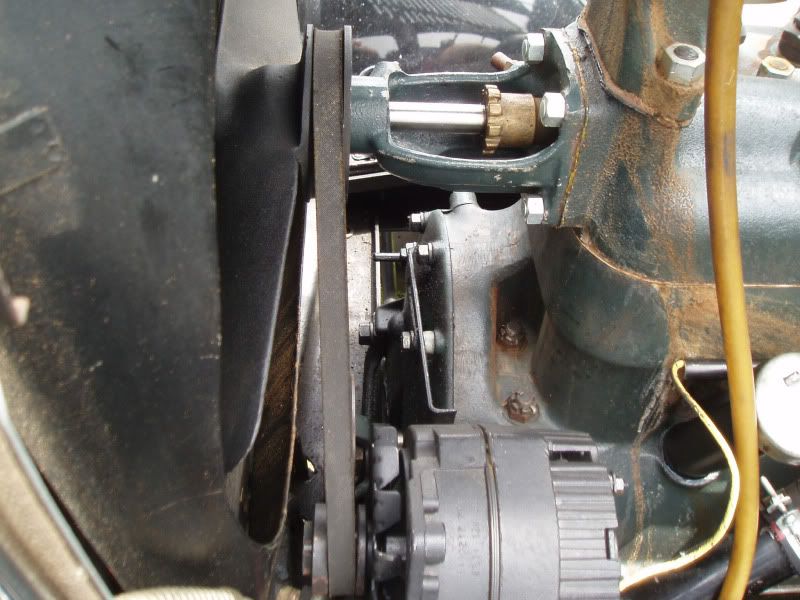
Alternators often have a belt alignment problem.
 
Last edited:
Alternator!......I don't need no stinking alternator!:mad: I don't need no Ford generator either.:p My '31 "A" roadster uses a 1936 Chevy Delco-Remy
heavy duty (air vented) truck generator. It also uses the original Delco cut-out and puts out more juice then the Ford generator. I've got a sportlite, driving/passing lights and just added an extra "stop" only light on the back of the car. So the extra juice is needed. Why this set up you ask? Well, I like being different then everybody else and I bought off
of eBay years ago. An old after market adapter bracket specifically made
for doing what I did.:)

Bob-A:D
 
Have you noticed the "pattern" here, ...those who understand, ...and can restore a generator use them with great satisfaction and success. Those who apparently can't restore/work on them (because they haven't tried or put forth the effort) choose to use an alternator. I have come to realize that the "purist" thingie, or calling a car a "driver" is just words, as that interpretation is in the mindset of the one doing the judging. For many, many years our totally original Model 'A's were "drivers" and they did so with great reliability. The late Chuck Shaw (a fellow Fordbarner) jokingly made a statement here on Fordbarn several years ago something to the effect that "It is OK for me to modify my Model 'A' but it is wrong for others to modify theirs." and that is probably how many people truly view it. There is a reason why many of us were attracted to an original Model A. It just takes determination and effort to have success. Again, I challenge folks to try to work on a stock generator and see the benefits of your toils.
 
When I first started working on cars for a living a guy at the shop said --alternators, disc brakes --how am I going to fix those cars-- alternators and disc brakes were still a mystery to him in the early 70s --he quit and got a job driving a truck ---now it is-- generator and mechanical drum brakes ---how am I going to fix it.
 
When I first started working on cars for a living a guy at the shop said --alternators, disc brakes --how am I going to fix those cars-- alternators and disc brakes were still a mystery to him in the early 70s --he quit and got a job driving a truck ---now it is-- generator and mechanical drum brakes ---how am I going to fix it.

You left one out. In the mid 70's it also was heard said "how am I going to ever be able to fix these electronic ignitions". Nowdays it is "how in the world do you adjust these #$%@# points, I'm putting on an electronic ignition and getting rid of them". :confused::D:D
 
Last edited:
I would think the reason why all the auto manufacturers went to using an alternator is because of the power needs for the particular vehicle they were manufacturing. I have yet to see the need to switch to 12 volt in an original Model A but I guess it is just a mindset. Same applies to converting to an Alternator.

There you go again Brent, confusing people with facts! I'll add another fact to the confusion. I've NEVER had a Model A generator failure but have had three alternator failures in modern cars. It's usually the diodes but if you can't manage a Model A generator how can you deal with that? Oh... I know, go to the local store.

Something else just as a thought. If someone truly "restores" their Model A to start with, why do they need to worry about finding an auto parts out in the country? Do it right the first time with quality parts and then know how to work on what you have, and you can always get yourself home. Therein lies the problem however in that most folks seemingly do NOT know how to work on something with their hands, ...so they do what is easiest and that is replace a part with something else. I am not being critical towards folks but in reality just issuing a challenge for people to learn how to work on something with their hands and at the same time try to preserve history.
There is almost nothing that can happen to a GOOD Model A that can keep the car from getting home under it's own power if the person has moderate skills. Can you say that about modern cars and "state of the art" technology? Not hardly.

About three months ago Susan's little Audi sport sedan (great fun with manual trans!) wouldn't start when she returned to it after an event a few miles away. Most folks would simply call for a tow to get it to a dealer. Being stubborn (and cheap) I chose to look at it first since it's well out of warranty even at 53k miles. Fortunately I was able to trace the problem to the #1 coil pack blowing the control circuit fuse with relative certainty. I was fortunate again to find there was a recall on the coil packs so there was no cost to me to have it repaired/updated. Until that day I didn't even know what a coil pack was!

The bottom line is I was very fortunate to successfully navigate "modern technology" and have the car close enough to home to try. Nothing on a Model A is like that.


My 31 Coupe I got last spring came with an alternator on it. Now I don't know much since I'm as I'm a Model A rookie but why would it have an alternator rather than a generator? Don't the original generators work very good? If I don't show for points is it ok to just leave it that way? Is there a disadvantage to having an alternator? How much did it cost someone to do that? If I bought it to just have fun driving should I just leave it that way?

There is no need or rush to change it unless it bothers you. Take time to get to know your car and have fun. If you drive the car enough the alternator will eventually fail but most folks don't drive their cars that much. With more time and exposure to other A's you will have a better idea just what you want YOUR car to be.
 
According to my Model A sage, 91 year old dad, Model As were cheap cars back in the day and the people who drove them didn't buy white walls.

Nothing against your dad, but whitewalls in the 1930's were actually the cheaper and less desirable tires. White rubber in those days was natural rubber, black rubber was (and still is) vulcanized and is tougher, wears longer, and is more expensive. The classic 2-sided whitewall look was created when they took all-natural white rubber cores and molded on only the tread with vulcanized rubber, in an attempt to make the tread last longer while keeping them as cheap as possible.

Blackwall tires were all black, meaning they were made of all vulcanized rubber, making them longer lasting and more expensive than the available whitewalls. When Henry decided to use blackwalls, he was actually providing the best and most desirable tires of the day - looks had nothing to do with it.

Modern whitewalls are just regular tires with white rubber veneers on the sidewalls. The difference in the cost of the materials is negligible, but are more expensive due to the increased labor, production steps, and quality control required to produce them; people buying whitewalls expect them to be perfect.
 
Last edited:
From what I have read the black tires were made by adding carbon black to the rubber. Both white and black rubber were vulcanized. Adding about 50% by weight of carbon black increases the road-wear abrasion of the tire by as much as 100 fold and improves the tensile strength of the tire by as much as 10 times.

Bob
 
Going to the local store may be a thing of the past shortly,The local Napa store does not stock any 80's Delcotron alternators.There are so many different alternators now that if they are not fast movers they are not stocked.The warehouse is close by,if you need one and order before 12:00,it will be here about 1:30. After 12:00 means it will be here at 5:00AM.Weekdays only.The wall that used to be starters,alternators,generators,regulators and batteries is now just alternators.They have no room for slow movers.I have never found generators to be more troublesome than alternators,I have found the owners to be most of the generator problems.I usually get to look at things after an owner has been at it.It quit working so I switched around some wires and took out a few.It still doesn't work,must be that generator setup.
 
Yes, either will work, but the alternator will work so much better to keep your high quality battery FULLY charged and lasting longer and better lights, better horn sound, better cranking and an all around healthier electrical system.
Keep the generator to refit to the system if you sell the car to a "GENNIE" person. Keep the alternator for your next car!!

Let me see if I got this straight. You're saying a generator will not fully charge a battery?

If I put in an alt my lights will become better and my horn will sound better?

Some how an alt will make a starter crank better?

What do you base this on?

Leave the Alt on, or change it to a generator, I still hold that it will make no difference in how your Model A will operate.
 
For my two cents, I've run original generators, 6-volt alternators, and currently run 12-volt alternators on my cars. Any of these will provide excellent service if properly maintained, but the reason that I went to alternators was that I occasionally stay out until dusk or early evening, and the alternators seem to run brighter lights - from a safety standpoint and therefore my personal comfort, I feel this alone helps me to see and be seen better by others. The reason for switching from a 6-volt to a 12-volt system was that I noticed that with the 6-volt system, the lights occasionally dimmed at traffic lights and stop signs. Again, just my opinion, but unless I were inclined to show a car, for all-around driveability, I prefer a 12-volt system. Regardless, I don't think you can make a wrong decision depending on how you plan to enjoy your car.

Dick

Well I guess I am confused. Please allow me to throw more popcorn from those balcony seats. :D

It has been my experience that brighter lights don't mean that I can/could see better in my 'A's. Matter of fact, just the opposite. I have installed 12 volt Halogen bulbs in the Vintique reproduction reflectors and found that I could actually see better with 6 volt 50cp bulbs in original silvered reflectors. The two things that happen is the silvered reflector projects more light than what the chrome plated reflector does, ...and the 2nd thing is the parabolic shape of the halogen reflector is incorrect causing the light to scatter instead of throwing a pencil beam like the original set-up does. Adding to that is the problem where the halogens are not abled to be focused like the originals. Now I agree the halogens are brighter yet it has been my experience over and over that you cannot see clearly with the halogens which is always my goal when driving after dark, --which I generally do after I show the car that evening. Maybe it is not a Show Car if I enter it in a car show, win a trophy, and then drive it 15-20 miles home after dark.

One other thought is if lights are dimming, very likely the wiring has excessive resistance. Not always the case but something is not up to parr. If a good 6 or 12 volts battery is connected to a set of Halogen bulbs, they will still be brightly after burning for 30 minutes. They will burn much longer with an incandescent bulb. I know, I have done it. Now if there is some sort of "regenerator" putting current back into the storage battery, how long will that battery last then before being discharged? Two hours, ...three hours, --maybe all night? So if you can see just as well with the original electrical system using 50cp bulbs in a properly restored headlamp as you can...... :confused:

Honestly I do get it, it's a "comfort thing". If someone feel more comfortable with an alternator, or feel like they can see better with halogens, it only makes sense for that person to do what makes them the most comfortable. For that I say go ahead and do it.

/
 
Back
Top