Vapor lock

Here's a thought, it appears that high temp. is a factor. I don't have engine pans on my car. Would the extra cooling that comes from having them installed perhaps make the car run just enough cooler to not have this problem? After I had my major boil out I put some insulation around the fuel bowl and the entire length of the fuel line and haven't had it happen again.
 
Bluebell,
Sorry, I'm not enough of a mechanic to answer your hardware questions; I don't know what a weatherhead fitting is. But, here's a few photos that may help you see what we're dealing with.

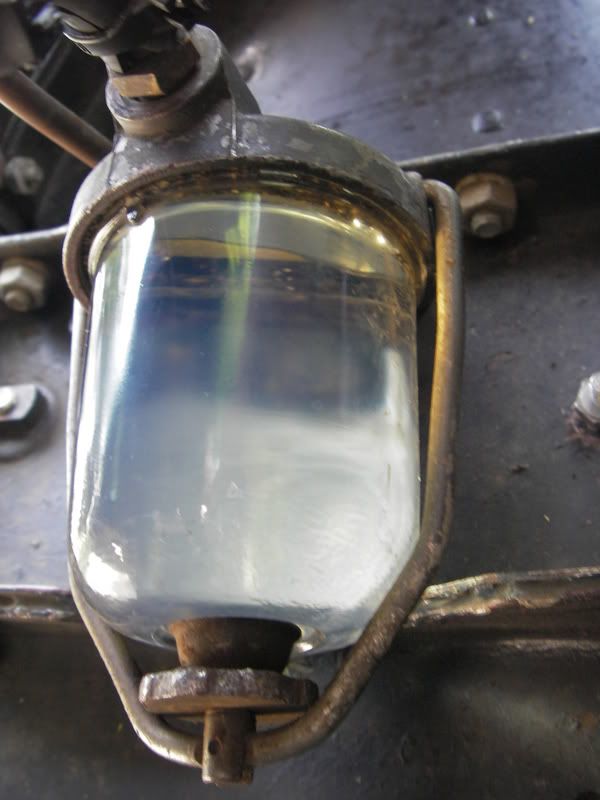
The first shows a fuel vapor bubble that I could watch grow in the top of my sediment bowl. With the engine idling, the bubble would grow (as fresh gasoline hit the warm engine compartment) until it got to a size covering the entire top of the bowl when it would burp on out and down the fuel line AS THE ENGINE CONTINUED TO IDLE SMOOTHLY WITH BARELY A HICCUP. The process would then repeat indefinitely. This proves several things: fuel vaporization can occur in the engine compartment; it is not necessarily a problem; sufficient fuel for idle can get around a fairly large bubble in the sed. bowl so there is no need for a bubble to get all the way back up into the tank; under some conditions a large fuel bubble can be accommodated by the carburetor.


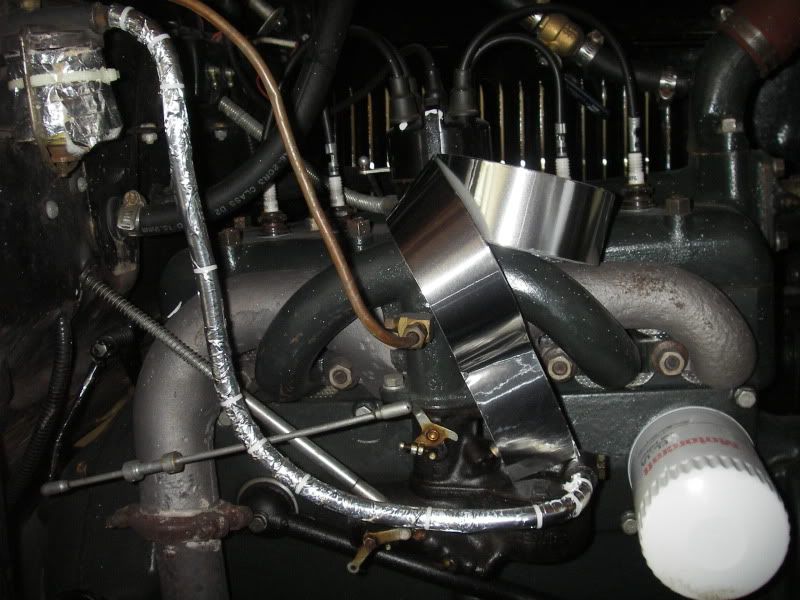
The next two photos show the fuel path after the sed. bowl, plus some insulating efforts I made to remedy the problem--with limited success. Under the reflective tape was fiberglass on the sed. bowl and rubber tubing on the fuel line. Also, a sheet metal heat shield was added between carb and engine.
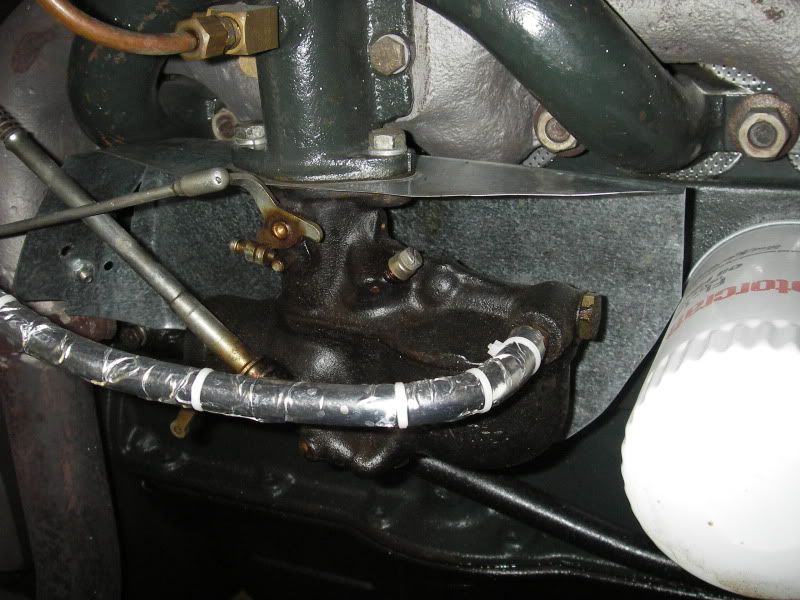


I also tried without success adding Marvel Mystery Oil and diesel fuel. I could not bring myself to try the clothes pin cure.

I think the immediate blockage problem for most people occurs at the carburetor, as established by the numerous reports of cures by pouring ice or cold water on it or by cracking the fuel line connection to it. However, other issues such as missing engine pans, mistuned engines, ethanolated gasoline, and hot weather may all contribute to pushing some particular setup past its limit, HOWEVER there have been many reports by people with each of the problems (except for mistuning) who did NOT have the problem. So, it is all rather mysterious, but I've never heard of any indication that the problem originates back at the fittings into the gas tank.

Here's the only photo I've got showing the fuel line from the sed. bowl to the tank. It does look a bit tilted the wrong way, but I believe that is due to the camera angle. Also, my hot water heater core has the hot water flow shut off in the summer time.


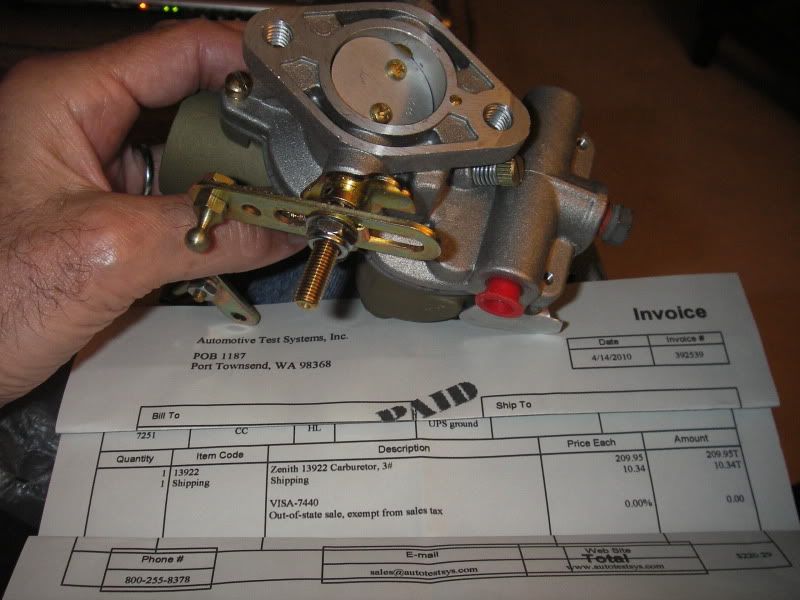
In my case, the final solution has been to switch to a more modern Zenith carb, #13922. It does not have the mesh screen at the inlet and I used a larger diameter fuel line (rubber) to connect it---either of which conceivably could have been what actually made the difference. For some reason I don't understand, use of this carb excites a lot of negative passions by some folks, while use of a Tilly or Marvel is OK.


I hope all this helps. It must be bit frustrating trying to diagnose a problem on an unfamiliar vehicle.

Steve

 
Last edited:
NOT RECOMMENDING THIS!! But if I encounter a hot weather fuel flow problen, since I have the fine mesh stainless "pencil" filter in my tank valve, I "MIGHT" try eliminating the sediment bowl completely & see what happens. Possibly, any vapor bubbles could get back to the tank easier??? (Maybe some bubbles might be generated IN the sediment bowl, even??)
I used to fit small cage type BILGE fans under '73 & '74 Datsun 240 Z carbs to prevent carb boiling problems. Maybe one could me mounted on an "A" to blow directly ono the carb??? Bill W.
 
here you go dad we just worked on this datsun with the carb fan

62dbf379d65170c675c7e80aa556e491.jpg
 
Yep, Son, I'd forgotten about those, they were factory installed, I don't remember which models had them, probably an F-10 with transverse engine. (If you have to do a clutch on one, along with a flywheel ring gear, E-Mail me for tips) Dad W.
 
Steve, In my total lack of experience with model A's, I will probably step on the toes of the purists. I offer my suggestions (and will not be offended should you decide to decline)
Once again, I ask, "Is the sediment trap sight glass arrangement original?
and is water and dirt in your tank a big enough reason to keep it?
I think if you were to strip it out, you would find at least part of your problem is right there.
I cannot be 100% sure, but I believe that is the item, that traps the bubble in the line. There is usually a screen in the top. the fuel flows onto and through the screen down into the bowl, and the clean, waterless fuel then flows up and out through the central outlet. The returning vapour bubble is trapped by this "S" bend.
(BTW. the photo with the fuel **** (tap) has a Weatherhead fitting. Over zealous use of solder may tend to partly block the inside. This is unlikely)In manufacture, the nut is first fitted over the pipe, and then the nipple is sweated on.

From what I can see from your pictures(and just reminding you that I have zero experience with a Model A);
1. I would dispense with the water trap assy. (is there a filter at the carb inlet?) If not a small inline filter on the down hill run might be a better option. (How clean is your tank?)
2. Make up and fit a steel fuel line shaped so that it has contant fall.
3.I would fit a fiber spacer between your carb and your heat shield.
This fiber heat barrier is probably the biggest and best single step you could make. Make sure you have a gasket between the heat shield and manifold as well.
This all assumes a minor vaporization in the fuel line, which would almost immediately cure its self.(the vaporised fuel will keep going back to the tank, and cooler fuel will keep replacing it, until a cooler condition returns)
If however the body of the carb gets so hot as to boil the fuel in the carb, then nothing is going to get you going,other than the water to cool the carb.
Happy motoring.

Bluebell,

The sediment bowl is stock. I've never seen a Model A without one. As a glance at my engine compartment photo shows, I am far from a purist, but nonetheless I think I would draw the line at removing the trap. My tank has been cleaned and coated inside, and it's been a long time since I've seen the sed. bowl actually trap anything, so, you are right, it's probably not needed. However, as I tried to explain, I've watched it deal with vapor bubbles very well, although not in the manner you'd prefer.

I believe that most of the time vaporization IN THE CARB is the problem, although I've also seen impenetrable bubbles form and be trapped by fuel filters in the sed. bowl or inline as you suggest. However, such filters work fine for some folks, so their usage is about as controversial as vapor lock itself. There is a screen filter behind the inlet of the stock carburetor. Other than the sed. bowl, nothing else.

Some folks report success with an insulating block between the manifold and carb mounting flange, but that throws off the alignment of the choke/enrichment rod.

There may be a good reason the fuel line is shaped the way it is. The motor bounces around a good bit with respect to the firewall. I'm speculating, but I've often wondered whether a straight line would allow enough flex, especially for a guy like me who is using the aftermarket float-a-motor mounts (another touchy subject).

The new carb (with larger fuel line) solved my problems. All of the insulation and shielding is gone.

I hope I've addressed all of your points.

Steve
 
Why don't you guys with this problem put an angled shim under the sediment bowl to tilt it downward a few degrees forcing the big bubble back towards the inlet, giving the bubble a better chance to force its way back into the tank?? It would also add a small downward angle to the first bit of line exiting the bowl. Cheers : Bruce
 
Why don't you guys with this problem put an angled shim under the sediment bowl to tilt it downward a few degrees forcing the big bubble back towards the inlet, giving the bubble a better chance to force its way back into the tank?? It would also add a small downward angle to the first bit of line exiting the bowl. Cheers : Bruce

I don't know how else to say it: The sediment bowl isn't the problem (unless maybe there's a microfilter in it).

However, if it were the problem, tilting it would not help; the fuel inlet is in the center top. Here's a photo. The shiny blob in the center of the crater is a nascent fuel vapor bubble forming. The bubble is not coming from further up in the fuel line, but forms when the fuel first enters the bowl. Plenty of fuel--at least enough for a good idle--can find find its way past the bubble. And then, after the bubble has completely filled the top of the bowl, it can smoothly burp on out the exit, down the line, into the carb without causing the running motor to even stumble. That makes sense, considering how long a motor can idle after closing the fuel shutoff valve. However, it won't make sense to people who believe that bubbles can only go up.

I believe that a Model A's version of vapor lock trouble occurs when massive vaporization in the carb overwhelms its ability to cope. To the extent that insulating the bowl and line helps, I believe that it's because the carb then receives somewhat less pre-heated fuel to deal with.


Steve
 
Last edited:
Sorry, you're right about the fact that tilting the bowl probably will not help.
If in fact the "vapor" bubble in your picture is forming where the fuel enters the bowl, where is the air coming from???? Surely no one will try to make us believe that the bubbles form in the line from the tank to the sediment bowl. If it is forming in the feed line or the tank, the temperature of either has to be at least 171 degrees F (the point at which some components of 10% ethanol fuel begin to boil). This means that the passenger compartment must also close to this temperature too. More likely, the air is entering the system past the gasket at the top of the sediment bowl as many of the pot metal bowls I've seen are warped due to over-tightening the clamp. Air can be drawn in but fuel does not leak out. To check this out, with the fuel shut off, remove the sediment bowl gasket, clean the gasket surface and press the glass bowl up into the cleaned pot metal gasket surface. I'll bet dollars to donuts the bowl will rock back to front, and not side to side. Do the '28-'29 cars with the cast iron sediment bowls have the same problem? I bet not. Cheers : Bruce

There is no air; the bubble is evaporated gasoline. Gasoline is a mixture of varying molecular weight molecules that boils over a range of temperatures. The lightest ingredients start boiling off at only about 100 degrees F--that's what is in the bubble. After they leave, the boiling point of the remainder is higher.

The ethanol problem is not from the boiling of the ethanol itself, but rather that the presence of ethanol makes the other hydrocarbons more eager to leave the mixture. Adjusting the gasoline composition to minimize this "non-ideal mixing" effect was a major challenge for the refiners when they were mandated to add ethanol to the mix.

Steve
 
Last edited:
So the bubble "forming at the entrance to the sediment bowl" is not air, but "evaporated gasoline"?????????? Are we to assume that the bubble originated in the carb and worked it's way past the needle and seat to the top of the sediment bowl and now will block the flow of gasoline back down to the carb? More likely the bubble formed right where you see it, at the top of the sediment bowl after it entered the system past the warped gasket surface. I really do not believe this is the "rocket science you are trying to make of it. Give me a break. If this is what everyone is calling "Vapor Lock" then run a solid line from the fuel shut-off under the tank to the carb and throw away the sediment bowl. End of problem. Bruce
 
So the bubble "forming at the entrance to the sediment bowl" is not air, but "evaporated gasoline"?????????? Are we to assume that the bubble originated in the carb and worked it's way past the needle and seat to the top of the sediment bowl and now will block the flow of gasoline back down to the carb? More likely the bubble formed right where you see it, at the top of the sediment bowl after it entered the system past the warped gasket surface. I really do not believe this is the "rocket science you are trying to make of it. Give me a break. If this is what everyone is calling "Vapor Lock" then run a solid line from the fuel shut-off under the tank to the carb and throw away the sediment bowl. End of problem. Bruce

Bruce,

Yes, the bubble is not air. Bubbles of all gases look pretty much alike. It is not rocket science, but it is science. The bubbles you see coming up in boiling water are water vapor, not air.

Yes, we are to assume, as I stated, that the bubble originated at the top of the sed bowl as soon as the gasoline hits the warmer environment of the engine compartment--it did not come up from the carb. As Mr. Google will confirm if you don't believe me, gasoline starts to boil around 100 degrees F and, as boiling proceeds, the boiling temperature rises to around 400 F. I think we will agree that a Model A engine compartment can easily exceed 100 F. I would like to hear an explanation of how some fuel vaporization COULD NOT occur in the fuel path before the carb.

You might wonder why the fuel doesn't ALL evaporate before getting to the carb. Three reasons: As the lighter fractions vaporize, the boiling point rises. The vaporization itself absorbs heat and tends to cool the remaining liquid. Heat flow takes time, so most of the fuel gets to carb before it has time to vaporize.

I presented the sed bowl bubble pictures merely to prove that vaporization does occur, HOWEVER, as I have said several times now, I'm not claiming that vaporization in the sed bowl is the cause of vapor lock in Model A's (unless the bubble gets jammed up in microfilter). I believe that Model A vapor lock problems originate with massive vaporization occurring in the carb. If the carb is really cooking, as others have commented, we're out of luck. In earlier threads on this topic, some folks have quibbled that vaporization in the carb should be called percolation, as though that matters.

Steve
 
Back
Top