No voltage to points - HELP?

HoarseWhisperer

Well-known member
Background: Had a shop take out gas tank for repair in which they had to remove the distributor, etc.

Symptoms:

1. No voltage to points.
2. Ammeter shows -8 discharge turning ignition switch to ON.
3. No spark from High Tension coil wire.

It will turn over and I have 6 volts at battery, starter connection, junction terminals, coil terminals, etc.

Can I assume since the ammeter shows discharge turning ignition on, that the ignition cable is ok, but have a short elsewhere? I already loosened the cable to distributor a turn thinking it might be grounding out.

Based on the symptoms, any guidance on how to isolate the cause?

Did I mention I'm electrically challenged with a multi-meter, but I'm trying? :o
 
Les Andrews' Red Book has a very good set of diagnostics (which I've come to practically memorize during the course of tracking down shorts in my distributor on two separate occasions), and mafca has a good set of step-by-steps to take as well here (in the "SHORTS" section).

Sorry - I'm too lazy to retype all of it here right now (I actually will be heading out to the garage soon to take another look at my disappearing spark problem myself)...

-

Yep, been using the red book for testing, but so far no luck in isolating the cause.
 
HW,two points(no pun) if you are checking for voltage at the points they should be open, you won't get any if closed.If you have juice at the coil, the problem is between there and the distributor including the key switch, the wires and the dizzy itself.Go with Les if you have it.
 
Hard to guess without more data, but the -8 amps with ignition switch on sounds like a short. Wonder if one of the bolts on the wiring block is shorting out.
 
1. No voltage to points.
2. Ammeter shows -8 discharge turning ignition switch to ON.
3. No spark from High Tension coil wire.

Start at the battery.. Check the bolt, ground and the battery for full charge, make sure all the connections are tight. Go next to the starter and follow the same..work you way through the primary circuit. if it stops at the COIL get a KNOWN GOOD Coil and put it on and test there and a known good wire....keep us informed., YOU WILL find it..DONT DIVE BOMB.,..follow the wiring in a logical way.
 
I've posted the familiar Model A schematic, which makes troubleshooting this type of problem much easier. Print this out and laminate it. You will find it very helpful.

You can use a continuity checker to make sure you have connections from the battery all the way to the points. Using this schematic, you'll be able to find the short. Just follow the "paths" on the diagram.

wiring-diagramcolor2sm.jpg
 
If you have an original popout, the wire inside the cable may have shed it's insulation and needs to be replaced.

If you have a repro switch, try jumping the two switch terminals, in case they have poor contact. Also make sure neither terminal is touching the gas tank. In other words remove the instrument panel and start your checks.

Since you show -8 amps it sounds like you have a short. The coil full on should only show -4 amps, but the -8 could be the ammeter isn't as accurate as a good original.
 
Last edited:
As previously mentioned, I have 6 volts at battery, starter connection, junction terminals, coil terminals, etc., just not at the points (with points open), nor spark from the high tension wire.

I have the schematic. Connections behind the instrument panel seem ok.

Coil testing: 1.8 ohms on coil terminals and 3.16 ohms from terminals to high tension contact.

Ign cable and Ammeter are original and working fine prior to tank removal.

I guess next is pulling the Distributor to check for 6v at end of ignition cable?

But, if ammeter shows discharge with ignition on, the ignition cable should be ok, no?
 
Last edited:
wait are you using the modern points/condenser IF NOT then check to see if the black wire under at the bottom plate is frayed or rubbing..check that
 
Newshirt, that is probably the best wiring schematic there is for the Model A.
It would be a good idea to print it out, have it laminated, and keep it under the seat. :)
 
But, if ammeter shows discharge with ignition on, the ignition cable should be ok, no?
end quote:
As mentioned, no. -8 amps is too much discharge, as mentioned. I think you'll find your problem [short/grouund] somewhere in the the primary lead from the switch to the distributor.
 
First we need to know if you are using an original popout, or a repro switch with the two screw terminals on the back?

As mentioned the screw terminal might be touching the gas tank. It did on my 29 Tudor after I had the instrument panel off and put it back on. Luckily I noticed the ammeter go to discharge as soon as I installed the panel, so I removed it agains and bent the switch terminals to the side..
 
The wire inside the armored cable is shorting out to the cable. The wire insulation is probably very brittle, and moving everything around during the work disturbed it enough to have it short now.
 
First we need to know if you are using an original popout, or a repro switch with the two screw terminals on the back?

As mentioned the screw terminal might be touching the gas tank. It did on my 29 Tudor after I had the instrument panel off and put it back on. Luckily I noticed the ammeter go to discharge as soon as I installed the panel, so I removed it agains and bent the switch terminals to the side..

Tom, as previously mentioned, the popout is original (one screw terminal).

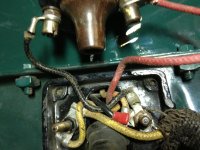
Here's a pic of the junction box wiring. Anything appear incorrect here?
 

Attachments

  • photo.jpg
    photo.jpg
    71.6 KB · Views: 57
The wire inside the armored cable is shorting out to the cable. The wire insulation is probably very brittle, and moving everything around during the work disturbed it enough to have it short now.

Sounds reasonable, P. S. I guess the next step, would be pulling the distributor, unscrewing the armored cable and checking continuity, etc?

Did I mention I'm challenged with a multi-meter? Never understood those things. :o
 
I think he needs to back up to his first description,A shop took the tank out.If it was good before I would be looking at the popout cable screwed in too far,when they replaced it,or as an original popout the wiggling and thrashing around it got during the operation crumbled the old wire insulation inside of it.I think I would concentrate there where there is an 8 amp draw with the ignition on.
 
I think he needs to back up to his first description,A shop took the tank out.If it was good before I would be looking at the popout cable screwed in too far,when they replaced it,or as an original popout the wiggling and thrashing around it got during the operation crumbled the old wire insulation inside of it.I think I would concentrate there where there is an 8 amp draw with the ignition on.


Exactly!!

Unscrewing the cabel to the distributor to ohm it out could well disturb it enough to show open circuit, and really throw you for a loop!

Test it while installed, without disturbing it. It's simple-

With the battery disconnected, open the points by putting a business card or plastic between the points and points block. Remove the condenser and put one ohm meter probe on the part where the condenser screw goes (through the hole where the screw was is OK if you can make contact with the metal part). Put the other probe to ground, like the block. With the ignition key "on", meter should be reading infinity ohms. If it shows less than several megohms, there's a problem. You can disconnect the wires on the coil primary if you want to narrow it down to the cable itself or the ignition switch.
 
Thanks, P.S and Keith,

Took the condensor out and placed the leads as you said, with the meter set at 200m. It would jump as high as 12.7 and then fall to 0, whether the ignition key was on or not. Not sure what that means.

Trying to get my head around what infinity ohms really means. 0?

Really appreciate the guidance.
 
"Infinite ohms" means the circuit between the two test leads is open. As though someone cut the wire. Or, if there were an on-off switch in the circuit that you had turned the switch to "off". Zero ohms means a good circuit between the two test leads.
 
Back
Top