Initial Timing via Vacuum

Another question. All I need to do with vacuum is block off the port in the carb and T into the vacuum from the intake to the wiper motor?
 
This TOPIC need to be differentiated between LOAD-O-MATIC (1954-1956) and DUAL ADVANCE (1957/ ) FYB -

CLICK HERE - http://m571.com/yblock/loadomatic.htm

ALSO CLICK HERE - https://4secondsflat.com/Ported Vs Constant Manifold Vacuum.htm

If a person wants to retain the stock appearance and function on an early Y-BLOCK, I would stay with the LOAD-O-MATIC, especially if a 6V SYSTEM.

Ain't nothing wrong with that (IMO)

The LOAD-O-MATIC curving is adjustable. You just need to find a speed shop having a DIST MACHINE w/ MANOMETER and an old fart that knows how to operate it.

Now why I am in my usual B!TCHING MODE, the PERTRONIX (IGN II) (for street use) only has to do with the intensity of the spark delivered. It has no effect on timing other than possibly giving a hotter spark and that may effect pre-igntion.

You make allowances and adjust for that.
 
If a person wants to retain the stock appearance and function on an early Y-BLOCK, I would stay with the LOAD-O-MATIC, especially if a 6V SYSTEM.

Ain't nothing wrong with that (IMO)

The LOAD-O-MATIC curving is adjustable. You just need to find a speed shop having a DIST MACHINE w/ MANOMETER and an old fart that knows how to operate it.

I've spent all the time, money and energy I am willing to spend on the stock distributor. I am not going to look for a shop with an old guy who knows how to operate an antique machine. IOW, I'm not you.

So, the question remains, block the carb port and tie into the intake manifold port?
 
So, the question remains, block the carb port and tie into the intake manifold port?

Let me make this brief as you are too honery ... ??? ...

- SPELL CHECK 101 -

... ornery ...​

... to exchange with ..

If you signal a DUAL ADVANCE DIST off manifold vacuum, it will have full vacuum advance and high idle instead of proper curb idle, upsetting carb calibration.

You have a 1954 256CI with a H2140 4V?

EDIT - CORRECTION - 13 SEP

You have a 1954 FORD 239CI w/ a 2V?

That carb can be modified cheaply to supply a ported vacuum supply. Interested?

EDIT - Below Referring URL For Those That Are Interested -

CLICK HERE -

https://www.eatonbalancing.com/2010...ey-94-two-barrel-for-late-model-distributors/​

If not interested, use manifold vacuum signal and try to live with it.
 
Last edited:
Forget all the vacuum voodoo hocus-pocus! Set the timing to the factory marks with a timing light, following the factory method. Mark the distributor base and the block (or head) with a center punch. These dots will serve as a reference point for your experimenting. You can move the distributor around as much as you like and the dots will get you back to stock timing if things get out of whack.
Setting timing by ear with a vacuum gauge is like setting your watch with a 4 lb. hammer! You have no clue where it's really at. With a light you can watch the timing advance as RPM goes up. If the marks jump around or don't move, the distributor needs work. Set the throttle on a fast idle, then disconnect and reconnect the vacuum advance. The timing should change. If you have a shop manual you can even check if the advance is within specs.
 
I have a timing light, and a dwell meter, and I know how to use them. Since the Skyliner didn't come with a 256ci the question is just a red herring. I know I need vacuum for the '57 distributor. If it doesn't come from the intake manifold where would it come from? Not the stock 239 carb, everything I've read about the conversion says that. Even if I changed carbs the vacuum source would remain the same so the only answer I can come up with is the intake manifold.
 
My '55 with stock 272 arrived here with a Holley 2300 carb and an unknown dissy. They did not play well together so I swapped in a freshly-curved '57 dissy. The curving was done locally on a SUN distributor machine by an old guy who knew what he was doing. The vacuum advance is ported into the carb. Both the Vic and I are happy...
 
Distributor is installed and the engine started on the first try. The lure of college football and cold beer invited me to get out of the TX heat so I did. Today I'm going to adjust the timing with the vacuum port disconnected. I've come up with another question. My plan was to T into the vacuum hose to the windshield wipers but this morning I had the epiphany that since I have a dual action fuel pump that it would alter manifold vacuum. Plan B now is to T into the vacuum line for the power brakes. Is there a better idea out there?
 
I took it for a drive today. Timing set on 8 degrees BTDC. At a fast idle it is about 16. It hasn't been on the road for 9 or 10 months. It definitely ran hot. Will timing that isn't advancing as much as needed cause heat or can I chalk it off to being in the 90s?

One other thing. Finding a T fitting that is 3/8 X 3/8 X 3/16 has turned up nothing so far. Any help would be appreciated.
 
... I know I need vacuum for the '57 distributor. If it doesn't come from the intake manifold where would it come from? ...
Vacuum for a '57 distributor would normally come from a 'ported' vacuum fitting on a '57+ carburetor. That ported vacuum signal is nearly opposite manifold vacuum as it comes from above the throttle plate. First image attached below.
Some earlier carburetors can be fairly easily modified to provide the correct vacuum signal for a '57+ distributor. The link above to an Eaton Balancing article is a good reference.

... Will timing that isn't advancing as much as needed cause heat ...
Yes it most often will.
"This condition can also be caused by a stuck distributor plate or loss of vacuum from the carburetor."
https://www.ctci.org/gilsgarage/cracked-exhaust-manifold/

If your '57 distributor is working correctly most of its timing advance comes from centrifugal weights under the points mounting plate. This may be sufficient but they can get stuck with age and improper lubrication. Image 2

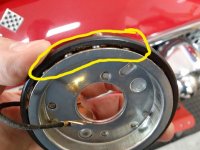
A '57 to '59 distributor has a circular points mounting plate with ball bearings around its lower outer edge. They can be stuck from corrosion or improper lubrication. Example image 3

.
 

Attachments

  • ported - manifold vacuum sources copy.jpg
    ported - manifold vacuum sources copy.jpg
    29.3 KB · Views: 13
  • TB, 57 dist advance weights.jpg
    TB, 57 dist advance weights.jpg
    34.2 KB · Views: 14
  • 20230626_105942 ball bearing '57 dist plate.jpg
    20230626_105942 ball bearing '57 dist plate.jpg
    56.9 KB · Views: 13
Last edited:
I'm confused. Earlier in this thread rotorwrench stated that the load-o-matic "works opposite of how a more modern distributor that uses centrifugal advance with a vacuum port for load control such as all distributors had up into the early 1970s." My take away was the newer distributors do not get their signal from the carb. I guess I should have popped the hood on my old Chev pickup. The distributor on it gets the vacuum from the carb. For some reason I was thinking the hose went to the intake manifold. It seems all I need to do is modify the throttle body of my carb. I might have to employ Eaton.
 
Last edited:
... My take away was the newer distributors do not get their signal from the carb. I guess I should have popped the hood on my old Chev pickup. The distributor on it gets the vacuum from the carb. For some reason I was thinking the hose went to the intake manifold. It seems all I need to do is modify the throttle body of my carb. I might have to employ Eaton.
Photo 1. You are correct, there's a vacuum line from the carb to the vacuum can on a '57+ distributor. Yellow circles, '57 4bbl setup on a '55 engine. (old photo, unfinished installation)
A '57+ distributor with mechanical advance does get a signal from a '57+ carb but it's used more to 'fine tune' the mechanical timing advance.

'54/'56 single canister Loadomatic distributors use metered(?) vacuum for All their timing advance functions but at a Much lower level. As shown in the far right-hand column in photo 2, more vacuum = more timing advance.
Effectively opposite the vacuum signal from a '57+ carb.

Fyi, these two conditions are why a '57+ carburetor cannot control a Loadomatic distributor correctly.
 

Attachments

  • dist vac line.jpg
    dist vac line.jpg
    76.8 KB · Views: 17
  • loado vac chart.jpg
    loado vac chart.jpg
    35.2 KB · Views: 14
Last edited:
I drilled a new vacuum passage in the throttle body as per the Eaton article. A word of advice to anyone who decides to mod their stock carb is to use a drill press for the first step. A hand drill could be disaster. Even with the drill press it was difficult, but not overly so. Now I'm trying to locate the fitting needed to connect to the distributor vacuum line.
 
Back
Top