Helicoil problem

700rpm

Well-known member
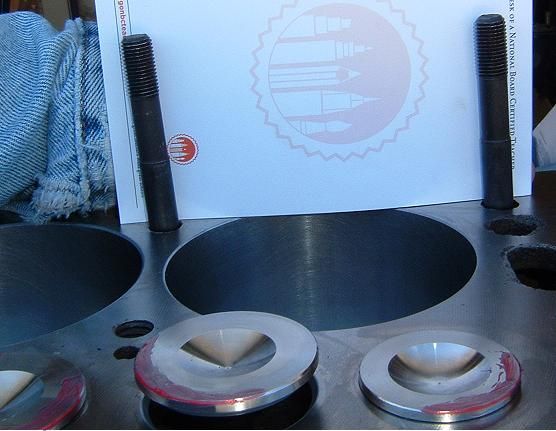
Some previous owner installed a helicoil for one head stud (#2) in such a way that that stud is off vertical by about 4 degrees. Can I remove the old helicoil (if so, how?) and install one correctly, or, as I suspect, was the hole drilled off kilter and replacing the helicoil would have no effect?

Or, is it just a bigger hammer problem? ;) Should I install the stud and attempt to coax it back to vertical, either by torqueing it or by rapping it with a hammer? I don't like these options, but what's a guy to do?
 
There are thread inserts of a solid type that you could recover this hole to vertical and it would be right, but slightly bending a new grade 8 stud would not alter it's strength.
Caution on bending in an unsupported hole.
 
When that happened to me, I tightened the stud and marked the side the direction it was leaning. Then I removed the stud, put it in my vice, put a nut on it, and hit it the direction I wanted it to go. The nut is to protect the threads. Fixing my mistakes is my specialty.
 
I would remove the helicol and retap the original thread as best as you can. Get a tangless threaded insert not a helicol. McMaster-Carr.com is a good source. You will have to go smaller on the bolt though. The outer thread will match the size of the original hole. The inner thread will be a new smaller size. The helcoil you have is like a spring and it was likely forced into really bad threads to start off with. Just a idea.
 
Just had my new rebuilt fixed after getting it from the rebuilder.
An OVERSIZED heli-coil was installed - five of them - and then installed standard size bolts.

Good Luck!
 
Just had my new rebuilt fixed after getting it from the rebuilder.
An OVERSIZED heli-coil was installed - five of them - and then installed standard size bolts.

Good Luck!

Sorry for the shameless plug but I had to do it.!


Poor quality remains long after the sweetness of low price is forgotten ...

www. jandm-machine.com
 
To answer the original question with a permanent repair though may be expensive.
Is to use the Lock N Stitch method of thread repair. This repair is a threaded plug that once installed duplicates the threads of the existing hole.
http://www.locknstitch.com/inserts.htm

The other back yard machinist solution is to drill the damaged hole bigger to 1/2-13" dimensions and then machine a threaded plug similar to the lock n stitch and then install with lock tight. Thereby recreating the existing straight threads. Hopefully you have a proper way of drilling this straight or else take it to the professionals.
 
Helicoils are very compliant because they are a wound spring and the threads can move independently. Here's a few crooked ones (not my work!!) in an engine I just rebuilt. A few taps with a hammer and they were straight without bending the stud.
The special helicoil taps leave a lot of 'slop' clearance to thread the spring into, one of the reasons I'm not overly partial to them. I did proof the studs by torquing a sleeve to 65 ft-lbs. Typical of newly installed helicoils, they felt a bit spongy 'till about 50, then they stopped moving against the clearance and felt like solid originals.

Crookedhelicoils.jpg

Mike, did you have the stud in the helicoil when you gave it a few taps with the hammer, or did you tap it with a punch and without the stud installed?
 
Mike, did you have the stud in the helicoil when you gave it a few taps with the hammer, or did you tap it with a punch and without the stud installed?

Just as you see it, with the stud installed. I used a small 8oz machinist's hammer on the larger diameter area near the stud base as I applied leverage to the top with a short piece of pipe. Moved fairly easily.

If that fails, as suggested above, either a solid Locknstitch FPS series or Time-sert solid 'bigsert' is an option to correct the crooked hole problem.
 
I had one like that picture come into my shop last week....a good slap with my hammer straightened it up fine.... although I would not do that with Grade 8 head studs...most studs are Grade 5 and easy to bend..

another trick you could do it remove the stud put the head in place then double nut the head nuts and screw the stud back in...it works fine...there is some slop in Heli-coils and 4 or 5 degrees is not bad...would not do it if they were really out of alignment....
Also...you should dip the end of every stud in something like Permatex (non hardning) to seal the threads....or water will seep up to the head nuts...that protects the studs from corrosion.

Joel
 
Allen: Good to know about Timesert also. I may have to resort to that.
Timeserts use the same STI type of thread, it's not normal or used onany other insert I know of. If you think about it the outside of a helicoil has the same pitch as the inside but the diameter is PLUS the wire diameter sort of.
 
Back
Top