
You are using an out of date browser. It may not display this or other websites correctly.
You should upgrade or use an alternative browser.
You should upgrade or use an alternative browser.
Flathead Cams
- Thread starter Krylon32
- Start date

HotRodmicky
Senior Member
I like the Max #1 as well. however, thought of paying 500 bucks to install one now, gets a second thought. Might as well get something better for your money. Trouble is the definitions of "Better". Plan ahead!
I dont like the Max1, but
Yep

500bucks for Max1 is stupid.....
Much better cams on the market...
HotRodmicky
Senior Member
To answer the question.... 4.25x3 5/16 and a Eab or Merc cam....
But where is the fun?
With a 5-speed you can run a more fun cam.
isky 1007b... even if it is not that wild/fun
400jr is probably to much for your liking...
A Flathead is a torque engine not a RPM engine...
Isnt camshaft talk the most interesting talk about Flatheads?
But where is the fun?
With a 5-speed you can run a more fun cam.
isky 1007b... even if it is not that wild/fun
400jr is probably to much for your liking...
A Flathead is a torque engine not a RPM engine...
Isnt camshaft talk the most interesting talk about Flatheads?

Admiral
Well-known member
Talk to Pete at D&L Automachine. For a nice boost over a stock camshaft without being too hairy, he recommended the Isky 1007B, just like Ol' Ron did above. He ground one on an EAA core for me about a year ago and the workmanship is primo. I haven't run it yet, so I can't comment on how it actually performs, but I can't wait to try it out.

flathead 39
Member
My engine was built before I bought the car but I got a spec sheet with the car. I wonder if one of the cam gurus could rate the cam: 8ba bore 3-5/16 stroke 4-1/8 stainless valves, balanced lightened flywheel..cam Schneider, valve lift .375, duration 264, lash .012 -.012 adjustable lifters. Offy heads & dual Holly 94s, 10" clutch. Seems to have lots of pull throughout the rpm range
(I havent gone above abt 4k rpm.) I cant find a cam with these numbers on the Schneider site. Is this a good overall setup?
(I havent gone above abt 4k rpm.) I cant find a cam with these numbers on the Schneider site. Is this a good overall setup?

Pete
BANNED
I just grabbed this from the HAMB.
"krylon32 said: ↑
What's wrong? I can't believe you HAMB guys don't have both the experience and an opinion on this."
Yes, everyone has an opinion. A few have experience. Although the info has been posted many times on here, I guess another time won't take up too much bandwidth.
A 400jr is a VERY poor choice for a street engine that is expected to live a long time.
It has very poor velocity and jerk numbers for longevity. It is a race grind.
Most of Isky mild grinds will live a long time. Some idle stock smooth, others have a slight lope which some people desire. The only way to experience what a certain cam is like is to find a car with one in it and see if you can drive it.
Even that is not too good because their engine may not be similar to what you plan. Most people choose too much cam for the type of driving they intend to do. You can make a stock cam have that drive-in rump rump idle just by tweeking the idle screws and it far cheaper.
There are certain cam grinds that you hear about all the time. Why is this you ask? It is because tomorrow no one remembers second place. Consistent winners are the ones you hear about most.
A cam can have fairly aggressive lift curve numbers but still be a good street grind if the numbers are applied right.
There are some that are right and quite a few that are way wrong.

Frank Miller
Well-known member
My take on the "nice lope at idle" is, here is a cam that performs poorly in the range you normally drive on the street. It needlessly wastes gas and promotes while sounding powerful but essentially doing nothing for you.
I just grabbed this from the HAMB.
"krylon32 said: ↑
What's wrong? I can't believe you HAMB guys don't have both the experience and an opinion on this."
Yes, everyone has an opinion. A few have experience. Although the info has been posted many times on here, I guess another time won't take up too much bandwidth.
A 400jr is a VERY poor choice for a street engine that is expected to live a long time.
It has very poor velocity and jerk numbers for longevity. It is a race grind.
Most of Isky mild grinds will live a long time. Some idle stock smooth, others have a slight lope which some people desire. The only way to experience what a certain cam is like is to find a car with one in it and see if you can drive it.
Even that is not too good because their engine may not be similar to what you plan. Most people choose too much cam for the type of driving they intend to do. You can make a stock cam have that drive-in rump rump idle just by tweeking the idle screws and it far cheaper.
There are certain cam grinds that you hear about all the time. Why is this you ask? It is because tomorrow no one remembers second place. Consistent winners are the ones you hear about most.
A cam can have fairly aggressive lift curve numbers but still be a good street grind if the numbers are applied right.
There are some that are right and quite a few that are way wrong.

glennpm
Well-known member
Hi,
I did some comparisons of four cams after learning how to deal with the graphics program, Gimp. Hard to understand without ramp rates to figure what could be best for a modified street application.
Glenn
PS Updated spreadsheet and added RPM chart
I did some comparisons of four cams after learning how to deal with the graphics program, Gimp. Hard to understand without ramp rates to figure what could be best for a modified street application.
Glenn
PS Updated spreadsheet and added RPM chart
Attachments

Last edited:

Flathead
Well-known member
I ran a 400jr in a 41 coupe 3/8 x 3/8 motor, slightly larger than OP's but close. I used stock springs and ran two 97's with direct linkage. Stock springs were easy on the cam and I did not need to wind it up like a race engine. Performance was strong no hesitation or flat spots, pulled real good low to high. I guess that puts me in the minority.
Pete
BANNED
I ran a 400jr in a 41 coupe 3/8 x 3/8 motor, slightly larger than OP's but close. I used stock springs and ran two 97's with direct linkage. Stock springs were easy on the cam and I did not need to wind it up like a race engine. Performance was strong no hesitation or flat spots, pulled real good low to high. I guess that puts me in the minority.
Heavens no, it just puts you at the tail of the B main....lol

Ol' Ron
Well-known member
Interesting numbers here. The cam in my 280 is an EAB. I used it because everybody said it was a good street cam, and I've never ran one or new of anyone who did. The engine also has milled EAB head, so it is basically a stock Merc engine with 3 5/16+ .020" over pistons. now rhe truck is a 47 international with ford F150 trans and a Spicer 44 rear with 3.73 gears and posi. It's hard to explain the torque the engine has. It's perfect for Vermont as once in OD you never have to shift, unless you drop under 20 mph and it will climb a 14% grade inOD at 43 mph with the Tac turning 1300 rpm at WOT. Unfortunately it runs iur of wing around 3500 rpm. But I'm keeping it.
Gramps
Gramps
flathead 39
Member
My engine was built before I bought the car but I got a spec sheet with the car. I wonder if one of the cam gurus could rate the cam: 8ba bore 3-5/16 stroke 4-1/8 stainless valves, balanced lightened flywheel..cam Schneider, valve lift .375, duration 264, lash .012 -.012 adjustable lifters. Offy heads & dual Holly 94s, 10" clutch. Seems to have lots of pull throughout the rpm range
(I havent gone above abt 4k rpm.) I cant find a cam with these numbers on the Schneider site. Is this a good overall setup?
In going back through the Schneider cams, mine comes close to the P-3/8.
Anybody had experience with this cam?
Pete
BANNED
In going back through the Schneider cams, mine comes close to the P-3/8.
Anybody had experience with this cam?
It is slightly less than a Potvin 3/8 so it should work fine on the street.
glennpm
Well-known member
Interesting numbers here. The cam in my 280 is an EAB. I used it because everybody said it was a good street cam ....
Gramps
Yes they are Ron. The thing that is curious is comparing especially the Max 1, 1007-B and the EAC. The EAC has the largest open durations and the least lift. Max 1 the shortest durations and largest lift. BTW I have JWL's book and he lists horsepower for the Max 1 but no torque unfortunately. For the street its mostly about the great torque for Flatheads.
It would be great to have a full profile of the Max 1 and EAC to try to figure why and how each effects torque and horsepower better based on accurate ramps and nose information of the cams.
Biggles measured accurately the 1007-B here https://fordbarn.com/forum/showpost.php?p=1781667&postcount=16
Last edited:

Automotive Stud
Well-known member
I currently have a max 1, an 88, and a 400jr. I'd go with the 88 for what you are looking for.

glennpm
Well-known member
Comparisons I did using a the convenient web page for camshaft below
https://mgispeedware.com/camshaft-calculator/
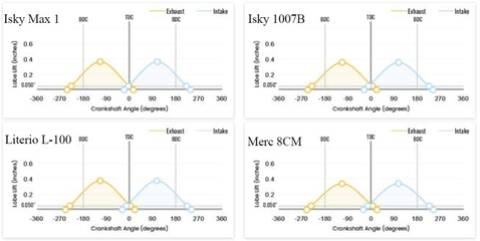
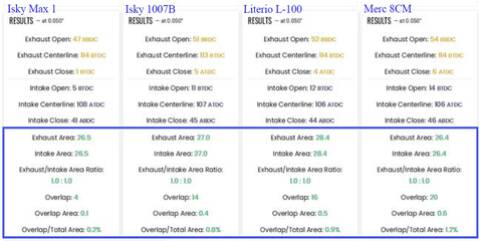
https://mgispeedware.com/camshaft-calculator/
Attachments
Last edited:
After reading all this I am left confused. I have ruled out the 400JR so now it's between the Max 1 and the 88. I have a good friend with a Max 1 in a 276 with fuel injection and his motor runs really good. I've used the Crower regrind that is similar to the 88 and it ran great. I think either one will do the job. I'm going to use Navarro heads and my biggest concern is selecting a cam that necessitates head work as I don't have a shop in the area to do that. I need a bolt on. Any more thoughts?

Bored&Stroked
Well-known member
If the Navarro heads have not been milled, I can't see you having an issue with either of your choices. You should have plenty of clearance over the valves. I'd still clay the pockets and the only area you really need to check is at the top of the 'eyebrow' cutouts - which is where the top of the valve gets the closest. The Drivers side is usually about .040 closer to the head than the Passengers side. Another good choice (which is what I'd use) is the 1007B grind. Pete can grind that profile for you . . .