
78-7006 Cases

HCO41

Senior Member
I copied this from VanPelt's site.
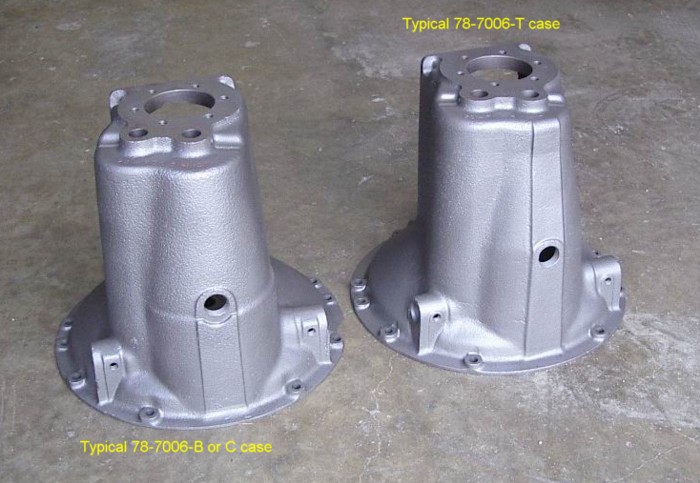
trans_78casestyles.jpg

Both are 78 cases. I assume the one on the right is from the light commercial truck. The site is unclear as to what years this case was used. There was an ad on Ebay for one like the one on the left describing it as a truck case. What years were these cases used?
 
I just sold a a case like the one on the right with a 18- serial number that placed as a 1940 case so I have to assume it was a '40 pickup case. Other than that I do not have hard evidence to determine what year each case was used. If the cases have stamped serial numbers research the numbers to determine the year they were used
 
The passenger cars only used them for little more than a year or so. FoMoCo made these cases so long that there are several variations in the castings but I don't think that any one of them is all that much stronger than another. 78 case is a 78 case pretty much. The part number prefix gives the year it was first engineered as an improvement over the earlier cases in 1937 but they didn't start use till 1938. As svm99 mentioned, serial number stampings will get you in a year range for approximate time of manufacture. The 78-7006 number is not in any of the parts books since it was a part of the 78-7005 case & bushing assembly and the transmission assembly part number was quickly superseded for the 1942 commercial models. The F1 bonus builts may have had some improvement in the casting quality just due to the time frame after the war but I've not heard of any real differences.
 
Last edited:
You didn't say why you are asking this question but if you call Macvp he will answer your question in person. A great guy.
John
 
I plan to replace the 60hp engine and running gear in my '37 coupe. VanPelt, Tardel and Navarro all recommend the light commercial 78 case. I'm trying to identify the difference between the commercial and non-commercial 78 cases used through '50 trucks so I'm looking for the right one.
 
i think you have the light commercial 78 cases there....if they weren't used in the cars, they were used in the light pickups, which is why you can find some of the transmissions with open drive rather than closed drive...not sure whether any open drives in cars....as rotorwrench says and MacVP says in his book, there doesn't seem to be any data saying the one on the right is stronger than the one on the left....good luck....Mike
 
I copied this from VanPelt's site.
trans_78casestyles.jpg

Both are 78 cases. I assume the one on the right is from the light commercial truck. The site is unclear as to what years this case was used. There was an ad on Ebay for one like the one on the left describing it as a truck case. What years were these cases used?
The 78 case on the LEFT is from a 1941- 1953 pickup and has more room below the cluster for easier assembly with the 29 tooth cluster. Look closely and you can see the deeper area in the picture below the cluster pin hole. The 78 case on the RIGHT was was used from 1937-1940 in cars and pickups.
 
I have a 1942 top loader case 78-7006-D with the rib running half way, as in your photo from VanPelt. All the 42 cars had column shift so they would have the side loader case. This case must be out of a light commercial like a pick up. When the above mentioned guys recommend a light commercial case I believe they are talking about the case with the full rib. Both of these cases are very strong and rebuilding either with a 40-48 style gear set will give you a very good, strong transmission. The reason the 78- case is recommended is the depth of the inside of the case and the extra room for the pressure plate . The 40-48 gear set is much easier to install in the 78- case where the gear set can be installed in the earlier 18- or 68- case with a bit of extra work. The earlier case is slightly shallow around the bell housing, this can cause interference between a larger 10 or 11 inch pressure plate, where the original style 9 inch usually fits fine.
 
I have two NOS transmission cases, Part Number 78-7006.. I'm not sure if they are FORD made, but they did come from a FORD dealership, years ago.
I have been using them to hold up shelves made from 6 foot long Model "A" Express truck running boards (The Waltons).
MIKE :)
 

Attachments

  • IMG_1279.jpg
    IMG_1279.jpg
    26 KB · Views: 74
  • IMG_1280.jpg
    IMG_1280.jpg
    45 KB · Views: 79
Mike: Something new every day! They do appear to be aftermarket, all of the Ford cases ( I have seen ) have the part number indented into the casting at the rear of the case just under the two holes. Do either of these cases have a vehicle serial number stamped above the inspection hole?
 
The 1935-6 48 cases have basically the same pressure plate clearance as the 78 cases. Also like the 78 cases, they have the clutch through-out shaft positioned away from the flywheel approx 1/8 inch and incorporate a different throughout bearing fork from the 18 cases. They do seem to have a little less clearance at the bottom around the cluster gear for assembly.
Mike's cases with the out-dented ID numbers could be Canadian??
 
The 78 case on the LEFT is from a 1941- 1953 pickup and has more room below the cluster for easier assembly with the 29 tooth cluster. Look closely and you can see the deeper area in the picture below the cluster pin hole. The 78 case on the RIGHT was was used from 1937-1940 in cars and pickups.
I have a complete transmission with a case like the one on the left in the photo. It has a 41 pickup serial number and the torque tube rear bearing retainer. Also has the 40-41 pickup clutch shaft.
 
Mike: Something new every day! They do appear to be aftermarket, all of the Ford cases ( I have seen ) have the part number indented into the casting at the rear of the case just under the two holes. Do either of these cases have a vehicle serial number stamped above the inspection hole?

TERRY .................
No, neither one of the cases have a serial number on them. These are NOS cases, which I found in a FORD dealership, during the 60s. They are both painted black and the bolt holes look like nothing has ever been screwed into them. I suspect that they are aftermarket.
I'll show them to you, on your next trip down.
MIKE :)
 
I have a complete transmission with a case like the one on the left in the photo. It has a 41 pickup serial number and the torque tube rear bearing retainer. Also has the 40-41 pickup clutch shaft.
Yep, That is what I have found also and it probably has the 29 tooth cluster and 15 tooth main drive.
 
The lack of serial is a potential clue to age...Ford and its pickups used the case 1937-47 with serial numbers stamped, and of course the serial will translate into a model year.
Replacement parts counter cases would not have had serials, but I suspect they are generally a rarity...case itself was not a failure point except for drag racers, and most people would have turned to the nearest junkyard if they needed one! Cases made for the 48 and up commercials would be the commonest ones with no serial, as Ford switched to body tags for the main serial location and no longer serialed the engine/trans unit.

Bruce Lancaster .................
I believe that you are correct.
The little ole lady, or very busy businessman, would not go to the nearest junkyard, to replace a transmission case that was cracked by a rock, on a rough road, or in a car accident. The FORD dealership, certainly, would not send a man to the junkyard, when they could sell a new one. There would have been a small market for new cases.
MIKE :)
 
A follow up: I picked up a 78 case a week ago at Bennington show/flea market. As I approached the space I saw two top loader cases. Here's the kick; the one with full length rib was a 48 case, the one with half rib is a 78 case. I bought the 78 case. There were no rear bearing retainers and cases were clean, so pn was easy to read. Also seeing them side by side, it was obvious that the 78 was the later, deeper case.
I believe the case on the right, shown on my original post, is a 48 case, not a 78 case as labeled. As noticed by another poster, the case on the right also appears to be shallower.
Thanks for all the input, now to the late gear set rebuild.
 
I bought an empty 78 case that was primed from someone on the hamb. Thinking I was good to go for my project but as it turned out under the primer there was a crack in one of the bolt holes for the front bearing retainer. Might want to double check this area on your case.
 
Case was clean and bare, except for clutch shaft bushings. I checked it visually and found no problems. As one of the other posters pointed out, I am waiting to see what I can find for a later side shift transmission before I start the build. Besides the gear set, some parts are the same ex. the front bearing retainer and clutch fork.
Meanwhile I'm working on the shift tower. Question re. tower: Leather washer/seal is listed as "no longer supplied" in green book. There was no evidence of this part on my tower but the shifter and assoc. parts had been removed so I don't know whether it originally had the seal. Also, I can't find source for 40-7206 (fork alignment pin). Is this pin hardened or will a piece of 1/4" (?) rod work? I might be able to reuse the one I removed. It has a little rust but no wear.
Any help is appreciated.
 
Back
Top