What is reasonable charge for engine work? 59A

Since it is fairly certain that we can't take our money with us to the other side, I spending mine on memories of this life that I'm pretty sure will go with me.:)

Likewise, having a garage full to "trailer queens" when I'm 90 won't bring near the peace and happy memories of driving my one old flathead to death over and over and over while I can.

Love it.:)
 
Did you or the shop determine what was causing the vibration ?

It turned out that quite a bit of balancing needed doing all around.
One of the connecting rods was "odd" and weighed 30 grams less than the rest, so some metal had to come off of all the rest to get them all the same weight. (Metal taken off of the bottom edge of the connecting ring)

DSC00786-r_zps9c0df2ed.jpg


The crankshaft also needed quite a bit of "adjusting" to be balanced. (Note holes drilled to remove metal to balance)

DSC00785-r_zps82039f9a.jpg


It's no wonder such needed doing when the original crank was missing a chunk of metal at one point from casting problems.

DSC00787-r_zps5355cd42.jpg


DSC00788-r_zps280f0c01.jpg


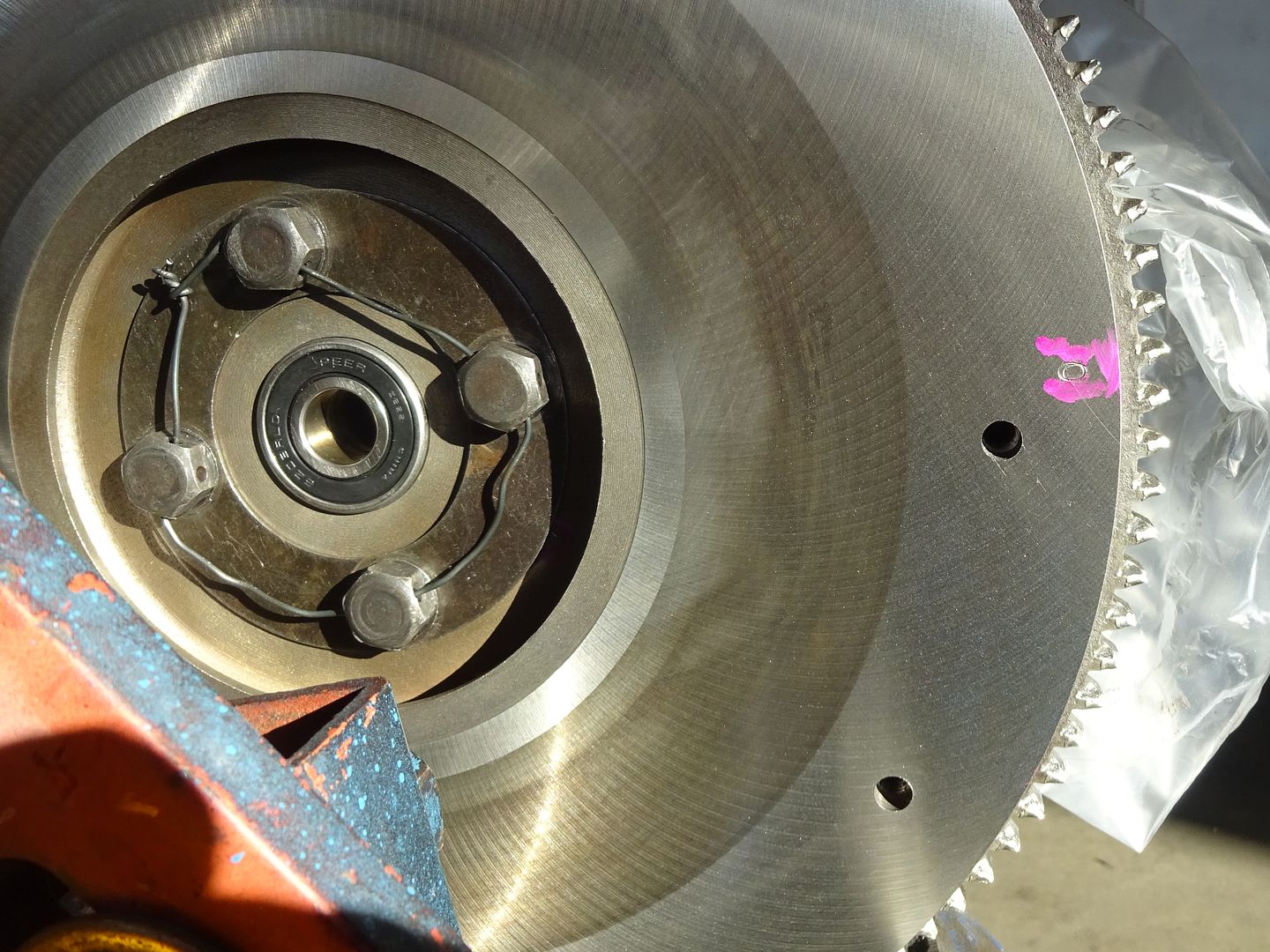
Then there was the new clutch I just bought from Fort Wayne Clutch that needed weight added to two flanges to get it in balance.

DSC00790-r_zpsd99d469b.jpg


The flywheel was balanced then indexed with the clutch to put together so they'd be balanced together.

DSC00784-R_zpsce4ae46b.jpg


DSC00789-r_zps918846c6.jpg
 
I've seen quite a few crankshafts with roughness on the back side of the counterweights. There may have been gas pockets inside the molds where the gasses couldn't escape during the poor. The crankshafts were cast in multiples then they were cut apart after they cooled. FoMoCo balanced them but I don't know what there minimum vibration specs were and I don't know what they used for bob weights. Generally they got them pretty close but if the rods are changed then the bob weights also have to be changed and that affects the overall balance. It doesn't look like they took too much off though It's not unusual to do that to get them in good balance. Sometimes they even pour melted heavy metal in the holes to add weight.

That old ring does have some wear but I've seen a lot worse still in service.
 
Last edited:
Curious - is the main cap safety wire normally done in this fashion?
Looks to be adequately functional but I have never seen a flathead bottom end apart.
 
About all those flatheads cranks have hunk that looks like it's been broke out but I understand it where the factory brakes it out of the mold. I'm sure there balanced and probably use bob weights and know what the rods and pistons weigh. But now days when we get these engines whey have been built before and rods mix up and pistons changed. SO That is why I have all my engines balanced. Walt
 
I've seen the films that show the cranks being removed from the mold shell and they weren't dainty with them. The casting with sprues and all were dropped down to knock the sand off. A lot of times the cranks would bust away from the tree sprues. What didn't break away from the tree was cut apart. They were just rough ground to remove the flash & protrusions before going on the machine shop.
 
Just curious about the nuts and studs on Ol Henry's main caps. Didn't the main caps have bolts?? John
 
Chris,

I'm talking about the threads that the nut goes on to hold the head down, i'm aware of the threads in the block being different and that you definitely shouldn't use a tap in them, rather a thread chaser.


Thanks for that info, pretty much what i was thinking. I suppose when the studs are in and the head needs a clean there isn't much else you can do about it. If you leave the studs in, is there still enough room to put new valve seats in and have them machined?

Never done seat cutting with studs in, if it needsmachining I pull the studs. There at a different angle to the seats, and can only imagine they'd be in the way.
Question for your machine shop really, I'd want them out, sorry.
Martin.
 
Use only a "chasing" tap or die to clean threads. Otherwise, you run the risk of damaging already fragile threads due to annealing caused by decades of hot/cold cycles. As for the surface of the heads and engine deck, there is a big difference between milling and surfacing. Heads and blocks should be carefully checked with a straightedge and, if necessary, just enough material should be removed to restore the surface.
 
The heat produced by a running engine, can't aneal metal parts.
The threads on the factory studs are very good and very strong.
Martin.
 
I've seen quite a few crankshafts with roughness on the back side of the counterweights. There may have been gas pockets inside the molds where the gasses couldn't escape during the poor. The crankshafts were cast in multiples then they were cut apart after they cooled. FoMoCo balanced them but I don't know what there minimum vibration specs were and I don't know what they used for bob weights. Generally they got them pretty close but if the rods are changed then the bob weights also have to be changed and that affects the overall balance. It doesn't look like they took too much off though It's not unusual to do that to get them in good balance. Sometimes they even pour melted heavy metal in the holes to add weight.

That old ring does have some wear but I've seen a lot worse still in service.

I think someone showed a video of the cranks being cast. They came out in batches of 4 and were broken apart. That "chunk" is where they are cast together and then broken apart while still white hot.
 
Back
Top