
You are using an out of date browser. It may not display this or other websites correctly.
You should upgrade or use an alternative browser.
You should upgrade or use an alternative browser.
Model A Horn
- Thread starter C4engr
- Start date


160B
Well-known member
The info below info is from this link
http://www.mafca.com/tqa_electrical.html
"To change the Model A horn from 6 volts to 12 volts, you must rewind the two field coils. Leave the armature as it is. First disassemble the horn to remove the brushes and the armature. Unsolder the two wires at the connector clip ( one from each field coil.) Note the direction of winding on the coils. The two coils are wound in opposite directions. The rule of thumb is that when you double the voltage, you use 1/2 the wire size and double the turns. So going from 6v to 12v use 24 gauge wire (original wire is 20 gauge, 1/2 that size is 23 gauge, but almost impossible to find 23 gauge so I have always used 24 gauge readily available at Radio Shack). Six volt coils have 45 turns and I have been using 100 turns with 24 gauge wire with great success. Be sure to use coated wire, normally used to wind RF radio coils or speaker coils. After winding the horn coils I usually brush a coat of light varnish to help insulate. The windings do not need to be real tight or in neat rows. In fact I found that if I wrapped just tight enough to form the wire around the core, and laid about 6 or 7 turns per layer, without being too careful how straight each wind was, I got better results on horn operation. In looking at a lot of original horns, some were manufactured with very precise and straight windings and some were wound very haphazardly."

BILL WILLIAMSON
Well-known member
I read where one poster hid an old coil inside the frame rail, ran the horn wire through it, for an effective voltage reducer. Bill W.

CarlG
Well-known member
This is what I have in my horn, available from Sacramento Vintage Ford -- works great.
HORN VOLTAGE REDUCER- inside cover 1928-31
Allows you to use the 6-volt horn with a 12-volt system. Made just for the Model A. This unit fits inside the horn motor cover. 1928-1931. 21A P.176
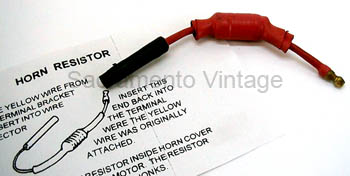
HORN VOLTAGE REDUCER- inside cover 1928-31
Allows you to use the 6-volt horn with a 12-volt system. Made just for the Model A. This unit fits inside the horn motor cover. 1928-1931. 21A P.176

John LaVoy
Well-known member
The voltage reducer works pretty well.
Is it possible to purchase new 6V coils from somewhere? I took my horn apart and notices one set of coils was black. I do not want to purchase a repo horn or pay over 250 dollars for a replacement.The info below info is from this link
http://www.mafca.com/tqa_electrical.html
"To change the Model A horn from 6 volts to 12 volts, you must rewind the two field coils. Leave the armature as it is. First disassemble the horn to remove the brushes and the armature. Unsolder the two wires at the connector clip ( one from each field coil.) Note the direction of winding on the coils. The two coils are wound in opposite directions. The rule of thumb is that when you double the voltage, you use 1/2 the wire size and double the turns. So going from 6v to 12v use 24 gauge wire (original wire is 20 gauge, 1/2 that size is 23 gauge, but almost impossible to find 23 gauge so I have always used 24 gauge readily available at Radio Shack). Six volt coils have 45 turns and I have been using 100 turns with 24 gauge wire with great success. Be sure to use coated wire, normally used to wind RF radio coils or speaker coils. After winding the horn coils I usually brush a coat of light varnish to help insulate. The windings do not need to be real tight or in neat rows. In fact I found that if I wrapped just tight enough to form the wire around the core, and laid about 6 or 7 turns per layer, without being too careful how straight each wind was, I got better results on horn operation. In looking at a lot of original horns, some were manufactured with very precise and straight windings and some were wound very haphazardly."
Swede, from Bow, Wa.

Tom Wesenberg
Well-known member
Is it possible to purchase new 6V coils from somewhere? I took my horn apart and notices one set of coils was black. I do not want to purchase a repo horn or pay over 250 dollars for a replacement.
Swede, from Bow, Wa.
Horn field windings are very easy to do yourself. Just measure the number of turns, (or feet of wire) and the gauge of the wire. Also note the direction each field is wound, so you establish the correct polarity for each field.
Are you sure the field is shot? Some laquer wire coatings are very dark.
Sir,
I have restored rewound field coils 6V or 12V available for exchange. Sparton or SW.
Neil
THE HORN MAN
601-469-0878
seaweed1996@yahoo.com
I have restored rewound field coils 6V or 12V available for exchange. Sparton or SW.
Neil
THE HORN MAN
601-469-0878
seaweed1996@yahoo.com

Billludwig
Junior Member
I first tried the Horn Resistor with my Sparton, but wasn't happy with the sound. Rewinding the fields (see 'swede' post above) made all the difference in the world!!