Reverse flow flatheads?

I've been doing some research and preparing to tear down my boneyard flatty to go to the machine shop for a dip and magnaflux...from what I've read the flatty had overheating issues due to the exhaust running through the water jacket. It seems that back in the day guys did a reverse flow on these motors and sent the exhaust out the intake ports...what I can't find though is exactly how this was done...I would think due to the head design that it wouldn't be too hard to do just change the intake for exhaust, granted a man would have to fab up new intake and exhaust manifolds...but the cam wouldn't have to be custom ground right? Has anybody got any insight as to how this was done? And better yet the details and benefits of doing it...
 
Well, if it was a good thing to do lots more people would have done it. An interesting little experiment, but of no real advantage. If you want to give it a go have at it, but it would be an expensive project in money and time for probably no tangible benefit other than a conversation piece.

Hey, I'm grumpy today!

Mart.
 
As I recall, sometime around 1950-51, one of the hot rod magazines, there were a lot of them on the news stands at that time, maybe it was actually Hod Rod, featured and article about a reversed flathead that intaked through the exhaust ports and exhausted via stacks in the intake ports.
The article in the "mag" showed the car, it was in being ran at a drag strip. As I recall the article stated that they had a lot of trouble with the trans during the speed runs. During the cars last run the trans again acted up, the driver said to hell with it, left the trans in second gear and ran it with the trans stuck in second gear. The car turned 101 in the quarter mile.
I think a friend of mine in Idaho still has the magazine article..
 
I've been doing some research and preparing to tear down my boneyard flatty to go to the machine shop for a dip and magnaflux...from what I've read the flatty had overheating issues due to the exhaust running through the water jacket. It seems that back in the day guys did a reverse flow on these motors and sent the exhaust out the intake ports...what I can't find though is exactly how this was done...I would think due to the head design that it wouldn't be too hard to do just change the intake for exhaust, granted a man would have to fab up new intake and exhaust manifolds...but the cam wouldn't have to be custom ground right? Has anybody got any insight as to how this was done? And better yet the details and benefits of doing it...


The overheating problem is caused by a lack of water jacket cooling capacity when a flathead is old and tired. The lack of cooling capacity is related to all the silt and rust type of material located around the two rear cylinders on each side of the block.
Another big problem is related to the small water holes in the head gaskets becoming plugged with old age reducing coolant flow from the block into the head. These two areas resulted in the overheating problems.
A properly cleaned block and sufficient coolant flow between the block and head eliminates the heating issues. These two corrections are a lot less work and a whole bunch less money than a reverse flow flathead.
Good luck on your new adventures with your flathead.
 
I recall seeing something on it as well,
I think they were running one of those at bonneville.

It would be neat, but you need deep pockets for that one. Might as well do an Arden conversion.
 
I'm not understanding why it would take deep pockets...just a matter of making the manifolds correct?

Did you not see all the extensive and expensive machine work that has to be done to the block???

Like 51 MERC says........!

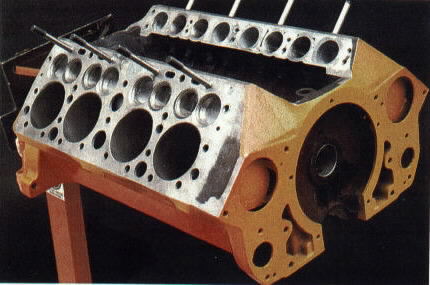
In the "rough"......

topright2.jpg


......and EXPENSIVELY-pretty!

rightmiddle2.jpg


And of course, up-top manifolding is "one-off" un-obtainium-like! DD
 
My dad once did it to a model A by using a timing chain to simply turn the cam backwards. Ran a 2 bbl carb and put it in a 30 sport coupe. Won west coast region champion at a hill climb event on Placerville Ca.
 
Guys I'm not looking to make 500hp...just more so to get people to scratch their heads and wonder...it's a 52 flatty which I believe is 130hp stock...considering my truck might weigh 1200-1500 pounds when built I don't believe it needs more power than that...I read the article and the guy used sbc mild domed Pistons and rods if I read correctly, made reference to using sbc rod bearings so I'd figure sbc rods as well...my plan was to rering my motor if everything is ok with the block (fatties are common to crack in the webs I'm told) and call it a day...maybe some finned aluminum heads just for looks but nothing like this guy has built for sure...at most a mild cam to give it some thump at idle
 
Ok, metalbender, you have a desire to do something with your motor. (Please don't be offended by anything I say). The people on this forum have collectively hundreds or even thousands of years of flathead building experience between them. Not one is running a reverse flow flathead. I don't know of any sbc commonality. In other words, real flathead nuts just mess about with flatheads using ford or aftermarket parts specifically designed for the flathead. The flatfire guys have (I guess) progressed to the stage they are at over many iterations, each more radical than the rest, and they have the skills and the resources to make it happen. In your last response you start to say things that make more sense to the regular flathead type guys that visit this forum. I don't think the flatheads made 130hp stock, but I am unfamiliar with the later ones.

A general tidy up of the motor, twin carbs, heads if you like, good ignition etc will get 'er running right.

Quietly forget what the out and out race guys get up to, it's not relevant here. Good down to earth flatty fun is what we like.

Mart.
 
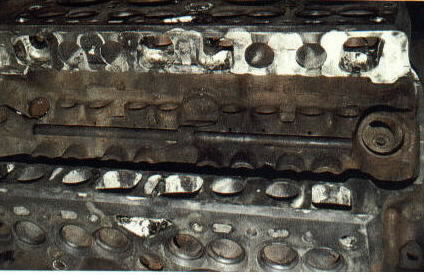
I have seen the "reverse flow" concept applied in a couple of ways to our Flatheads. In the very earliest example, I remember, a single barrel carb was mounted at each of the standard exhaust locations(6 carbs) and special headers made on top of the engine for exhaust outlets. The guys were happy with their work and garnered mucho attention. BUT, they were 20 MPH slower than our conventional arranged Flathead.

Simply doing a flow test will explain why. As bad as the conventional intake flow is, the exhaust is slightly worse. Putting the inlet charge through the conventional exhaust ports would only serve to reduce potential power.

However, there is some potential power improvement when revised ports are bored into a new location at the top of the block. This improvement is a result of flows being increased.

The overheating "problem" has already been addressed in this thread and becomes irrelevant unless reasonable measures are not maintained.
 
....and nothing we're talking about here really addresses the true hurdle to side valve engine performance.

The last turn as the charge enters the cylinder and has to bounce off the head to get turned down into the cylinder. That's the bugger.

There is a cylinder head that is commercially available that helps with this problem. It is called the Navarro "Hi-Dome". The literature says 30% increase in airflow on an "un-relieved" block.

This is a more expensive cylinder head and requires a special pistons BUT! This is exactly what the little Flathead needs more of. This type of head allows for a more generous flow path into the cylinder.

Running reverse ports like they tried trough the exhausts doesn't help and actually sucks as a solution.

Running exhaust ports out the top of the block like a Caddy is cute but does little for performance. The damning thing about any "L" head is just exactly what I described.
 
Metal bender: Wouldn't it possible to figure out a way to reverse the 49-53 heads so that the water entered the engine from the rear of the block? I recall Ford did change teir head gasket design to get more water to flow to the rear of the block in a effort to enhance cooling.
 
Metal bender: Wouldn't it possible to figure out a way to reverse the 49-53 heads so that the water entered the engine from the rear of the block? I recall Ford did change teir head gasket design to get more water to flow to the rear of the block in a effort to enhance cooling.

Why would anyone go to that much trouble when engine cooling isn't an issue in the first place on a properly cleaned out block?
 
One modification I make to all my flatheads id to increase the exit angle of the transfer area to improve the AF turn into the cylinder. I have no idea if it works, but it doesn't cost anything and is a good idea. I was at Bville when the Landy engines were run. They had quite a few spare engines. As JWL says, exhaust ports don't flow very well as intakes. I think this should be obvious.
 
Back
Top