I may have stumbled onto something that deserves it's own thread. During the past week, I have been posting thoughts and info regarding the authenticity/originality of our 1960 Sunliner's 352/360 HP engine. A lot of good information was exchanged. Until this past week, everything that I have read concerning this rare engine has stated that there was no way of identifying the block as the HP engine. The casting number (C9AE6015D) merely identified it as a 352 engine. Thanks to information obtained on this board, I located additional identifiers stamped on the block where the oil dipstick is located. There are two markings on our car: "HP" and "3-0C22J." The "HP" designation clearly identifies the block as a 352/360. However, I could not figure out what the other marking indicated. This morning, as I was looking at the mountain of paperwork that I have collected, it hit me. That number matches exactly the numbers on the data plate. The date code of March 22, 1960 and the paint code "J." Is this possible? It cannot be a coincidence. I would love any and all feedback regarding this discovery. Needless to say, I am stoked! Has this been documented anywhere else? It would be very cool if has not...
You are using an out of date browser. It may not display this or other websites correctly.
You should upgrade or use an alternative browser.
You should upgrade or use an alternative browser.
Wow! Is this possible???
- Thread starter Jlau
- Start date


dmsfrr
Well-known member
Not sure why a 'J' car exterior paint code letter would be on the block, doesn't make any sense to me.
But if the letter 'J' on the block is to match the 2nd character of the serial number that may be more likely. That's the Assembly Plant: J = Los Angles, CA.
http://www.tpocr.com/fordvin.html
Unless the internet is lying to me again...
But if the letter 'J' on the block is to match the 2nd character of the serial number that may be more likely. That's the Assembly Plant: J = Los Angles, CA.
http://www.tpocr.com/fordvin.html
Unless the internet is lying to me again...
Not sure why a 'J' car exterior paint code letter would be on the block, doesn't make any sense to me.
But if the letter 'J' on the block is to match the 2nd character of the serial number that may be more likely. That's the Assembly Plant: J = Los Angles, CA.
http://www.tpocr.com/fordvin.html
Unless the internet is lying to me again...
That makes more sense.

KULTULZ
Well-known member
You haven't been following the original thread-
The actual stamping date on the pad is the date the engine was assembled. It still has to be shipped to whatever assembly plant the car is scheduled to be assembled.
KULTULZ;1632989 05-25-2018 @ 07:39 PM said:
Stamped Date Code - 3-0C22J HP
3= Dearborn Engine Plant (ASSY)
0= 1960
C= MAR
22= Day of Month
J= Inspector Code
HP= Designates 360HP (For 1960 Model Year)
Now put this info with your block/cyl head Casting Date Code(s) and you will have NUMBERS CORRECT.
The actual stamping date on the pad is the date the engine was assembled. It still has to be shipped to whatever assembly plant the car is scheduled to be assembled.

KULTULZ
Well-known member
FIRST FIVE CHARACTERS of VIN-
0J55Y
0 = 1960 (Model Year)
J = Los Angeles (Assy Pant)
55 = 1960 FORD Galaxie Conv (Body Series Code)
Y = 352CI (Engine Code)
BODY = 76B (Conv)
COLOR = J (Body Paint Color)
TRIM = 45 (Interior Trim Code)
DATE = 22C (Assembly Date) (22 MAR 1960)
TRANS = 2 3/S OD
AXLE = 3.89 Open
0J55Y
0 = 1960 (Model Year)
J = Los Angeles (Assy Pant)
55 = 1960 FORD Galaxie Conv (Body Series Code)
Y = 352CI (Engine Code)
BODY = 76B (Conv)
COLOR = J (Body Paint Color)
TRIM = 45 (Interior Trim Code)
DATE = 22C (Assembly Date) (22 MAR 1960)
TRANS = 2 3/S OD
AXLE = 3.89 Open

raceron1120
Well-known member
...The casting number (C9AE6015D) merely identified it as a 352 engine...
C9AE = 1969, not 1959. Is that casting # correct as typed?

KULTULZ
Well-known member
Originally Posted by Jlau 
...The casting number (C9AE6015D) merely identified it as a 352 engine..
B9AE 6015-B

...The casting number (C9AE6015D) merely identified it as a 352 engine..
C9AE = 1969, not 1959. Is that casting # correct as typed?
B9AE 6015-B
Attachments

KULTULZ
Well-known member
Jlau -
Do you see the conflict of the vehicle assembly and engine assembly date(s)?
Do you have any other 352 block in the shop? It may be that when gone through they pulled another block.
Are the original pistons (EDT) still on-hand or were they tossed?
SOURCE- https://www.newsday.com/classifieds...bers-has-lost-meaning-in-appraisals-1.6154213
Do you see the conflict of the vehicle assembly and engine assembly date(s)?
Do you have any other 352 block in the shop? It may be that when gone through they pulled another block.
Are the original pistons (EDT) still on-hand or were they tossed?
Now that we have that cleared up, what happens when “matching” numbers really aren’t. The deceptive practice of re-stamping engine parts with the correct “matching numbers” has been around for a long time. This is usually done to enhance the value of a collector car. A seller that gets caught doing this, and ends up in court, will usually offer the excuse that “I said it was matching numbers, and it is. I never said it was the original engine.”
Many advertisements will list a car a “matching numbers” but then go on to indicate that it has a “restoration block.” It’s up to you to know that this simply means that the engine block has been re-stamped to include the correct numbers for that particular car.
SOURCE- https://www.newsday.com/classifieds...bers-has-lost-meaning-in-appraisals-1.6154213
Last edited:


KULTULZ
Well-known member
...how often do you find rivets holding plate so clean.with the scuff marks on plate they look out of place.there was a time you could have a plate made.
Exactly. That is when you start looking for the buck tag and frame stampings.


rotorwrench
Well-known member
The new plate rivets are available. If the structure that holds the plate has to be replaced, (when and if it is possible) then the plate has to be transferred to the replacement structure. If there are no signs or evidence of tampering such as over stamped or re-stamped frame numbers then I wouldn't get too concerned about it. New plates can be fabricated to replace damaged ones. I haven't ever had a need to do it but I've seen adds for folks that reproduce them. The main thing is that the frame number is intact with no sign of tampering. The plate is easy to remove but the frame is not. The cars of the late 50s & early 60s have a more descriptive VIN than the older cars did.
KULTULZ
Well-known member
We have matching frame and data plate VINs. What is a buck tag, is that the build sheet?
If the car came through with one and was not removed at some point, it should be located on the RS cowl/firewall area.The buck tags purpose was to notify line worker that some hole or modification needed to happen during assembly on the shell or sheet metal.
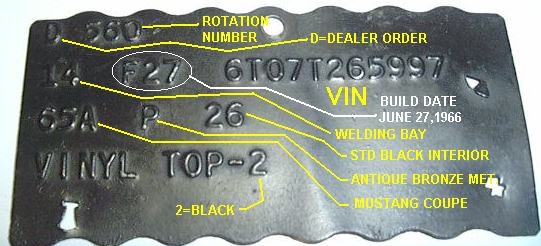
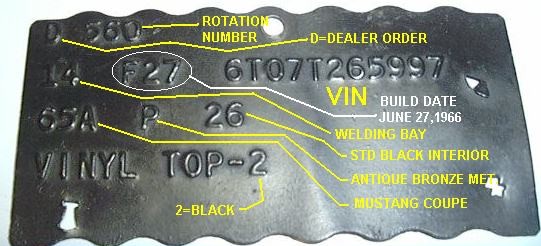
Interesting Read- http://www.collectorcarmarket.com/collector-car-profiles/articles/clones/collector_car_clones.html
