
You are using an out of date browser. It may not display this or other websites correctly.
You should upgrade or use an alternative browser.
You should upgrade or use an alternative browser.
What to do when your garage is small
- Thread starter Ken Arms
- Start date


Jack Olsen
Junior Member
Thanks!
Tinker, that was a picture that I saw, somewhere along the way. In an odd coincidence, the garage itself ended up in a much-more-recent issue of the same magazine.

For me, the benches are there for a lot of different reasons. If I only did automotive work in the place, there would be fewer of them. But I do a lot of different stuff in the one place, and it's a small place, so it's not optimized really for any one thing.
But I've thought about re-painting the car in it. It wouldn't be impossible.
And it worked pretty well for last year's engine and suspension rebuild on the car.
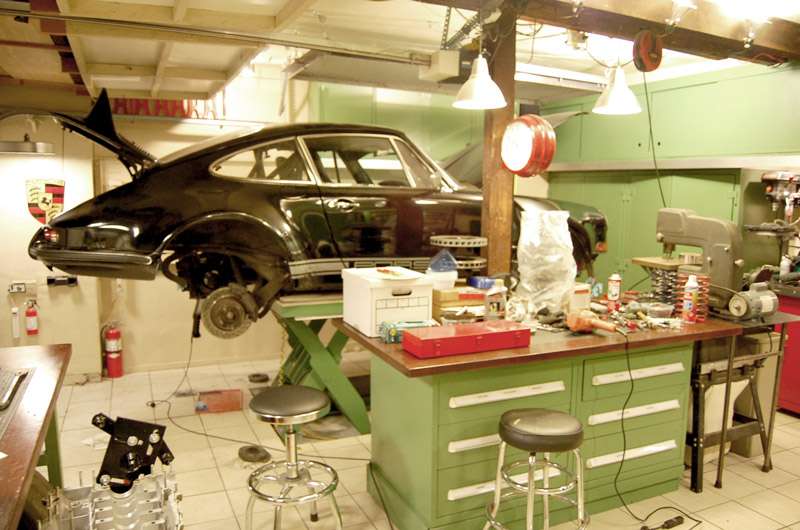
Tinker, that was a picture that I saw, somewhere along the way. In an odd coincidence, the garage itself ended up in a much-more-recent issue of the same magazine.
For me, the benches are there for a lot of different reasons. If I only did automotive work in the place, there would be fewer of them. But I do a lot of different stuff in the one place, and it's a small place, so it's not optimized really for any one thing.
But I've thought about re-painting the car in it. It wouldn't be impossible.
And it worked pretty well for last year's engine and suspension rebuild on the car.


peewee2you
Well-known member
Jack Olsen is a bad ***!!! Very nice Jack.....what type of lift is that in your garage and what is it's weight capacity. Here is a snapshot of my 20x20 packed with projects.


Jack Olsen
Junior Member
Thanks. The lift is not an automotive lift at all. It's a Vestil hydraulic lift table, made in Indiana, and designed for use in warehouse and industrial settings. It's different from an automotive lift in a few ways. On the negative side, it doesn't switch over to a mechanical stop when it's in position -- automotive lifts will usually have a hydraulically or pneumatically controlled set of ratcheting stops to relieve pressure on the hydraulic cylinders and provide a safety net if those should fail. On the positive side, its hydraulics are very robust -- it's designed for a 30-minute-non-stop duty cycle, and it has other mechanisms in place to prevent an uncontrolled descent in the case of hydraulic failure, as well as OSHA-mandated switches to stop descent if the table comes in contact with anything on the way down. It's designed for industrial use -- being bumped on a regular basis by forklifts, for example.
It was not designed for automotive use, so I'm leery about recommending it to anyone. It doesn't have swing-out arms, and its flat top restricts access to the underbelly of the car. They also cost more than most consumer-level automotive lifts. Depending on capacity, these things sell for $2.5-12K.
But a local company that re-sells second-hand stock from machine shops and manufacturing plants brought two of these up on Ebay. The first sold for $750, and it got me thinking about how a table like this could conceivably function for my rear-engine car. I did a little research, and saw that the 48" square top would cover all of my 911's factory lift points while also leaving me full access to the engine, transaxle, exhaust and (of course) the suspension and wheels. The old 911s simply have a flat belly pan where this lift contacts the car.
This is what it looked like originally. The things I liked about this picture were that 1) the safety rails make it likely that it was used to lift people, which is easy work, and 2) where they welded on the rails and left bare metal, there wasn't any rust -- which suggested indoor work.

I talked to a few different engineers about the viability of my idea. I worked out the actual balancing point on my car by perching it on a steel beam. Then I worked out how that point would shift as weight was taken off.

When I was convinced it would work, I bid on the second unit up for sale -- and got it for $455. I put another $215 into tool rental, concrete, rebar and replacement tiles. My 'out the door and in the floor' cost was $670 for the whole shebang.
And then there was the labor. I dug out 2000 pounds of clay and old concrete and poured about 1000 pounds of new concrete back in. It sits on an 8" pad now, which is overkill. But why not?
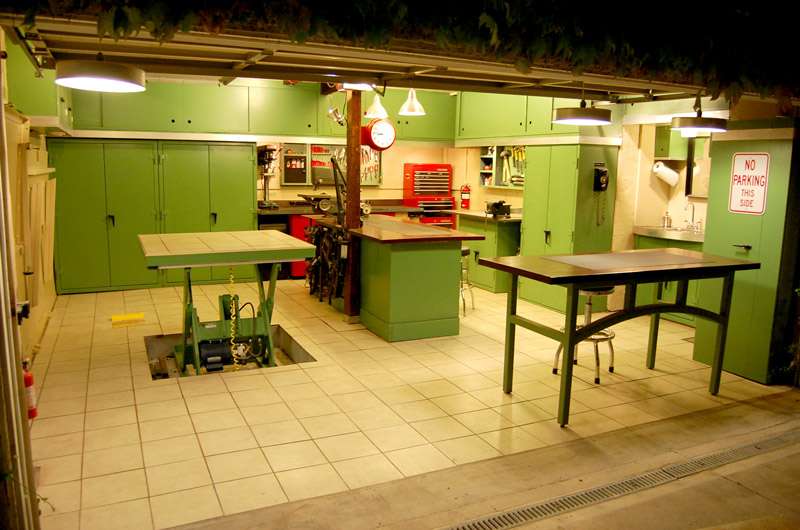
I think a conventional automotive scissors lift makes more sense for most car owners. Putting it into a recessed pit is not nearly as difficult as you might think (I'd never cut or poured concrete before this). And if you make a lip for a 1" plywood cover, you can get the same benefit of a zero-footprint piece of machinery that also lifts your car up at the push of a button.
Here's a video showing it going up and down. It's kind of cheesy, with the music -- but it captures the sense of relief I felt when I got to see that it actually worked.
http://www.youtube.com/watch?v=9taIj0qw5SM
And thanks, Mike. I'm really kind of a hack, compared to many guys. But I'm persistent. The shed always looks funny to me, because of how quickly I came up with the idea for its shape. I got a Home Depot gift card in the mail one morning, and decided that I'd build the shed starting right then. So I drew a scale drawing on some graph paper, knowing I could have two different roof heights and needed to leave space for the electric box. I thought of the arched roofs because there were still some plates sitting on the kitchen table where I was working. The larger roof corresponds to the diameter of a dinner plate and the smaller roof was a dessert plate. Whenever I look at the thing, I still see those dishes.
It was not designed for automotive use, so I'm leery about recommending it to anyone. It doesn't have swing-out arms, and its flat top restricts access to the underbelly of the car. They also cost more than most consumer-level automotive lifts. Depending on capacity, these things sell for $2.5-12K.
But a local company that re-sells second-hand stock from machine shops and manufacturing plants brought two of these up on Ebay. The first sold for $750, and it got me thinking about how a table like this could conceivably function for my rear-engine car. I did a little research, and saw that the 48" square top would cover all of my 911's factory lift points while also leaving me full access to the engine, transaxle, exhaust and (of course) the suspension and wheels. The old 911s simply have a flat belly pan where this lift contacts the car.
This is what it looked like originally. The things I liked about this picture were that 1) the safety rails make it likely that it was used to lift people, which is easy work, and 2) where they welded on the rails and left bare metal, there wasn't any rust -- which suggested indoor work.
I talked to a few different engineers about the viability of my idea. I worked out the actual balancing point on my car by perching it on a steel beam. Then I worked out how that point would shift as weight was taken off.
When I was convinced it would work, I bid on the second unit up for sale -- and got it for $455. I put another $215 into tool rental, concrete, rebar and replacement tiles. My 'out the door and in the floor' cost was $670 for the whole shebang.
And then there was the labor. I dug out 2000 pounds of clay and old concrete and poured about 1000 pounds of new concrete back in. It sits on an 8" pad now, which is overkill. But why not?
I think a conventional automotive scissors lift makes more sense for most car owners. Putting it into a recessed pit is not nearly as difficult as you might think (I'd never cut or poured concrete before this). And if you make a lip for a 1" plywood cover, you can get the same benefit of a zero-footprint piece of machinery that also lifts your car up at the push of a button.
Here's a video showing it going up and down. It's kind of cheesy, with the music -- but it captures the sense of relief I felt when I got to see that it actually worked.
http://www.youtube.com/watch?v=9taIj0qw5SM
And thanks, Mike. I'm really kind of a hack, compared to many guys. But I'm persistent. The shed always looks funny to me, because of how quickly I came up with the idea for its shape. I got a Home Depot gift card in the mail one morning, and decided that I'd build the shed starting right then. So I drew a scale drawing on some graph paper, knowing I could have two different roof heights and needed to leave space for the electric box. I thought of the arched roofs because there were still some plates sitting on the kitchen table where I was working. The larger roof corresponds to the diameter of a dinner plate and the smaller roof was a dessert plate. Whenever I look at the thing, I still see those dishes.

Tinker
Well-known member
What was once old, is now new again.
Scissor lifts are decent, had one. A little difficult to work on anything in the center of the car. Just my opinion and you know what they say about that.
Nice work and great setup! Definitely well thought out, I like it a lot!!!
Scissor lifts are decent, had one. A little difficult to work on anything in the center of the car. Just my opinion and you know what they say about that.
Nice work and great setup! Definitely well thought out, I like it a lot!!!
Thanks!
Tinker, that was a picture that I saw, somewhere along the way. In an odd coincidence, the garage itself ended up in a much-more-recent issue of the same magazine.
Last edited:
peewee2you
Well-known member
Jack, thanks for letting me know about the lift, I questioned only because I am what you would call on the challenged side! (handicap'd) and sometimes jacking up the old ford via a floorjack can be a work out for me. I am always looking for other means that are cost effective to work safer from injury and convenience. Although we are enjoying your work and craftsmanship, a lot of times what appears that I can do that, doesn't really reflect the hours of design, and the many many man hours of labor and construction of such art, because truly that's what your garage is art, that is very functional and useful as you described it, and it's no surprise that is was in a magazine, to spark the rest of us to use our knowledge and talent for a task such as that. Jack, thanks for sharing..

pauldeborr
Member
Freaking awesome!!! You are my hero
Jack Olsen
Junior Member
Thanks, guys.
peewee2you, I wouldn't describe myself as a craftsman (but thanks!), but I do agree that the amount of time I put into the shop might make it difficult to copy for guys with less free time available. I also have a brain trust at the other end of the phone, since both my father and brother are engineers. I can run the crazier stuff past them before I jump off a cliff.
Getting a truck up off the ground is a potentially dangerous proposition no matter how you slice it. Once you've got a few thousand pounds up in the air, gravity essentially turns it into a loaded weapon. Jacks, jack stands, pits, and even lifts all have safety risks. I'm surprised there aren't more (are there any?) consumer-level pneumatic/hydraulic lifts available, which might make this sort of thing easier for people who are restricted in one way or the other. I think the company that made the drill-driven lift (EZ Car Lift?) might have run into trouble? I'm not sure, but they were an interesting example of still one more way to skin the cat of lifting a car in a regular size garage. MaxJax is another.