Water in the oil...

Hey guys,
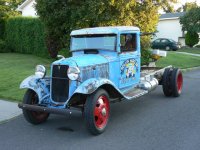
I just pulled the head and intake on my 59AB in my basically stock 1934 1 1/2 ton to free a sticking valve. No big deal. Upon reassembling everything with new gaskets, it starts to overheat and upon inspection find water in the oil pan and all over the garage floor. Removed and cleaned the oil pan, new oil and new copper sprayed head gasket ...and upon firing it up did it all over again. What the heck am I looking past? Any body have a clue? Thanks for any suggestions. Dave
 
Water in the oil don't come from the over flow tube. I would remove the fan belt, top radiator hoses and fill the water on both sides to the top of the head outlets. Crank the engine or start it for a few minutes and watch for bubbles in the water. You could have a problem on the other side. After determining which side leaks remove that head and make a good inspection of the gasket and cracks at the stud bolts. You can loose the drain plug slightly after the engine sits over night and let the water drip out until it becomes oil. The small amount of water remaining will be removed by the engine heat when it gets up to temperature. G.M,
 
While I agree with G.M. and both sides should be checked as he indicates, I would focus on the side you dis-assembled. If the engine been rebuilt recently your gasket surface s/b pretty good. If it's an older one with lots of miles the gasket surfaces will need attention? In either case after cleaning a thin even film of hi-temp RTV ( copper ) on both sides of the gasket then reassy but don't torque ( light snug ) for a day. Then full torque the next day after RTV has cured. If it was a bad seat for the gasket to the head or motor that should work.
 
Thanks everyone,
This is not a little from the over flow, this is bubbling like boiling water (had the radiator cap off) even before the water got hot and water out the exhaust. Sure makes sense to be because of pulling the head and lack of getting it to seal again. It has sat over night so the water should have separated out of the oil and I did notice the water came out first last time. I will try that trick and not go to all the work of pan removal. I did not notice any cracks in either the head or the block the last 3 times I have had the head off this week but you know how that goes. This seems to be a big leak? I will find some of the hi-temp copper RTV and give that a try. I have one head gasket left before I just pore a can of gas over the whole rig. Our big early Ford swap meet is in two days and the truck is all loaded with my collection of (27) 1/8 scale "32 / T models still in the box and 3 sets of vintage IROC / Z28 wheels. Thanks for the help but watch for the smoke on the horizon!! Any body want to buy a neat old truck before the fire sale? Dave
 
Personally I don't like using sealers and I've had bad experiences with copper gaskets.
Get a Fel-Pro fiber gasket and clean the deck and heads spotlessly, I mean spotlessly. Install bare gasket and torque to spec. If that doesn't seal, you have a more serious problem.
 
Is there anyway you could have a warped head? Might be worth checking it. How about a photo of the block surface next time you pull the head?
 
GM...read it again.....Dave said he discovers water in the oil pan AND on the garage floor. Hence my question: is water coming from the radiator overflow? One of the symptoms of head gasket failure
 
I don't like bare gaskets. I slather both sides with multipurpose grease or chassis lube and install part. Easy to remove later if you have to.
 
Lawson,
You are right on. Grease um up and torque them down. That seals fine for me. Then you don't have to buy new head gaskets if you have to pull the heads.
John
 
Sounds like you may have failed to retorque the heads after running for a while. I always retorque twice. A buddy of mine had a Model A engine professionally rebuilt, brought it home and never started it for 5 yrs. He installed it in the car and we put water in and fired it up and it sprayed water out the tail pipe like a fire hose. I thought the head surely must have a big hole that everyone missed. So we pulled the head and no problem found and I asked him if he had retorqued the head and he had not. We put everything back together and torqued the head and it ran fine. We let it run 30 min. And retorqued the head and they all took a half turn on the torque wrench. A month later he retorqued them again and they moved very little and the car has never leaked again. Good luck with your engine.
 
GM...read it again.....Dave said he discovers water in the oil pan AND on the garage floor. Hence my question: is water coming from the radiator overflow? One of the symptoms of head gasket failure

Sure it's going to get some water out the over flow also because the over flow is an open tube off the top tank of the radiator. The compression pressure is pushing water through the rings or valve train down into the pan and compression in the water is pushing it out the over flow. G.M.
 
I don't like bare gaskets. I slather both sides with multipurpose grease or chassis lube and install part. Easy to remove later if you have to.

Greasing gaskets works unless the gasket is under high pressure. That grease just might help that gasket spit out of its location. I take my head gaskets straight-up and put a new one every time.
 
Hey guys,
I just pulled the head and intake on my 59AB in my basically stock 1934 1 1/2 ton to free a sticking valve. No big deal. Upon reassembling everything with new gaskets, it starts to overheat and upon inspection find water in the oil pan and all over the garage floor. Removed and cleaned the oil pan, new oil and new copper sprayed head gasket ...and upon firing it up did it all over again. What the heck am I looking past? Any body have a clue? Thanks for any suggestions. Dave

Dave, I would run a compression test first before you do anything else. What repairs did you do to free up the sticking valve?
Sounds like you may have a warped or cracked head, but if you isolate the problem to a particular cylinder, it'll be easier to find the problem, no?
 
Hello Guys,
The end of the story...kind of!!! With only #4 head gasket left and the big swap meet 1 day away, even though the head straight edged with no gap I took the head to have it milled flat. .035 later the problem was solved !!! "You have a canal between one of the water holes and #4 cylinder!!" Drove it to the Early Ford V-8 annual swap meet (no over heating) and within 200 feet of the assigned "For Sale" parking space the coil fried!! Will have to address that tomorrow morning and either drive it back or tow it back if it doesn't.
Thousand of people climbed over the truck but all were just kickers or reliving days growing up on the farm....anybody need a truck for half what I have in it. Basically I am losing my *** to buy the space back in my own garage so I have room to work on other old car projects. But oh well I did make it to the swap meet and would have never know if I hadn't made the effort. I already have have a very cool rusty old farm truck complete with moss as yard art that doesn't ever move ...it is a '34 Chevy! Thanks for all of the help and suggestions. Dave in Spokane
 

Attachments

  • P1010206.JPG
    P1010206.JPG
    91.8 KB · Views: 30
  • P1010207.JPG
    P1010207.JPG
    90.4 KB · Views: 38
  • P1010208.JPG
    P1010208.JPG
    93.9 KB · Views: 28
  • P1010209.JPG
    P1010209.JPG
    93.3 KB · Views: 27
  • P1010210.JPG
    P1010210.JPG
    89.2 KB · Views: 26
I don't like bare gaskets. I slather both sides with multipurpose grease or chassis lube and install part. Easy to remove later if you have to.


My uncle was a mechanic in the army during WWII. He later worked as a mechanic at one of the local garages. As a youngster I would hang out with him as he did mechanic work at home for people. He would always grease the head gaskets on both sides before installing. And so do I..
 
Back
Top