Vapor lock

While on a trip the last two days (hot over 100F) the car backfired and ran real rough at times. i think it was vapor lock. Where in the fuel system does vapor lockoccur, fuel line or carb? Any suggestions? I tried some heat rpotective sleeve around the fuel lin, which i thought helped some. Any thing else?
thanks
 
When in Florida this past winter, I saw a Model A with clothes pins clipped to the fuel line, just before the carb. When I asked the owner what they were for, he said "To prevent vapor lock". Go figure.
 
There have been a number of long strings recently on this subject. Try the "search" function.

Gar Williams
 
Part of the problem is the ethanol in the fuel. Many states are allowing lower octane and higher ethanol content, even in premium
. Adding Marvel Mystery Oil or something like that seemed to help on the recent Summer Tour 2012 to Marquette and back
 
Thanks to all of you. Will try the suggestions to find something to work. I hate to have to wait until the weather cools to drive the A.
 
FuelLine-1.jpg


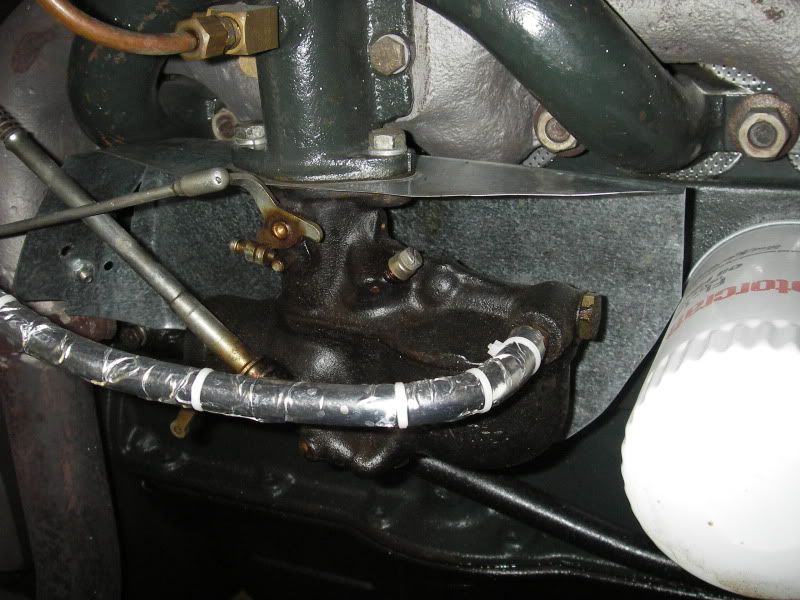
Slipping some white plastic wire harness material over the fuel line helped, but the real solution was to buy gas without the ethanol crap in it.
 
When in Florida this past winter, I saw a Model A with clothes pins clipped to the fuel line, just before the carb. When I asked the owner what they were for, he said "To prevent vapor lock". Go figure.


This is an old trick from the 50's. Supposedly, the clothes pins act as heat sinks. I remember one of my uncles had about 20 of them on his '55 Ford. He swore that they worked.
 
The problem seems to be in the fuel line. What leads me to that conclusion is a very common report that after stopping at a light for instance the car goes for some short distance and then starts the backfire and loss of power routine. This distance seems to be about the distance the fuel in the carb would take you. This condition continues for some distance and then the car returns to normal.

My guess at what happens is while traveling the fuel flow is forcing any vapor forming to the carb where it's vented. While stopped and at an idle the flow is reduced to the point where much more vapor forms in the line than is being vented. When the car starts moving again it runs until the carb is low on fuel and fuel starvation occurs. At this point the fuel flow resumes and after some distance the vapor is vented and full fuel flow starts again.

In severe cases the condition occurs with higher fuel flow and may never correct without cooling off the engine compartment. In this case the vapor is forming faster than the fuel flow can push it to the carb to be vented. Operating at a partial choke condition causes the engine to run rich which increases the fuel flow enough to help some marginal conditions. Increasing the GAV setting may do the same.

Different fuels and even different tanks of seeming same fuels seem to change the conditions where the problem occurs. Adding any additive to the gas does not reduce the existence of the volatile components so I question this solution unless enough is added to dilute the entire fuel capacity. Failed experiments of mine have been installing an insulator between the carb and the manifold, insulating the fuel line, and replacing the line with other types of materials. Two methods have been effective. Cooling the fuel by packing the sediment bowl in ice and adding an electric fuel pump. Cooling the line works in on the road conditions but is not a great permanent solution. It works because the cooled fuel cools the line and the carb preventing vaporization. Fuel pressure works because under pressure fuel vaporizes at higher temperatures reducing the amount of vapor and the pressure forces any vapor that forms to the carb much faster.
 
Carburetor 7-9-12.jpg

Heat shield + 3/16" insulator between carburetor and intake manifold + insulated fuel inlet line + 87 octane gas + engine pans + regular 'ol "Mark I Mod 0" Zenith 2 carburetor = no problems. [Will probably work better once I engine-turn the heat shield and correctly paint the intake manifold and carburetor but meanwhile seems to run fine in what passes for high temperatures in this part of California.]
 
I like Skip's idea but I have to wonder.

Wouldn't a great solution be to add a 6V in tank electric pump? You wouldn't see it and no one would know its there.

Just dreaming out loud.
 
Same thing happened to me on club tour last Aug in Michigan.. Tried insulating sediment bulb and fuel line... did not help. Dealt with problem for days unitil I got home and drained gasoline. I had been running with 1 oz Marvel Mystery Oil in tank fill up. From that day forward I discontinued using the Marvel Oil and started using Sta-bil ethanol Marine Formula, 1 oz per full tank. I never had the problem again. UNTIL TODAY! Last week, I filled up my "A" as always and failed to add the Sta-bil ethanol treatment ( the bottle was in the trunk of my roadster ) Today I drove my sedan to work where it sat out in the sun all day (85 degrees this PM). I barely made it home, starting and stopping, took me 35 minutes to cover 4 miles. When I cool off, I will l go out to be barn and add the Stabil to drive the car tomorrow.
 
Here's a couple of heat shields that a friend made. They helped a bit.

bobsnewerheatshield.jpg


bobsheatshield004.jpg


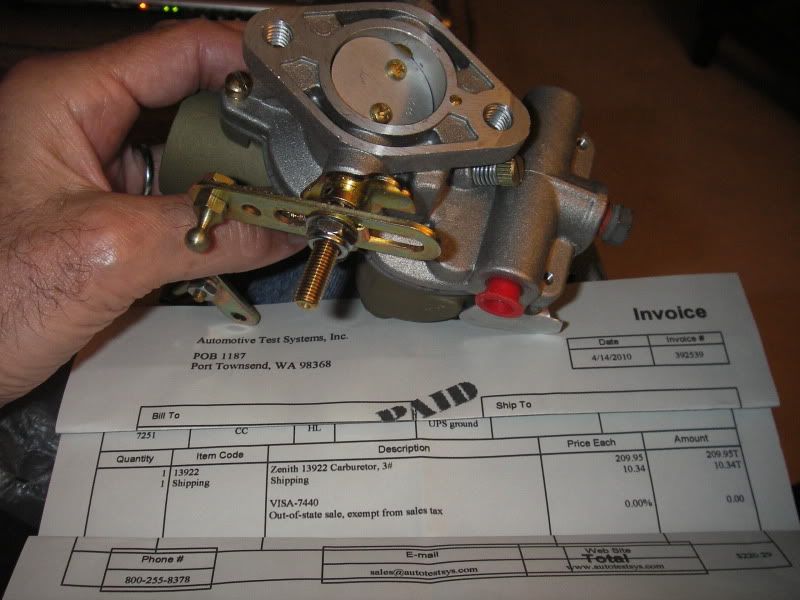
Here is the final solution for me.

2010parts009.jpg


Another fellow in our club told me the other day that adding between 2-4 quarts of diesel per gas tank worked for him; it did nothing but add an obnoxious smell when I tried it.

Steve
 
Last edited:
Our A has been stalling the past few hot days here in Michigan. What I discovered is that the carburetor temperature was between 130 -140 degrees. I opened the drain on the carb and a small amount of fuel discharged. I waited a few minutes and the fuel failed to begin flowing. I tapped on the carb with a wrench and the fuel began to flow. Now when it stalls, I don't open the carb drain - I just tap the carb and I am on my way - no waiting for it to cool down. The float valve, because of the fuel boiling in the carb bowl, creates a vapor and in my opinion, raises the float shutting off the fuel. The fuel lines were cool, the engine coolant was about 150 degrees. I have an carburetor insulator on hand to install as soon as I receive the new valve and float from Snyder's. Hope this works. If not, next step is to try premium fuel or the addition of diesel or some other additive. The resolution for this annoying problem is out there. Let's keep trying new ideas and sharing the results. Tom
 
I had a vapor-lock experience with my stock '28 coupe last summer.

I had taken it out on the Northeast Extension of the PA Turnpike as a dry-run before attempting the trip to Macungie and back, and it was a blistering hot day...

I had been running along at 50 mph or so, then had to stop for a toll-plaza... there was a line. As I was waiting for the cars ahead to get through, all odf a sudden, the Ford started to buck and spit and run really rough... I futzed with the spark, the throttle, the GAV... nothing really helped, but advancing the throttle kept it from stalling at least... during this eposide, I glanced down at my temp gauge under the dash, and it was pushing 200 * F... when I was moving it held around 180*.

Once I sputtered through the toll plaza, and got moving again, the engine cooled down a bit, and after about a 1/2 mile, it began to run normally again.

My next stop was after getting off the T-pike, having just pulled a steep 5-mile grade. While things were still good and hot (idling on the shoulder), I opened the hood on the passenger side and observed the fuel in the glass sediment bowl boiling...

So, I now "believe" in Vapor-lock as a real phenomenon, and usually add a couple ounces of MMO to each tank and have not had a recurrence...

In my case, this lousy ethanated fuel(10%) is to blame... can't get the plain stuff easily anymore...

I don't think that vapor in the float-bowl will raise the float, shutting off the fuel, but a vapor bubble could rise through the valve and into the fuel-line, and overcome the gravity pressure of fuel trying to flow downwards...

In down-draft carbs,when you shut-off a hot engine, boiling fuel can force liquid gasoline out through the jets and into the intake, flooding the engine and at the same time causing the float-bowl to go dry, then it's really difficult to re-start ( this is actually" percolation" , and is usually relieved by the float-bowl vent and or a special anti-perc valve).

SC Frank

 
Back
Top