
You are using an out of date browser. It may not display this or other websites correctly.
You should upgrade or use an alternative browser.
You should upgrade or use an alternative browser.
Vapor lock Really!
- Thread starter 59mgaguy
- Start date

BRENT in 10-uh-C
Well-known member
Oh Boy, ...here we go again!! 

Marcus
Well-known member
59mgaguy: I will get hammered for this comment, but I have never, under any conditions, in any vehicle, A or otherwise, experienced vapor lock. I am NOT convinced that there truly is such a thing! (AND before I receive the incoming comments, I own 10 antique vehicles, to include two A's, three flatheads, and others supposedly prone to "vapor lock".......

Franchise_24
Well-known member
59mgaguy: I will get hammered for this comment, but I have never, under any conditions, in any vehicle, A or otherwise, experienced vapor lock. I am NOT convinced that there truly is such a thing! (AND before I receive the incoming comments, I own 10 antique vehicles, to include two A's, three flatheads, and others supposedly prone to "vapor lock".......
So what is it called when it is extremely hot and you turn your car off and the gas in the garb boils away?
So what is it called when it is extremely hot and you turn your car off and the gas in the garb boils away?
That would be "percolation", but regardless, I do believe in vapor lock.
I do not know about other states but in CO we started seeing the "crap gas" around 1989. I could remove the gas cap, on a 1 year old car, on hot day (over 100) and the crap gas will boil for 20-30 seconds with vapor rushing out around the cap.
1. One reason for all the "nay sayers" is that Ethanol was not used or is NOT EVEN used to this day in many small towns and rural areas because they do not have a pollution problem. Only large cities mandate its use.
2. Some states have recently expanded mandates to include more areas of their state.
3. Some states have only recently adopted the use of the "crap gas" (Tom Wesenberg says that ... I love that term!) ... so many folks have not had the "pleasure" of using it.
4. I opened a 5 gallon Steel GI can that was sitting out side in the shade on a 100 degree day. As soon as I loosened the lid slightly the crap gas started to boil and contained to boil, with vapor rushing out around the cap for 30 seconds.
5. Sure sounds like a recipe for vapor lock to me.
Last edited:

Model A Man
Well-known member
yes, yes and yes. I have had it several time in the hot California summers

Jim/GA
Well-known member
On a car with a fuel pump (Model A does not have one) if the fuel going into the fuel pump is hot enough to boil (fuel inlet line close to exhaust pipe or manifold, very hot day, stopped after running hard) the vaporized fuel in the fuel line does not allow the fuel pump to pump enough liquid fuel up to the carb to keep the engine running. The fuel pump diaphragm is pumping small bits of vapor with each pulse, but the engine needs liquid fuel, so it dies. That is classic vapor lock.
You can't have vapor lock in the classic sense with an A with gravity feed, because you have no fuel pump.
You CAN have the fuel boiling in the carb of a Model A when you sit at idle, run very slow or shut down with high temperatures under the hood. Having the fuel level in the carb lowered by boiling will make it not want to run. (But it's not "vapor lock" because no fuel pump.) I have seen this on many A's and experienced it myself. Opening the hood to let the hot air out and pouring water on the carb usually fixes it. I have also seen it be a plugged vent hole in the gas cap, though, so don't always jump to fuel boiling.
On mine, if I can catch it before it dies, I open the GAV and try to keep the RPM up long enough to flush the hot air out from under the hood. Once the temperatures are down a bit under there and it is running smooth again, I close the GAV back down to normal running position and off we go.
Normally on a carb, when the fuel level is low (from using the fuel or having it boil) the float valve will open up and replenish the fuel in the bowl. So you have to ask yourself why this is not happening on your car. An A does not have much pressure to get fuel to flow, only gravity.
Do you have a restriction that is not allowing fuel to flow into the carb fast enough? A partly plugged fuel filter? An external modern fuel filter that is too restrictive?
Is the new fresh fuel boiling as fast as it gets into the carb, because it is so hot?
I suspect that the people who do not experience this problem have fuel running quickly enough into the carb to replace the fuel boil off.

ken ct
BANNED
Im with YOU Marcus,we've had 10% here for around 15 yrs now and never experianced VL in all that time on my 36 ???? ken ct.59mgaguy: I will get hammered for this comment, but I have never, under any conditions, in any vehicle, A or otherwise, experienced vapor lock. I am NOT convinced that there truly is such a thing! (AND before I receive the incoming comments, I own 10 antique vehicles, to include two A's, three flatheads, and others supposedly prone to "vapor lock".......


Tom Wesenberg
Well-known member
I didn't think vapor lock could happen on a gravity feed fuel system, until it happened to my friend while I was riding with him years ago. He slowed to make a sharp right turn and the engine started to cough and stall. The crap gas was boiling in the fuel line allowing only vapors into the carb.
A few years ago I was parked in the Twin Cities Ford plant parking lot on a hot day and when I went to start my Model A it only fired a few times and died. The fuel had boiled away and wouldn't flow. I had to unscrew the fuel line at the carb before the fuel would start flowing again. I've also had lots of problems at red lights when using crap gas. It would cough and buck, even with the choke pulled half way, until I drove about 5 blocks and got cooler air into the engine compartment. Since I've been paying a buck a gallon extra for REAL gas I've never had a problem. This summer I may try MMO and crap gas to see how it works for me.
A few years ago I was parked in the Twin Cities Ford plant parking lot on a hot day and when I went to start my Model A it only fired a few times and died. The fuel had boiled away and wouldn't flow. I had to unscrew the fuel line at the carb before the fuel would start flowing again. I've also had lots of problems at red lights when using crap gas. It would cough and buck, even with the choke pulled half way, until I drove about 5 blocks and got cooler air into the engine compartment. Since I've been paying a buck a gallon extra for REAL gas I've never had a problem. This summer I may try MMO and crap gas to see how it works for me.

steve s
Well-known member
...
You can't have vapor lock in the classic sense with an A with gravity feed, because you have no fuel pump.
You CAN have the fuel boiling in the carb of a Model A when you sit at idle, run very slow or shut down with high temperatures under the hood. Having the fuel level in the carb lowered by boiling will make it not want to run. (But it's not "vapor lock" because no fuel pump.) ....
Jim illustrates a semantic issue that always comes up on this topic: "real" vapor lock has to involve a fuel pump. Others define any interference with smooth running due to fuel vaporization anywhere along the line as vapor lock. I'm in the latter camp.
I have seen with my own eyes the fuel vaporize in the Model A line. Sometimes there is no perceptible effect on engine running; other times the engine stumbles but can be kept running by fiddling the GAV, choke, or throttle; other times is shuts down the engine.
I have watched with my own eyes a clear plastic inline fuel filter fill up with vapor and stall the engine, as though it were locked. To my mind, that HAS to qualifiy as vapor lock.
At the other extreme, I have watched with my own eyes a vapor bubble repeatedly buildup in and then burp over and on out of the sediment bulb with barely a discernible effect on the motor's idle. Here's one of my photos I took while this was going on. The shiny part is the growing vapor bubble, viewed against the brass screen.
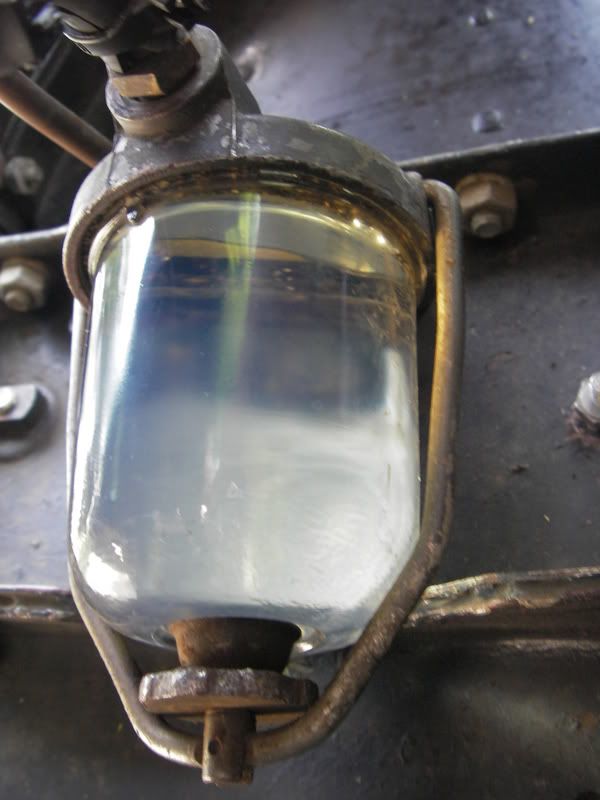
I have to believe that this sort of thing can occur all up and down the fuel line, including in the carb and any filters that may exist, and, depending on the vagueries of surface tension and fuel pathway geometries, may or may not cause problems.
Newer cars deal with this by using fuel pumps with vapor return lines, or by keeping the pump immersed in liquid fuel in the gas tank, so it's always pushing on liquid, rather than sucking on the fuel and thereby promoting vaporization by lowering its pressure.
Ethanol addition has definitely aggravated the problem, but not because ethanol has a lower boiling point--it doesn't--but because it actually raises the vapor pressure of the gasoline, due to what's called non-ideal mixing. Getting a handle on this was a major challenge for industry when the addition of ethanol was first mandated.
There's always a surge of vapor lock problems during the first really warm days and before people have burned up all of their winter gasoline, which is formulated to be more volatile.
Steve
Last edited:
To follow up on Jim`s post which pretty much nails it I will add that last summer I was experiencing vapor lock and had submitted some post as to the fixes I was doing to solve this problem . None of which solved the problem . In the mean time I have discovered that my gas cap was not venting as it should . I have fixed this issue and hopefully also solved the vapor lock problem . I will know soon enough as the temp here in Texas is on the rise . 195 dregrees f on the temp gauge will be the test .

john in illinois
Well-known member
I have said this before but I will say again ,16,000 miles and no problems with ethanol or vaporlock. I have had carb percolation when I stop in hot weather,but I drive 1/2 block and it smooths out.
John
John

Phil
Senior Member
In Oklahoma we have many 100 + days. Never had a vapor lock problem with an A. Have seen many cases where fine dirt/rust particles get caught in at the 90 degree turn in the fuel valve. Does not stop the fuel flow but slows it way down. Car will act like vapor lock. I don't have all the gas problems that others talk about and I keep a dozen Model As, flatheads and couple street rods going. Obviously Most don't get driven all that much.they all start and run when asked to.
steve s
Well-known member
...
For me, the perplexing aspect of this problem is that....per people in the know.....gasoline WITHOUT ethanol will supposedly boil at a LOWER temperature than gasoline WITH ethanol. If this is true, then why does gasoline with ethanol causes such problems (boiling in the carburetor, for example) in hot conditions when real gasoline does not?
Tim,
Your supposition is not true: ethanol lowers the boiling point of gasoline, even though pure ethanol boils at higher temperature. Actually, gasoline does not have a single well-defined boiling point: It boils over a range of temperatures, starting around 100 degrees F. As the lighter fractions boil off, the boiling point goes up.
The vapor lock conditions you describe are standard scenario. It is seldom a problem going down the road, and commonly most severe right when you stop after a hard run, when the temperature rises under the hood. While it's true that hot weather is asking for trouble, the ambient air temp does not have to be 95 or above--it seldom is in Michigan. Gasoline is formulated differently for winter and summer and for areas where it is reliably hot, like Florida and Oklahoma. Season transitions can be a problem.
Steve
Last edited:
Anybody sell a cooling system for the fuel system/carb other than bottle water.Back in the 60`s we use to coil up the fuel line and put the coil portion in a large coffee can and put ice in the coffee can . But only did this on drag cars that went 1/4 mile . Solved the vapor lock problem .

ctlikon0712
Well-known member
It is my understandng that it happenes when a fuel sysytem is under pressure and then the fuel flows into a carb its pressure was decreased I.E. exited into the float bowl via the needle and seat that is when it boiled. Unless an engine is getting allot of its heat soaking into the fuel lines of a gravity fed sysytem I wouldnt think it as likely. Not to say that its impossible...... JMHO
Tom Wesenberg
Well-known member
Anybody sell a cooling system for the fuel system/carb other than bottle water.Back in the 60`s we use to coil up the fuel line and put the coil portion in a large coffee can and put ice in the coffee can . But only did this on drag cars that went 1/4 mile . Solved the vapor lock problem .
A year or so ago someone posted a picture of the heat shield they made to fit around the carb to help keep the exhaust manifold heat away.
My heat related problems when using crap gas start when the temp is about 80* or higher. I do have a lot of stop and go driving, living in the Twin Cities. Sure wish I lived out in the country.