Towing question-closed trailer

Bob from Northport

Well-known member
Can I get some opinions on the placement of a Model A inside a covered trailer- 20 foot. In relation to the dual axles on the trailer-where should the car/truck be placed for best towing balance in the trailer??
 
I'm not a big tower, but my rule of thumb has always been to bring the vehicle just past center, maybe by about a foot, facing forward. Considering the weight of the engine, that usually allows enough tongue weight for a straight tow.
 
I agree with Bob about making sure you have proper tongue weight. I have found it makes a world of difference in improved highway handling by having the car WAY up forward.

trailer.jpg
 
Bob...you should have at least 10% of the total weight of the trailer and load (Model A) on the tongue for best towing performance. Any less can result in swaying at expressway speeds...with oscillation coming on sooner as the tongue weight get lighter. Trust me...this is NOT something you want to happen.

If your enclosed trailer has a side door, I like to get the front axle about 2/3rds of the way past the rear edge of the door opening. That seems to work best on my '65 Shelby Cobra which is about 2500 pounds....about the same weight as the Model A. I used that positioning when I brought my A back from Wisconsin and found it worked very well.

Be sure and tie down front and rear...right and left....and remember to have the tie downs pulling against each other. When tied down correctly, the trailer can roll upside down and the load will still be tied and suspended to the floor.

Good luck...and drive safely!
 
Any towing, open trailer, enclosed, or camper should also include a sway control between trailer and tow vehicle. Sway controller is a friction device, I believe reese is one brand, should be readily avail any camper store or trailer/hitch dealer. JMO
Paul in CT Towed 24 ft prowler all over with olds customer cruiser wagon, NO sway.
 
Can I get some opinions on the placement of a Model A inside a covered trailer- 20 foot. In relation to the dual axles on the trailer-where should the car/truck be placed for best towing balance in the trailer??

Trailer-1.jpg


I'm afraid a simple measurement just won't get it. The weight distribution standard for safety is 10-15% of the total weight on the tongue. As mentioned, too little tongue weight is VERY hazardous. Too much is problematic as well but can be aided by a weight distribution hitch within reason. Your tow vehicle is also very important. A short wheelbase and/or light duty tow vehicle requires hitch devices to insure a relatively safe level of stability.

The pic above it my second "used" trailer (I'm cheap). With both trailers I set mine up by feel when driving the car in and marked the location so I can repeat the location each time I load up. While that has worked for me I DO NOT recommend this method. Not everyone would have the same result. In fact I've carried different types of loads in this trailer (Like moving my sister) with varying results and intend to purchase a Sherline tongue weight scale in the near future so I can check my tongue weight conveniently at will.

I've towed about 20k miles in the last fifteen years.
 
"with varying results and intend to purchase a Sherline tongue weight scale in the near future so I can check my tongue weight conveniently at will."

A cheap and easy scale for checking tongue weights can be made by installing a 3000 lb hydraulic gauge in the bottom of a cheap bottle jack...Most of these jacks have a 1/8 pipe plug somewhere in the base..
Calibration can be done roughly by sitting the jack on a bathroom scale and putting a known weight on the jack...Then compare the scale to the gauge. Mine came out within 10 lb.
This can be used to check weight distribution on race cars also.
 
Bob...when I bought my 20' enclosed trailer ("used", too...Marco ;)) I loaded up my race car - the '65 Shelby Cobra - and took both of them down to a trusted trailer hitch and repair shop in Memphis. They used small scale to measure the load on the trailer tongue while I moved my car back and forth as requested inside the trailer. Each time, they would take a measurement and have me either move the car foward or back, then get out of the trailer, close the doors and take another measurement.

DOT requires that trailer specifics be on a tag affixed to the trailer somewhere easily seen. My Pace trailer's data tag is on the left (driver's) side, right up near the front of the trailer down low. It has the trailer Tare weight, the capacity of the trailer, and the total maximum weight allowed. My trailer has two 7,000# axles with electric brakes, and weighs 3750# empty, making the max load capacity 3250#.

So...with a 3750# trailer and a 2465# race car...that totaled a loaded weight of 6215#. Since I was going to be carrying race wheels and tires, plus some tools, we figured all that would weigh about another 800#, so we tried to get 700-840# (10-12% of the total all-up weight) on the tongue. After a couple of tries, we measured 770# on the tongue, which we figured is close enough for government work.

The shop also recommended a weight distribution hitch, plus an anti-sway attachement. I bought both from them and had everything installed. Since then, in over 40K miles of towing over the past 10 years, not one single problem has occurred out of the ordinary. The entire setup has been virtually trouble free, and tows like a dream - you hardly even know it's back there in my Navigator once you get to speed.

The only caveat I may offer to you is TIRES. These are the single biggest cause of trouble I've experienced. Buy tires certified for trailer operation, and follow the manufacturers air pressure recommendations to the LETTER! And plan on replacing tires about every 3-4 years...the problem is not with wear, but ozone and dry rot. I don't need to tell anyone how "exciting" things become when towing almost $100K worth of race car, tires, wheels, and parts 70 MPH down the X-way and have a tire come apart on you...KA-BOOOM! It happened to me THREE times on one trip a couple of years ago...! I ended up paying way to much for a set of Goodyear Marathons just outside Atlanta, GA, and not making it to my hotel until almost 1 AM the next morning. Not exactly a "stellar" experience, but an educational one, nonetheless.

FYI...Goodyear has a bulletin available online where they advise increasing air pressure in trailer tires 10 pounds over their posted maximum when towing for long distances over the hiway at between 65 and 75 MPH. My guess is this stops the sidewall from flexing somewhat causing excessive heat buildup, which leads to the blowouts I experienced. All I know is - according to this bulletin - I increase the tire pressure from 50# normal to 60# when towing on the X-way...and so far, no problems...he said with his fingers crossed for good luck!

Hope all this helps, Bob...lots of good advice here.

PS...here's a link to the Goodyear Technical Bulletin where they cover increasing tire pressures when towing on the X-way... http://www.tirerack.com/images/tires/goodyear/Marathon_Special_Trailer_Applications.pdf
It's worth reading...
 
Last edited:
The only caveat I may offer to you is TIRES. These are the single biggest cause of trouble I've experienced. Buy tires certified for trailer operation, and follow the manufacturers air pressure recommendations to the LETTER! And plan on replacing tires about every 3-4 years...the problem is not with wear, but ozone and dry rot. I don't need to tell anyone how "exciting" things become when towing almost $100K worth of race car, tires, wheels, and parts 70 MPH down the X-way and have a tire come apart on you...KA-BOOOM! It happened to me THREE times on one trip a couple of years ago...! I ended up paying way to much for a set of Goodyear Marathons just outside Atlanta, GA, and not making it to my hotel until almost 1 AM the next morning. Not exactly a "stellar" experience, but an educational one, nonetheless.


I seriously doubt "ozone and dry rot" is more than a minor factor. My first trailer was nine years old with original tires when I made my first 5,000 mile trip. No tire problems whatsoever.

The problems for everyone I know began when the manufacturing of trailer tires was moved off shore. I lost an almost new tire last March in Nevada. Because of stopping for a warm wheel bearing I caught the tire before it blew. The tire was subtly out of shape in one area with a odd twist or shift in the tread pattern in one spot and a slight flat spot adjacent on the side wall. Basically the internal cords were broken down but there was not yet a single mark in the rubber. The previous TWO tires I blew went without warning so the cause was not so clear.

Everyone I know has had problems with tires in recent years. In fact if you search you will find the problem discussed on hundreds of forums (and all tire brands) with no real solution. Every time someone thinks they have the problem beat, a few hundred miles into the next trip, BOOM! This is often with new tires just before the trip. Most are looking to change to LT (light truck) tires. I also located that Goodyear bulletin when I was researching my two blowouts on the Dallas trip two years ago.

I really DO wish you luck and hope you do better than many of us!
 
Marco...I can't expalin it either...but what else could it be but ozone and dry rot maybe causing the intenal cord failure? From substandard rubber, maybe?

On my trip where I lost three of the four tires...two of them had warped treads, and mishapened sidewalls, too....but they had sat in a covered parking area for almost two years...without being moved. I can't vouch for the 3rd tire because it was destroyed in the blowout...leaving only two beads and some cord behind...there wasn't a piece of rubber left that was larger than a nickle by the time I got stopped! But, during storage, the sun could not get to them, nor could rain...the shed is used to house Class A motorhomes and is large enough and high enough to permit me to get my trailer back far enought under the shed roof to prevent sunlight and rain from reaching my trailer at all.

Each of the tires were inspected and pressure checked prior to leaving on that trip. But...since I didn't find the Goodyear bulletin until AFTER the tire failures, I put 50 lbs of air in each tire...and then drove out on to the express way within a couple of days. I don't doubt it was caused byy internal cord failure...because my traveling buddy saw a bubble in the inside of the right rear while going through Birmingham, AL. I changed it with the spare...and in less than 100 miles another had blown out!

Finally, I've had several of my buddies also pullng race car trailers state they have never gotten more than 2 years out of a set of trailer tires. If you got NINE years out of a set....then, you must never exceed 50 MPH on your road trips! :rolleyes: We run about 70-75 for hours on end...hop off...get gas...and we're right back at it in 15-20 minutes. I would NEVER go on a long road trip on nine-year old tires. Even manufacturer warranties run out in 60 months...
 
Need a 'ton' of weight on the hitch to keep the trailer from fish tailing behind the tow car/truck. 40%/60% up front works OK.

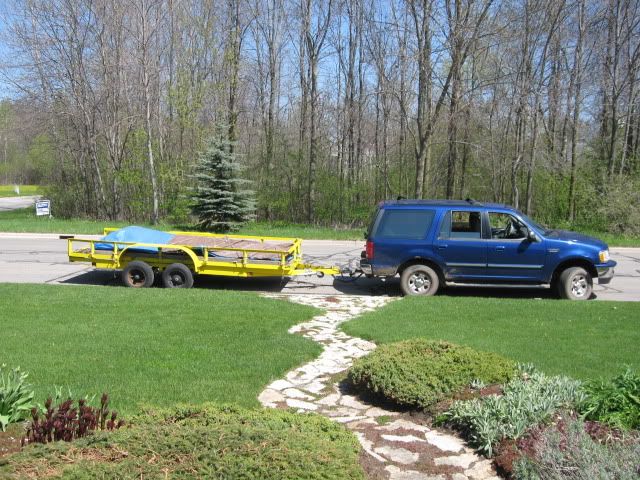
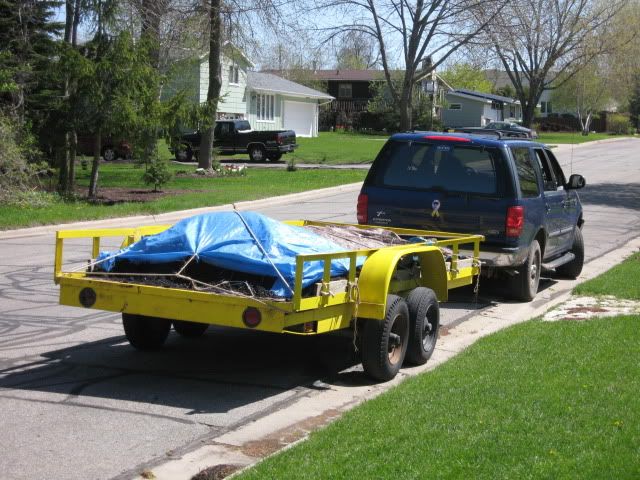
Here is my 16 foot double axle that I cobbled together back in 1982. She's hauled as much as a 14,000 lbs industrial batch oven from Black Detroit to Sylvania, Ohio. Then after refurbishing~back to Chicago. Don't laugh! Cost me nothing but a little wire welding wire and some gas. All the steel is 'farmer steal' laying around.

The axles were bent when my employee dropped a 60 hp Baldor motor on to the deck from about ten foot in Mt. Sterling, KY. All we did was rotate the axles 180 deg and weld them again. I never fixed her up after that. Works for me. We have a compost from the city on board for the picture.

FlowersandTrailer001.jpg


FlowersandTrailer006.jpg

skip.
 
Last edited:
I bought a new trailer last fall from the factory in Elkhart. On the way home it vibrated noticably forwhich I thought it was the road. Not so as I went on different roads. My alignment shop didn't want to deal with tracking the problem (because you can't drive a trailer on their equipment) and suggested I spin each one to check for out-of-round. All were true. Pulled them off and took them in for balancing. One was good, two were fair, and one took excessive weights. Appears the reason was Chinese manufactured. Never had problems with previous Goodyears. Now as mentioned even those are made in China so apparently there is nowhere to turn! BTW, even though I'm sure the TV report on old but unused tires sold as new is a bad thing, I sold a trailer today that had cracked, checked but great tread 27 year old tires. It was enclosed, used only for storage. I told the buyer I wouldn't leave my driveway with them. He was venturesome and headed out-of-state with no spare! Said he'd call when he got home which wasn't real far. Joked if he'd be calling today. Called and said he had no problems! Though US made I still wouldn't have done it. And the beat goes on............ Relative to the original question, I put 10-15% tongue weight.
 
Marco...I can't expalin it either...but what else could it be but ozone and dry rot maybe causing the intenal cord failure? From substandard rubber, maybe?

As I mentioned, the problems arose when tires were no longer manufactured in the U.S.A. Age has little (if anything) to do with the failures we see within reason. On the surface it would seem to be related to heat but that would require an extremely low temperature threshold. The only other thing that increased pressure would do (besides reduce heat) is stabilize the structure of the tire reducing the flex. Why would the higher spinning speed increase the breakdown of the cords at a given tire pressure? I can only speculate. To me it seems certain they begin breaking down long before the internal cording finally breaks loose enough for the tire to lose it's shape and fail.

I feel all the tires and hubs every time I stop which is every 200 miles on average plus occasional rest stops. They are never very warm. The tires are breaking down internally which to me indicates something is sub-standard in the materials or construction. It's possible that the standards were relaxed to further reduce cost. Again, this has occurred with brand new tires well within the first year of manufacture.

I'm betting I have a few years on you (I'm 53). Growing up here in California we never heard of tire blowouts accept with "recaps" or striking an object on the road. We just replaced tires when the tread wear reached an unsafe level regardless of appearance. With those "aged" tires on my first trailer I had almost perfect tread and simply monitored the tire temperatures as I traveled. they were made in the US however. My second set of tires were also US made and were five years old when I made the 2300 trip (each way) to Indy in 2005. I tried to keep my speed down to the legal limit of 75 mph in Nevada, Utah, Wyoming, etc., but the trucks made that tough!
I can tell you one thing, when I'm covering 1,000 miles a day by myself I'm not going 55 mph!
 
I have found 18 feet to be good for an open car trailer.I have built a lot of trailers,and nobody has ever complained that the trailer was too long,but I sure heard plenty of complaining about being too short.There is no such thing as,I'm just gonna haul the Model A,or the old Jeep,or VW.It WILL get used for other things,wood,steel,brush,you name it,once you have it you will dream up all kinds of uses for it.A little advantage not too many think of is that a longer trailer backs up easier.Much more predictable and easier to chase.That may or may not be a big deal to you,but if you are a weekend truck driver you should give yourself every advantage.A long trailer rides better too.A short one seems to be kicking you in the rear all the time.If the picture comes through it is one I built to keep for myself.18 feet,winch,with the wheels just a couple of inches rear of where they should be.I like a tad more tongue weight,and it gives you a better ride.I will NOT pull this trailer with a half ton truck,only because of the extra weight it places on the front.
 

Attachments

  • Picture 168.jpg
    Picture 168.jpg
    73.4 KB · Views: 14
MARCO wrote...
"...I'm betting I have a few years on you (I'm 53). Growing up here in California we never heard of tire blowouts accept with "recaps" or striking an object on the road..."
All right...what's the bet...? You name your poison...

I was born in Richmond, Virginia, at MeHarry Medical College Hospital at 7:40 PM, on July 24, 1949.

You do the math.... "sonny boy"... :D

PS...we had twin boys when I was 50...she was 48...after 26 years of marriage!
 
"...I feel all the tires and hubs every time I stop which is every 200 miles on average plus occasional rest stops. They are never very warm. .."

I read somewhere that a good method is to rest your hand on the axle hub to see how hot it is. If you can keep your hand on it for 20 seconds then the bearings are okay. Like you, we check hubs and tires at every stop...250-300 miles, or so.

I also like to stop about 10 minutes out to make sure everything is still attached, hooked up, and tied down.

We have a fellow racer who got to the hotel the day before an event at Mid-Ohio Sports Car Track about five years ago. There was the usual parking lot party going on when he arrived...we had the Margarita machine cranked up and we were well into partying. Mike joined us and never looked at his Cobra in the trailer. When he got to the track the next morning, two of his street tires had rolled off his tire rack inside the tralier. One was laying on the nose of his car...while another was leaning against the left front fender and had rolled back and forth long enough to wear the paint down to the fiberglass. He made the statement..."I sure wish I had looked in the trailer before I got on the road yesterday!"

After that incident, we started stopping just before we got on the hiway on our way out of town. Not only do we inspect all the trailer connections...anti-sway system, weight distribution hitch arms, safety chains, breakaway cable, trailer electric plug, safety pins, and all locks and connections...but we also unlock the trailer and step inside to make sure nothing has shifted around. We've not found too many problems....we've been towing race cars for about 15 years and we've pretty well got a procedure we follow each time we hookup, load, and unload.

Bottom line is this...no matter how careful you may be, "excrement occurs".

BTW...if someone finds a solution to the Chinese made trailer tires, I'd sure like to know about it. My trailer cannot take any tire size but 205/75R15...according to the manufacturer's tech at their factory. The wheel well is just too close to the inside of the tire to take a larger tire size. I'll go start looking for light truck tires in that size, but I don't think I'm going to find any.

Take it light...tow safely...and I'll see you on down the road.
 
500 lbs tongue weight is too much! If you need to run that much tongue weight you need a proper weight distributing hitch.

500lbs tongue weight is the MAX RATING for most hitches on your everyday truck. You NEVER want to run right at the max rating all the time.

Not to mention in an accident if you are found to have been exceeding that rating it opens you up to some liability.
 
Back
Top