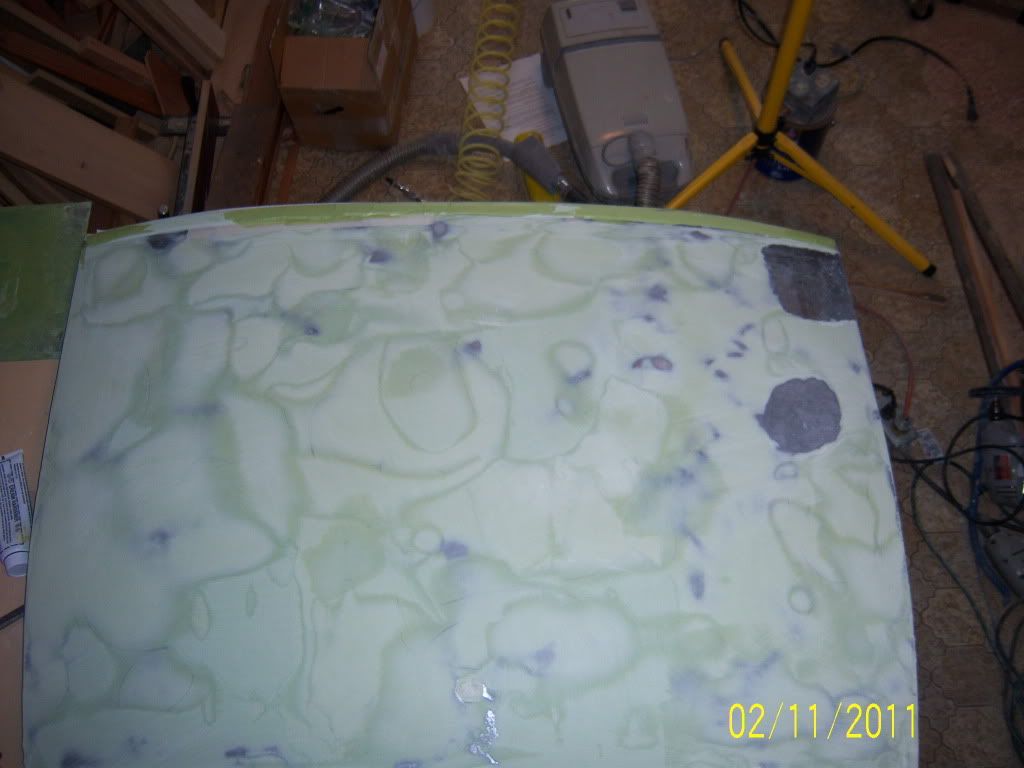
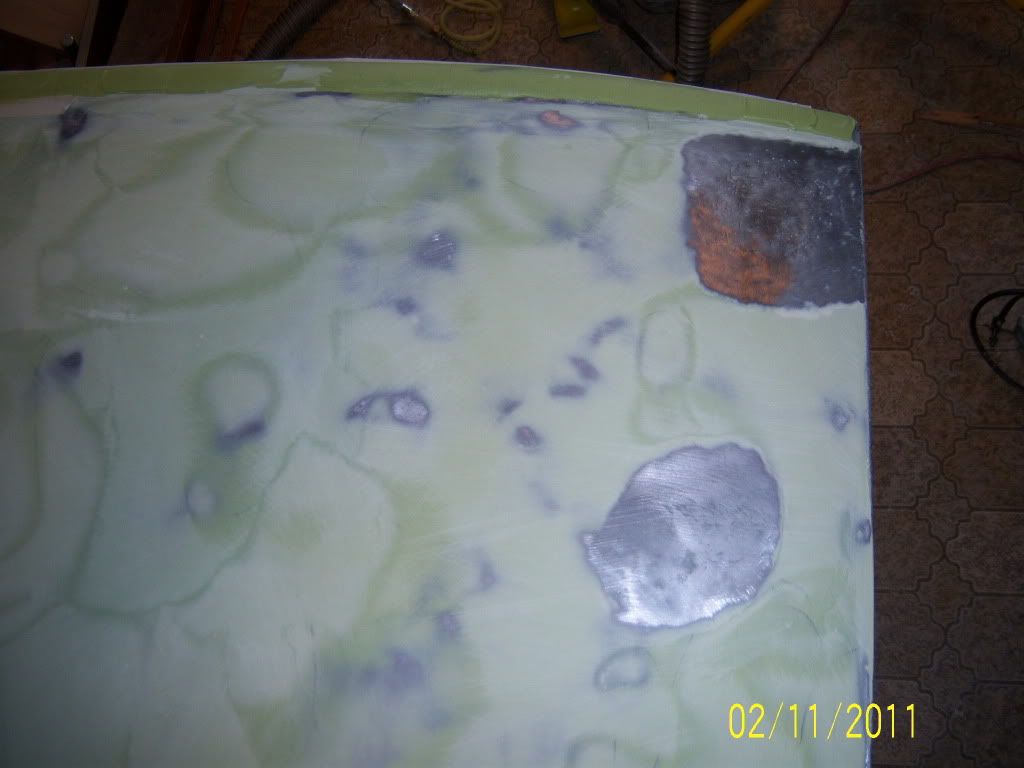
WOW, Rusty. I am really hestitant to to even say anything for fear of hurting your feelings, but since I have met you a few times in person and spoken with you on the phone, I am going to say this with some reservations. What you are trying to accomplish in this task is not that easy. If it were, then everyone would be doing it!!
What I am seeing based on the panel is you have not mastered the basics of 'defining shape' yet. Until you do, I'm not sure you will ever be successful at this. Each one of those rings appears to be where you have added more filler over the top of previous filler. The darker areas appear to be low spots that are getting moved around as more "mountains" are created. Just as in screeding & leveling freshly poured concrete, the forms or the edges are your starting point. Your edges are all filled with filler so how do you have a starting point? Also, using a torch or a shrinking disc at this stage of your panel is a little too late. The straightening of the sheetmetal should happen prior to the bodywork process. Only if by chance a small area shows up can you work it down with a hammer & dolly.
I am really going to suggest that if you want to be successful in this, you need to consider getting some professional instruction (
NOT YouTube or Videos!!) from someplace like
McPherson College (CLICK ON NAME) where you can spend a week learning the foundational basics, and then what to look for regarding shapes & form when you are working a panel.
I am going to share something about a fellow Fordbarner here who will remain nameless by me at the moment unless he decides to chime in. This gentleman I am speaking of is one of the most talented individuals that I know who is perfectionist oriented and has great mind-to-hand coordination. Even with all of his attributes, he attends 3 or 4 schools or workshops annually just to make his skills even better. Some of these 2-5 day long classes require well into the thousands of dollars for him to attend however he realizes that restoring Model A's to the level he desires takes strong commitment to learning and then dedication & practice to master a skill.
This world has gotten into a mindset that everything we need to know in life can be learned watching a DVD or a video on
YouTube. Even to the point my daughter was trying to take some on-line college courses to suppliment her regular curriculum at college. My wife & I finally said
NO, all of her college classes would be taken on campus in front of a "live" college professor where she can have interaction with that professor. A 'Craft' or skill used to be taught under an Apprenticeship program where the understudy worked along-side of the experienced craftsman in a live environment where the Journeyman could interact and correct the little mistakes the understudy was making. Someone decided that actual work experience was not totally necessary and thus they developed a mindset where it would be spoken by a professor using a textbook as a way of showing what needed to be done and having classroom interaction on theoretical scenarios. Now it seems everyone just wants to see it done in a 30 minute DVD/Video, ....and "fast-forward" thru the parts of the DVD that seem boring, --i.e.: learning the basics first!
Rusty, please understand I am not being cruel or trying to belittle you whatsoever
(--AND I feel like there are plenty others in the same boat as you) but I truly feel it would be in your best interest to
stop your current restoration projects and spend some time & money working on your skills through professional education so your end result will be much better. This time & $$ will be returned to you in huge dividends from savings of money on materials, saving your time on the project tasks from doing it incorrectly, ...and the end results of the restoration project will be much superior IMHO!
.