You are using an out of date browser. It may not display this or other websites correctly.
You should upgrade or use an alternative browser.
You should upgrade or use an alternative browser.
Starter Bushing Lubrication
- Thread starter Stinch
- Start date


Craig Lewis
Well-known member
I would clean the bushing and soak it with 30 wt motor oil.
Bushings are made of a sintered porous material which holds oil and allows it to pass through...so never use grease.
** Below is an explanation I typed a while back for a fella who was wondering why the felt lubrication wick was resting against the outside of a generator rear bushing with no apparent oil entry hole....
Bushings are made from a material called "oilite", as opposed to just being machined from a chunk of brass or bronze alloy.
Oilite is a porous bronze or iron alloy commonly impregnated with oil.
A recommended step before pressing a new bushing into place is to "load" it.
"Loading" was explained in old manuals, but as we have transgressed into a greaseless, lubless society of "run it till it breaks", much of the valuable old tips and lessons have been forgotten.
To "load" a bushing...
#1) balance the bushing on your forefinger (sitting on your fingerprint) and fill it to the very top with a good grade of oil.
#2) bring you thumb down to close off the end
..you now have both ends closed between 2 fingers...
#3) SQUEEZE the bushing tightly...and you will see the oil seep out through the walls of the bushing as the oil is compressed.
Your bushing is now "loaded" and ready to install.
NOW to answer your question finally...the wick holds a ready supply of oil against the bushing, which flows THROUGH the oilite and forms a protective film of lubricant between the shaft and bushing.
As you can see there's no need to drill an access hole as this just robs surface area and provides an entry point for contamination or dirt.... dirt which I suppose is normally filtered by the bearing material itself.

Tom Wesenberg
Well-known member
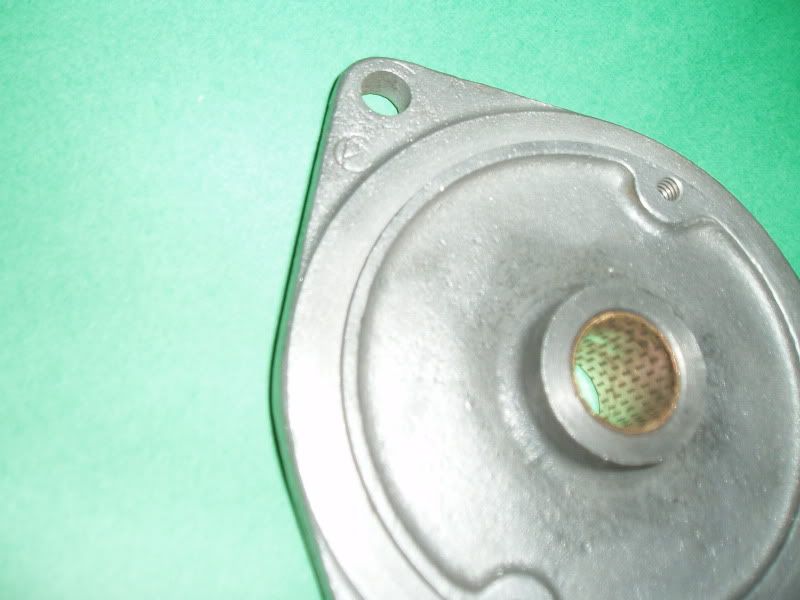
As Craig said, oil for the oilite bushings. On the solid copper or copper alloy bushings like my starter uses, I use Mystik JT-6 High Temp grease. These bushing are not porous, but have many dimples in them to hold grease.
My bushings are still good enough to use, but I thought I'd install new ones while I had it apart for a restoration. I can't find new bushings to fit, and I doubt I'll wear these out in my lifetime, so I'll leave them in.
Craig Lewis
Well-known member
Thanks Tom for explaining the difference between Oillite and the dimpled bushings.
I was checking my bushing assortment last week for your starter bushings (nil) and I noticed all my "dimpled" bushings are split, AND they come with a hard (graphite?) material imbedded in each dimple.
....I wonder if this material melts with high heat, or just wears away?
I was checking my bushing assortment last week for your starter bushings (nil) and I noticed all my "dimpled" bushings are split, AND they come with a hard (graphite?) material imbedded in each dimple.
....I wonder if this material melts with high heat, or just wears away?