
You are using an out of date browser. It may not display this or other websites correctly.
You should upgrade or use an alternative browser.
You should upgrade or use an alternative browser.
Rear axle nut
- Thread starter rer_239
- Start date


Joe K
Well-known member
The rear axle thread/nut I believe to be one of those "unusual" threads. Today the fit/tolerance would be a matter of "thread class" - although I don't think Ford had brought it to that level of standardization.
This akin to the threads/bolts in the "punkin" which are just a "skosh" (technical term) larger than the USS - and for which a lot of people have to use "sealant"
My experience with "recutting" axle/hub thread is that a "fair" amount of material is removed by the die in the recutting. Enough to make me concerned for "thread fit" and wonder if I'm not making the thread more subject to tension failure?
Thread files MAY help reduce this. So maybe might using a tap & die in the "Little Giant" pattern - which can be adjusted for oversize nicely.
BUT - to solve my problem henceforth I bought a "thread restorer" which is made to the purpose, and "restores" the threads by compression. Shown below. This one is on Ebay, so the pix won't last, but the tool is available "Buy it Now" at a good buy.
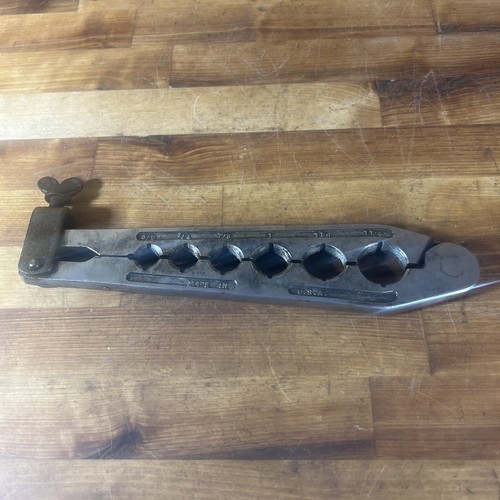
Some have opined that the axle/hub threads were originally "rolled." This is a distinct possibility.
IMHO, this is the proper tool for a rear axle thread restoration.
Joe K
This akin to the threads/bolts in the "punkin" which are just a "skosh" (technical term) larger than the USS - and for which a lot of people have to use "sealant"
My experience with "recutting" axle/hub thread is that a "fair" amount of material is removed by the die in the recutting. Enough to make me concerned for "thread fit" and wonder if I'm not making the thread more subject to tension failure?
Thread files MAY help reduce this. So maybe might using a tap & die in the "Little Giant" pattern - which can be adjusted for oversize nicely.
BUT - to solve my problem henceforth I bought a "thread restorer" which is made to the purpose, and "restores" the threads by compression. Shown below. This one is on Ebay, so the pix won't last, but the tool is available "Buy it Now" at a good buy.
Some have opined that the axle/hub threads were originally "rolled." This is a distinct possibility.
IMHO, this is the proper tool for a rear axle thread restoration.
Joe K
Last edited:

Synchro909
Well-known member
The rear axle thread/nut I believe to be one of those "unusual" threads.
Joe K
Those threads are 5/8" UNF, a standard thread. The ones in the differential "pumpkin" are 3/8" UNF. There are UNC (coarse threads) and UNF (fine threads). Both are part of the American standard thread system.
The British system was very similar (BSW and BSF) and the metric system also has a coarse and fine thread standard.
Joe K
Well-known member
Those threads are 5/8" UNF, a standard thread. The ones in the differential "pumpkin" are 3/8" UNF. There are UNC (coarse threads) and UNF (fine threads). Both are part of the American standard thread system.
The British system was very similar (BSW and BSF) and the metric system also has a coarse and fine thread standard.
In my post I referenced "class fit."
What you say is doubtless true, but add in the additional variable of "tolerance."
Fastenal in their most excellent site on thread design addresses this. https://www.fastenal.com/content/feds/pdf/Article%20-%20Screw%20Threads%20Design.pdf
I'll take a couple of paragraphs which show the effect. This does not cut/paste well.
Now I don't imagine Ford HAD the standard in 1928, so I imagine he developed his own.Rev. 3-4-09
An intentional clearance is created between mating threads when the nut and bolt are manufactured.
This clearance is known as theallowance. Having an allowance ensures that when the threads are
manufactured there will be a positive space between them. For fasteners, the allowance is generally
applied to the external thread.Tolerancesare specified amounts by which dimensions are
permitted to vary for convenience of manufacturing. The tolerance is the difference between the
maximum and minimum permitted limits.
Thread Fit
Thread fitis a combination of allowances and tolerances and a measure of tightness or looseness
between them. Aclearance fitis one that provides a free running assembly and an interference fit
is one that has a positive interference thus requiring tools for the initial run-down of the nut.
For Unified inch screw threads there are six standard classes of fit: 1B, 2B, and 3B for internal
threads; and 1A, 2A, and 3A for external threads. All are considered clearance fits. That is, they
assemble without interference. The higher the class number, the tighter the fit. The ‘A’ designates
an external thread, and ‘B’ designates an internal thread.
•Classes 1A and 1Bare considered an extremely loose tolerance thread fit. This class is
suited for quick and easy assembly and disassembly. Outside of low-carbon threaded rod or
machine screws, this thread fit is rarely specified.
•Classes 2A and 2Boffer optimum thread fit that balances fastener performance,
manufacturing, economy, and convenience. Nearly 90% of all commercial and industrial
fasteners use this class of thread fit.
•Classes 3A and 3Bare suited for close tolerance fasteners. These fasteners are intended for
service where safety is a critical design consideration. This class of fit has restrictive
tolerances and no allowance. Socket products generally have a 3A thread fit.
And while UNF/UNC were used for the vast majority of Ford fasteners, it is not impossible for Ford to have "deviated." After all, Ford probably produced (or at least tightly controlled) fasteners for critical use.
As I say, recutting an axle thread with a non-adjustable die results in "substantial" chip production. This being a "typical" TRW or better quality die. I imagine made to produce the class 2 fit.
I won't be doing that again.
Any more than I will use commercial, even stainless steel cap screws on the punkin. Permatex is best applied knowing the seal is probably already "tight."
Joe K
Last edited:
Synchro909
Well-known member
Joe, I was responding to your comment that they were "unusual" threads
"The rear axle thread/nut I believe to be one of those "unusual" threads. "
I make no comment class of thread but find your comments about cutting the 9/16 thread quite reasonable. Mine were done on a lathe (not with a die) by a very experienced operator. The fit with the nut is quite good.
PS I am not trying to be confrontational or augmentative here.
"The rear axle thread/nut I believe to be one of those "unusual" threads. "
I make no comment class of thread but find your comments about cutting the 9/16 thread quite reasonable. Mine were done on a lathe (not with a die) by a very experienced operator. The fit with the nut is quite good.
PS I am not trying to be confrontational or augmentative here.


Pete
BANNED
Threads come in different "classes" or tolerances.
For talking here we will talk about common threads used in automotive applications, NOT close tolerance types.
Standard die nuts are made to cut standard size threads.
These are the die nuts found in hardware and tool supply stores. They are guaranteed to cut standard size threads, NOT undersize and NOT oversize.
A thread chaser will NOT cut a standard thread, it will be oversize for a die and undersize for a tap.
These will normally clean some rust and dirt out of threads, BUT, they will NOT restore a thread to new clean metal dimensions. Another thing to remember is a dirty thread CAN NOT be torqued to an accurate value.
If the thread has been damaged, it will cut SOME of the high spots off but IT WILL NOT RESTORE THE LOW SPOTS to original. A die nut is required to restore the high spots to proper dimensions. Nothing can be done for the low spots.
This may or may not leave the thread capable of reaching the designed torque for the application.
Usually if metal has been lost from a thread for any reason, it will not carry the load it was designed for.
This is especially true in the case of old Ford axle threads.
What came from the factory worked fine. There are MANY improvements that have been developed over the years by the racing industry to use both for street and racing.
I will venture to say ALL of the pertinent info has been posted on this and the HAMB forums several times along with all of the old wive's tales and bad info.
For talking here we will talk about common threads used in automotive applications, NOT close tolerance types.
Standard die nuts are made to cut standard size threads.
These are the die nuts found in hardware and tool supply stores. They are guaranteed to cut standard size threads, NOT undersize and NOT oversize.
A thread chaser will NOT cut a standard thread, it will be oversize for a die and undersize for a tap.
These will normally clean some rust and dirt out of threads, BUT, they will NOT restore a thread to new clean metal dimensions. Another thing to remember is a dirty thread CAN NOT be torqued to an accurate value.
If the thread has been damaged, it will cut SOME of the high spots off but IT WILL NOT RESTORE THE LOW SPOTS to original. A die nut is required to restore the high spots to proper dimensions. Nothing can be done for the low spots.
This may or may not leave the thread capable of reaching the designed torque for the application.
Usually if metal has been lost from a thread for any reason, it will not carry the load it was designed for.
This is especially true in the case of old Ford axle threads.
What came from the factory worked fine. There are MANY improvements that have been developed over the years by the racing industry to use both for street and racing.
I will venture to say ALL of the pertinent info has been posted on this and the HAMB forums several times along with all of the old wive's tales and bad info.

Joe K
Well-known member
I did not take it as such. But your answer (and mine) did not outline the "quality" differences in thread science.PS I am not trying to be confrontational or augmentative here.
And Ford MAY HAVE pushed the quality boundary, as they did many times even in other areas such as Johannson Blocks and dimensionalities.
https://en.wikipedia.org/wiki/Gauge_block
Seemingly Ford was not the first US user of "jo-blocks" but probably ahead of the rest of the automotive industry.Between 1923 and 1927, the Johansson division supplied 'Jo-blocks' to the Ford toolroom and any manufacturer who could afford them. It also made some of the Ford 'go' and 'no-go' gauges used in production as well as other precision production devices."[9]
Joe K
I only go about 90-100ft.lbs. 120 seems too much for 90 year old threads.
Yes and even 85-95 may be enough depending on hub and axle key condition, torque wrench used for small '# increments approaching the end setting. Supposedly factory didn't use a torque wrench until later years , and some mechanics advise to go back and recheck after driving for some mileage like for wheel studs..
Synchro909
Well-known member
Yes and even 85-95 may be enough depending on hub and axle key condition, torque wrench used for small '# increments approaching the end setting. Supposedly factory didn't use a torque wrench until later years , and some mechanics advise to go back and recheck after driving for some mileage like for wheel studs..
These old cars need constant checking and maintenance. In addition to checking the tension on the axle nuts and wheel nuts, there is also the head nuts and the stress levels of the nut behind the steering wheel.
As for the axle nuts, I fitted the rear hubs on one of my cars recently and checked them after only about 8-10 miles. I got enough out of them that I am pleased that I did. We have a longer drive coming up soon so I will make sure I drive it some more and check them again before we go. After checking yet again on our return, I think I will be able to call them good. We'll see.
johnneilson
Well-known member
Interesting subject, fasteners.
I was looking thru the 1919 Machinery Handbook
Not sure when the S.A.E specs came into existence except to mention it replaced the A.L.A.M specs of April 1906 (association of licensed automobile manufacturers)
So, Class fits did not exist in the SAE specifications.
Specs given as the body of the fastener to be .001 less than the nominal diameter, nor smaller than .002 smaller than nominal dia. That is not the case today at all.
The nut to be .002 - .003 larger than nominal dia (major dia of thread)
materials for screws and plain nuts steel min 100,000 psi tensile with elastic limit of 60,000 psi
castle nuts to be case hardened.
John
I was looking thru the 1919 Machinery Handbook
Not sure when the S.A.E specs came into existence except to mention it replaced the A.L.A.M specs of April 1906 (association of licensed automobile manufacturers)
So, Class fits did not exist in the SAE specifications.
Specs given as the body of the fastener to be .001 less than the nominal diameter, nor smaller than .002 smaller than nominal dia. That is not the case today at all.
The nut to be .002 - .003 larger than nominal dia (major dia of thread)
materials for screws and plain nuts steel min 100,000 psi tensile with elastic limit of 60,000 psi
castle nuts to be case hardened.
John

Y-Blockhead
Well-known member
Bruce, the linked page shows "out of stock". Looks good though.
If you are interested in the Lang Thread Chaser set you can get it from Amazon.com https://www.amazon.com/s?k=Lang+Too...aps,141&ref=nb_sb_noss_1&tag=atomicindus08-20