Jim Brierley
Well-known member
I recommend driving around the block without installing the cotter pins after initial tightening, then re-torquing and installing pins. I do this 2 or 3 times.


The taper faces IN and DOWN.Oh my gosh. So much about axle torque and nothing till no 37 finally answered the other mans question. I was looking for which way the taper goes up or down.

Self-Holding Tapers
Fig 2. Self-Holding Tapers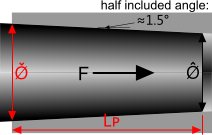
A special case for the beneficial use of friction is 'self-holding' Tapers (Fig 2) for easy machine/equipment component assembly and disassembly such as drill chucks and lathe tail-stock accessories.
A self-holding 'Taper' is an accurately machined tapering shaft and mating sleeve (both of which are dry and clean) that lock together using the coefficient of friction between the two surfaces (shaft and sleeve) and an assembly force (F). If the Taper is machined correctly, the same force (F) will be needed to separate the shaft and sleeve.
If the angle of the Taper is 'exactly right', the shaft or sleeve will be capable of driving the other with no additional assistance for light duty applications and yet part easily with no resultant damage to either of the mating surfaces.
It is important to remember that a plain self-holding taper is only capable of transmitting a force achievable from 'frictional' grip and is thereby limited in its driving capacity. For heavy duty applications the taper is usually provided with a key, the frictional grip providing the holding capacity only.