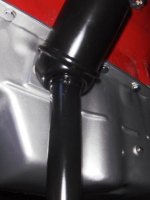
PCV kits

Bob/Ohio,
I have seen several other guys route the PCV the same way you have, but there is one problem, and that is most of the air the PVC valve will pull is only through the top of the engine's valve chest area. The 8BA vent system works by air entering the front breather, flowing through the valve chest, then DOWN into the crankcase at the rear, and UP into the front stand pipe, which connects to the road draft tube through an isolated chamber in the intake. In this way, the entire engine has fresh air flowing through it and venting.

The best way to install a PVC on an 8BA is to position the valve in place of the road draft tube, and run the vacuum hose to the intake, as the "kits" on the market are set up to do. This eliminates the road draft tube, and the stock fuel pump can then be used, or simply blocked off. My '51 is set up this way, and you have to really look for the valve and hose to see them.

Another method is to cut the front vent tube shorter under the intake, fix a plug with a grommet and PVC, and run the vacuum hose to connections under the intake. This is a good way when using an early intake on an 8BA. This makes the entire system invisible, and is what my '32 has. To add to both methods, the distributor and oil dip stick should be sealed as well. You want ALL the air being pulled by the PVC to enter through the inlet filter.

I am not trying to be critical, or offend anyone, only to explain some facts about the late flathead engine vent design. You have a very nice looking engine, and having the PCV work most efficient will help keep it and the oil in good condition longer. IMO
 
Last edited:
Good point, I had not thought about the original way the air circulated. If you are think about the early small block Chevys, the PVC pulled air through the breather tube into the lifter valley from the rear of the valley. This is the same place the road draft tube was before the PVC system. I would say that both ways you describe would be more efficient, but as long as you move the air through the motor you will still vent the crankcase better than the road draft tube to remove the moisture and particulates in the oil.
 
I removed down draft tube and oil fill tube,made aluminum mushroom shaped plug for oil fill with o ring.useing one of Gunn12-Ross Gunning pcv in the down draft hole a verry nice part.( hi Ross) removed org. fuel pump and now oil fill. I like Bob|Ohio idea.I hooked my hose to manafold but now think the gasses should be going down the carb. and out the tail pipe. what do the barners think?
 
I have an 8ba with an Offy and three 97's and am thinking of plugging the down draft tube location and installing a PCV there. I wonder about where to tap the intake manifold. It seems that wherever I locate the tap will cause a leaner situation near that carb. Will that effect how the motor runs?
 
Bob/Ohio,
I have seen several other guys route the PCV the same way you have, but there is one problem, and that is most of the air the PVC valve will pull is only through the top of the engine's valve chest area. The 8BA vent system works by air entering the front breather, flowing through the valve chest, then DOWN into the crankcase at the rear, and UP into the front stand pipe, which connects to the road draft tube through an isolated chamber in the intake. In this way, the entire engine has fresh air flowing through it and venting.

The best way to install a PVC on an 8BA is to position the valve in place of the road draft tube, and run the vacuum hose to the intake, as the "kits" on the market are set up to do. This eliminates the road draft tube, and the stock fuel pump can then be used, or simply blocked off. My '51 is set up this way, and you have to really look for the valve and hose to see them.

Another method is to cut the front vent tube shorter under the intake, fix a plug with a grommet and PVC, and run the vacuum hose to connections under the intake. This is a good way when using an early intake on an 8BA. This makes the entire system invisible, and is what my '32 has. To add to both methods, the distributor and oil dip stick should be sealed as well. You want ALL the air being pulled by the PVC to enter through the inlet filter.

I am not trying to be critical, or offend anyone, only to explain some facts about the late flathead engine vent design. You have a very nice looking engine, and having the PCV work most efficient will help keep it and the oil in good condition longer. IMO

The PCV in our '51 F-1 8RT is set up the way you describe your 8BA PCV and I'm happy with it. I think I'll just go with that same set up in our '53 8RT even though I like the way the oil filler tube set up looked.
 
Roger, I put a 3x2 on my 8BA with one of the Southwind heater plates under the center carb. I am using the kit from the Canadian fella plugging the down draft tube and connected to the heater plate. The heater plate is 1/4" thick, so you may have to put some spacers under the front and rear carbs to level them out but I don't think it would affect performance if you didn't. It would be more for aesthetics. You can usually find the Southwind plates on that internet auction site.
 
Last edited:
Contrary to the general consensus here, the purpose of the PCV (positive crankcase ventilation) system is not to circulate air through your crankcase but to seal and lower internal crankcase pressures.
As an engine operates, high-pressure gases are contained within the combustion chamber and prevented from passing into the crankcase (containing the crankshaft and other parts) between the side of the piston and the cylinder bore by piston rings which seal against the cylinder. However, some amount of gas always leaks past the piston rings into the crankcase. This amount is very small in a new or properly rebuilt engine, provided that the piston rings and cylinder walls are correctly "broken in", and increases as the engine wears. Scratches on the cylinder walls or piston rings, such as those caused by foreign objects entering the engine, can cause large amounts of leakage. This leaked gas is known as blow-by because the pressure within the cylinders blows it by the piston rings. If this blow-by gas could not escape then pressure would build up within the crankcase.
Prior to about 1960 these gases were just vented to the atmosphere by the use of an open vent to the atmosphere. This vent allowed air to move in both directions so it could be a source for dirt to enter the engine. Many different designs were created to prevent the introduction of dirt but all still provided open access to the atmosphere for the crankcase to vent pressure.
After about 1960 the advent of the Positive Crankcase Ventilation system was devised for the purpose of lowering emissions by reducing the pressures inside of the crankcase to a pressure less than atmospheric pressure by drawing a calibrated volume with the manifold depression (vacuum) created by the induction system of the engine.
This then created a sealed system that returned the blow by back into the combustion chambers for re-burning and out the exhaust. This also had the added benefit of preventing a source of dirt introduction into the crankcase through the crankcase vent and the negative pressures created in the crankcase by this system also helped keep the seals from leaking oil to the outside of the engine.
I am sorry for the long post but hopefully this will help the understanding of the function of the PCV system concept.
 
Hello Ross Gunning here(gunn12). I have just become a member to the Ford barn. I sell PCV valve kits for the 49-53 Ford/Mercury flatheads. I have just put a listing on E-bay for them ( E-bay item #3304338103800)
Please feel free to take a look. I do sell direct should you miss the auction. Just a pat on the back here...To date I have sold over two hundred fifty of these with no complaints.
Thank you for your interest, Ross

Hi Ross, I have bought a couple to use on my f1 trucks and am happy with them. The only thing I would change is if the hose was not glued to the plastic tee at the carb end. It would lay on the intake better if the hose from the pcv connected to the end of the tee instead of the middle port.
 
Hello All. The E-bay item # for my 49-53 Ford Mercury PCV valve kits is 330433810380 Sorry for the oversight. Ross
 
Ross in east Texas, thanks Ross that comfirms what I was thinking,I have a vacuum plate that goes between carb. and intake .why are these called south wind heater plates? I thought some dist. needed carb. vacuum instead of manifold vacuum .Harold
 
The Southwind heater required a vacuum source for the heater to pull fuel from the carb as well as air into the firebox for combustion. All exhaust gases from combustion are drawn into this plate under the carb.
 
I may have a way of not boring into the intake manifold. I have some 1/4" thick walnut spacers (identical shape of the carb base) that I planned to use under the three carbs. Thought it would be cute and help to keep the carbs cooler. I could bore a hole into the side of the spacer under the middle carb and run the hose connection there.
 
Roger,
A 1/4" spacer does not allow for a very big hole. 1/4" pipe should be the smallest threaded hole, to allow a 1/4" pipe/3/8" hose fitting to connect the normally used 3/8" ID hose to the PCV valve.

There should be an area just below the center carb that is flat enough to drill and tap for a 1/4" pipe thread. Start out with a 1/4" drill bit and continue into the first runner and through the plenum divider. This will not effect the 2-plane operation of the intake, but will ensure all 8 cylinders will act on the PCV valve.

Although the PCV is a controlled vacuum leak, using a valve for a similar sized engine will not effect the mixture enough to make any jet changes. A good check is to make sure the manifold vacuum stays the same after the PCV is in operation. If it drops, the valve is wrong for your engine. I'm using a valve for a 281" (4.6L) Mustang Cobra on my stock 239" '51 flathead, one of many that will work just fine.
 
Last edited:
here is how i did mine,
 

Attachments

  • 1 186.jpg
    1 186.jpg
    58.9 KB · Views: 171
  • 1 187.jpg
    1 187.jpg
    58.3 KB · Views: 160
  • 1 188.jpg
    1 188.jpg
    68.6 KB · Views: 181
What about pre-8BA's? Is doing something like what elwood did for the vacuum plumbing underneath then running a hose down to the pan breather the way to go? Inquiring minds want to know?
 
Bob, Could I hire you to make one for my 8BA in my 1940 Ford Convertible? You can email me back or call me at 218-224-2269 (MN). Thank You, Stan
 
I am about to install a down draft tube on my oil pan as I have done on my 41 Lincoln Zephyr years ago. I have the same style as installed from the factory for the 1955 to 57 T Bird. Here you can see a picture of it. The only thing I have to do is drill a small hole on the side of the oil pan and well the small plate to accept the down draft tube very simple. Or I have seen on the earlier 1938 and 1939 Zephyr where they have a piece of tubing from the oil filler neck running down to below the oil pan so when you are driving the fumes or pressure is released under the car.

Frenchy
 

Attachments

  • Down draft tube for V12 engines 001.jpg
    Down draft tube for V12 engines 001.jpg
    57.8 KB · Views: 46
  • Down draft tube for V12 engines 002.jpg
    Down draft tube for V12 engines 002.jpg
    64.3 KB · Views: 38
I have installed a Merc. (4 bolt) intake on my 276" 8BA. I then installed a Rochester 2GC carb to feed the extra inches. As an unexpected side benefit, the 2GC has a PCV valve opening in its base which is threaded 1/4" NPT. I had to turn the carb. 180* to get the throttle to operate in concert with the stock linkage. In so doing, the tapped hole in the base of the carb. points forward and is about 8" from the hole for the road draft tube. I used one of Mr. Gunnings PCV kits and installed a 1/4" NPT X 3/8" hose barb fitting in the base of the carb, cut the hose to length and now have a compact PCV set-up. It took longer to write this than it did to hook everything up. Hope this is of use to someone.
 
Here is the road draft tube after the installation.

Frenchy
 

Attachments

  • Road Draft Tube on V12 Lincoln oil pan 002.jpg
    Road Draft Tube on V12 Lincoln oil pan 002.jpg
    29.5 KB · Views: 58
  • Road Draft Tube on V12 Lincoln oil pan 001.jpg
    Road Draft Tube on V12 Lincoln oil pan 001.jpg
    90.7 KB · Views: 51
  • Road Draft Tube on V12 Lincoln oil pan 003.jpg
    Road Draft Tube on V12 Lincoln oil pan 003.jpg
    22.6 KB · Views: 46
  • Road Draft Tube on V12 Lincoln oil pan 004.jpg
    Road Draft Tube on V12 Lincoln oil pan 004.jpg
    25.1 KB · Views: 42
Another method is to cut the front vent tube shorter under the intake, fix a plug with a grommet and PVC, and run the vacuum hose to connections under the intake. This is a good way when using an early intake on an 8BA. This makes the entire system invisible, and is what my '32 has. To add to both methods, the distributor and oil dip stick should be sealed as well. You want ALL the air being pulled by the PVC to enter through the inlet filter.

If you do it this way it will suck oil and smoke like you wouldnt belive..............ask me how I know
73442936.jpg
 
Last edited:
Back
Top