

m610
Member
I'm not trying to be argumentative, but I ask genuine question on the matter and a "here's what I do" answer won't do. I've googled this question and that's pretty much all I am hearing. Some people use a copper-based anti-seize, others say you should not use anything. In the latter case, if a reason is given, it is that the friction between the two parts is necessary. In all of these cases they were talking about situations that did not involve a keyway, or at least none was mentioned.
My Opel engines have a keyway on the nose of the crank. It turns a gear which operates the oil pump, fuel pump, and distributor. It also sets the timing, to an extent, for everything it turns. This is not on a tapered shaft so the keyway is necessary, and I've never heard anyone express a concern about the load on the keyway fracturing the crank. Granted, the loads are lower, but still. The issue has never even been broached.
In our case we have a keyway that is nearly 4" long, possibly longer. (I have not measured it.) If loading it could lead to axle failure, why is it even there? I don't think there is any issue concerning timing. And given it's length, I'd say it was meant to carry a load and that is is capable of carrying a considerable load.
My reason for wanting to use anti-seize is to prevent the axle and drum from essentially welding themselves together. If you take two clean pieces of metal and rub them together hard enough, the oxide keeping them from bonding when simply touching each other, is rubbed away and you have actual bare metal in contact with actual bare metal, and when that happens they will bond, aka, weld. I think this is why it is so difficult to get these parts apart, not because they are wedged tightly together, or that they have rusted, but because they have welded themselves together, partially. In industry they do this for certain metals.
As things are now, I am going to clean everything up and apply a thin layer of anti-seize, unless someone can give me a good reason not to. And I welcome hearing a good reason not to.
In other news, I cleaned up the drums today and they are in great shape. There are hardly any signs of wear in them. Tomorrow I'll paint them and set them aside while I clean up the backing plates.
Today's photo:
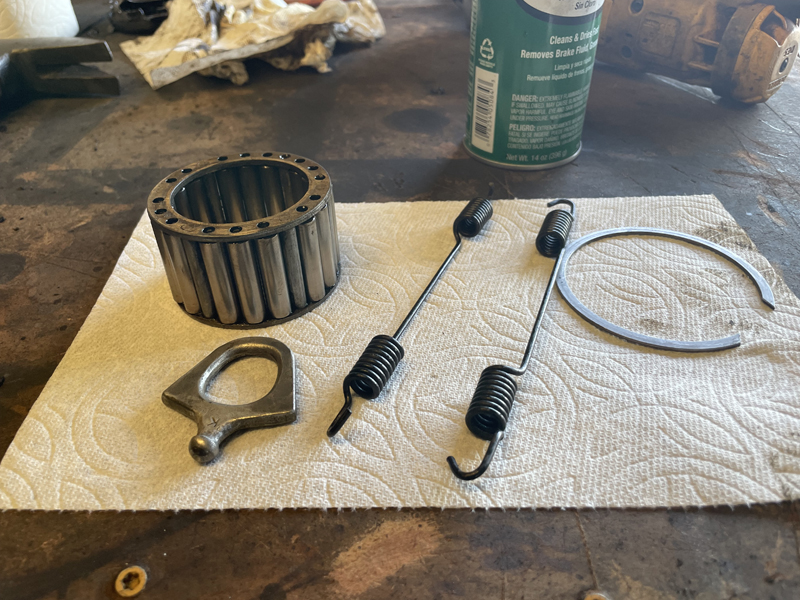
The bearing and race look great. All I am going to need to finish this is the seal, shoes, and some axle grease.
Mike
My Opel engines have a keyway on the nose of the crank. It turns a gear which operates the oil pump, fuel pump, and distributor. It also sets the timing, to an extent, for everything it turns. This is not on a tapered shaft so the keyway is necessary, and I've never heard anyone express a concern about the load on the keyway fracturing the crank. Granted, the loads are lower, but still. The issue has never even been broached.
In our case we have a keyway that is nearly 4" long, possibly longer. (I have not measured it.) If loading it could lead to axle failure, why is it even there? I don't think there is any issue concerning timing. And given it's length, I'd say it was meant to carry a load and that is is capable of carrying a considerable load.
My reason for wanting to use anti-seize is to prevent the axle and drum from essentially welding themselves together. If you take two clean pieces of metal and rub them together hard enough, the oxide keeping them from bonding when simply touching each other, is rubbed away and you have actual bare metal in contact with actual bare metal, and when that happens they will bond, aka, weld. I think this is why it is so difficult to get these parts apart, not because they are wedged tightly together, or that they have rusted, but because they have welded themselves together, partially. In industry they do this for certain metals.
As things are now, I am going to clean everything up and apply a thin layer of anti-seize, unless someone can give me a good reason not to. And I welcome hearing a good reason not to.
In other news, I cleaned up the drums today and they are in great shape. There are hardly any signs of wear in them. Tomorrow I'll paint them and set them aside while I clean up the backing plates.
Today's photo:
The bearing and race look great. All I am going to need to finish this is the seal, shoes, and some axle grease.
Mike


