New car and help diagnosing a backfire

dan

Senior Member
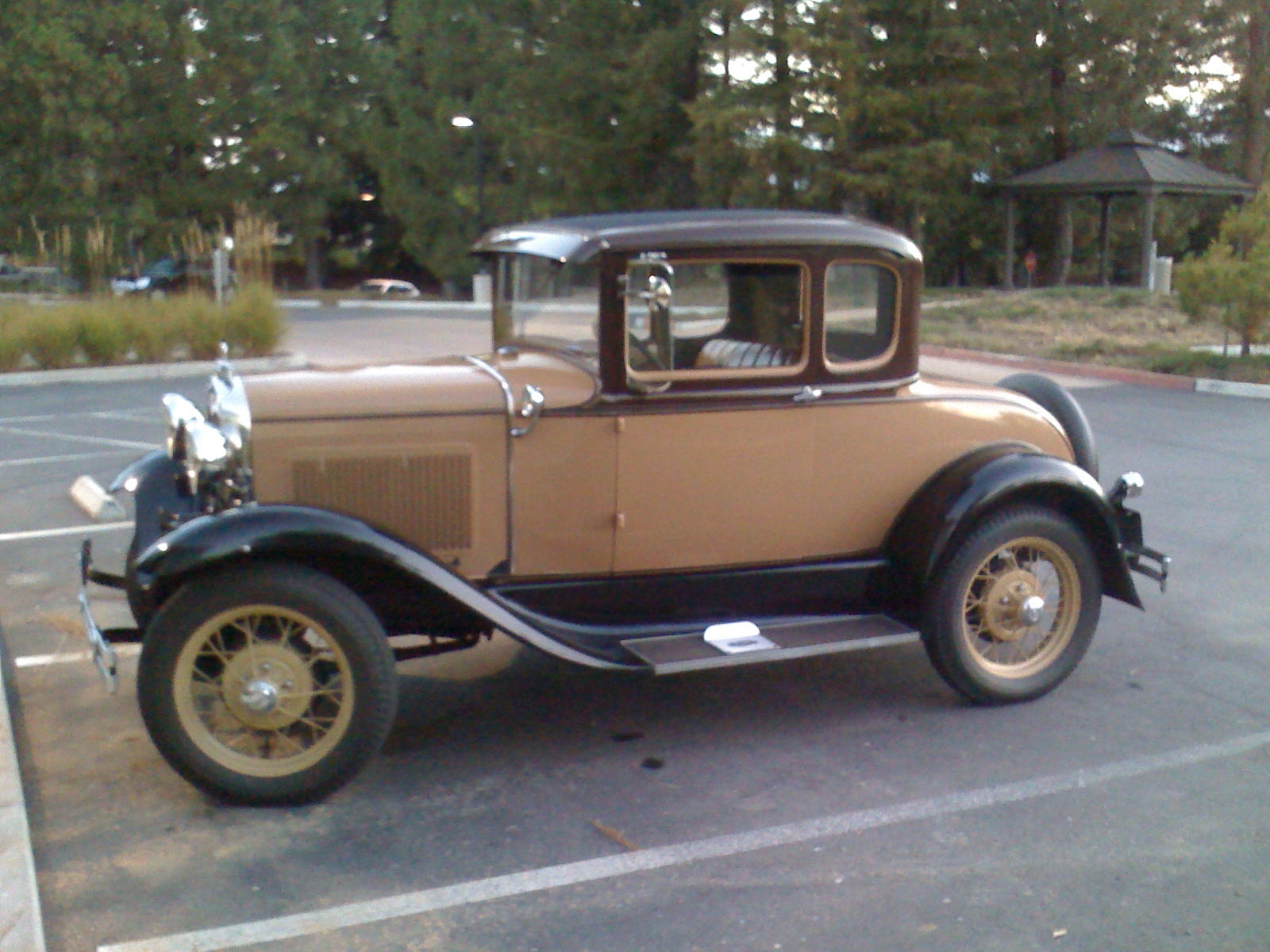
Well, I finally purchased and dragged home my first A. (Don't tell my wife--I told her that it followed me home so I had to keep it :)). It's a 1931 standard coupe and I drove her to work this morning. Pictures below, of course.

hilda_8_11_2010-1small.jpg

hilda_8_11_2010-2small.jpg

OK--so here's the backfire story. Anyone want to help diagnose over the Internet? ;) The important bit of information (I think) is that the car currently has a Weber carb.

I started the car this morning according to Dave's instructions (Hi Dave!): key on, fuel petcock open, fuel pump on, choke to 3/4, spark and throttle set. Started on the second try, fired up and ran fine. I idled for a few minutes (grabbing my jacket, closing the garage door, etc) and off I went. Ran great all the way to the gas station, about six miles away. When I stopped the car, it backfired once.

I put fuel in her and started her back up--again according to the instructions, less choke. This is where the problem started (the putting gas into the tank story is a by-the-way, I'm not sure it's related). She started fine, but immediately backfired twice. I closed the choke fully (no GAV with a Weber) and started off, but noticed serious hesitation and periodic backfires. These seem to be tailpipe backfires from the directionality of the sound.

I made it safely to work, but am now at my desk thinking about the problem and what the solution might be.

Additional information:

  1. The car came from a higher altitude (I'm not sure this is relevant, as it is only about 2,500 ft higher)
  2. The gas I put in is the dreaded E85--all you can get here in CCCalifornia
  3. The problem seemed to be less when tooling along at 50MPH in third gear. When I had to stop to turn in to my employer's driveway in 1st, the hesitation was worse and I got another backfire.
So, oh enlightened ones: what say you? Adjust the carb for lower altitude? Build a still to get the ethanol out of my gas? Other thoughts?
 
Congrats on a beautiful coupe! When you shut down the engine do you put the levers up to slow it to a slow idle? That usually helps. Once I do that on mine, I
let the engine idle for a couple of seconds before shutting it down to lower the gas
level in the bowl. You can always flip the gas lever under the dash (if so located),
and let it run out. If it takes awhile it could mean that your float level is too high
and you will need to adjust it. That involves taking off the carburetor----and that's another discussion. Try these things first. Once again----a beautiful ride!

Jack
 
sharp looking coupe,
i think the first thing you need to do is go over all your adjustments points, timing, plugs. if the points are pitted or worn change them out also with a condensor. the condensors are a known problem. if it was my car i would replace points, condensor, clean and gap the plugs, or replace them, go over and service all the fluids etc. i like starting out fresh this way i know what i got.
good luck
 
Nice looking coupe. I believe that the problem will be with the Weber carburetor. None of the things related to model A carburetors will apply to this setup. I wish I could be more helpful. This is why I avoid the Weber carburetor, I don't know anything about them. If it was mine I would replace the Weber with the more simple Zenith updraft setup. If I wanted MORE performance, I would go with a dual updraft setup. You could probably sell the Weber setup for more than it would cost to replace with an original Zenith carb and manifold. Just an old guy set in his ways. Good luck.
 
Thanks to all who've answered so far.

Mitch, I do have a set of points and a condenser handy, so I can try that as a first step. However, it seems a little odd that the car ran fine when I picked it up (and right after starting this morning) but had a problem later. I hate to "fix" something by semi-randomly replacing parts, since that means if it goes wrong again I won't necessarily know what fixed it next time it goes wrong. (Something always goes wrong, right?) Excellent point about changing the fluids--I'll get to that this weekend.

Purdy, I am leaning towards putting the carb back to a stock Zenith. Partly because when I have trouble I want the local club guys to be able to help out :) I figure I could buy a Zenith and stock manifolds for somewhere around what I can sell the Weber for. If I do need more umph, I can always go with a HC head.

Thanks again--and anyone else with an opinion, please speak up.
 
The Weber/ engine is starving for gas. Have you checked both the carb and intake to block gasket for air leaks? Do you have a fuel pump? Many Webers are not happy with gravity feed. Are you sure it was E85, not E10? There is no place where you can ONLY get E85. E85 will not run in any carb without rejetting. E10 does fine 'cause old carbs were always jetted a bit on the rich side. E85 requires seriously larger jets and may not work with the fixed drilled idle passages in some carbs, despite running the idle mix screw all the way to rich.
 
Hi Mike,

Yes, the car has a fuel pump and it's working as far as I can tell, at least there's the tell-tale whine when I turn it on. I'll have to pull the line and then put the end over a bucket and switch it on to be 100% sure.

I think you're right though--it's E10. There's been a lot of confusion here in California as the State and the EPA have been arguing about MTBE (now illegal in Ca), ethanol, and the increase in smog in the L.A. basin since the switch to reformulated gas. But closer investigation suggests that everything's E10--there doesn't appear to be a way to buy unadulterated gas in the state.

When I get home this afternoon, I'll fiddle with the idle level and see what happens. I do know that the car was idling fine this morning while it sat for a few minutes warming up.

<edited>On further though, I don't think it can be fuel starvation... adding choke (which should enrich the mix) didn't solve the problem. In fact, it seemed to make it worse. But I'm not sure why the car would be running rich after coming down from the mountains--unadjusted it should run lean, right?</edit>
 
Last edited:
Hi Mike,

Yes, the car has a fuel pump and it's working as far as I can tell, at least there's the tell-tale whine when I turn it on. I'll have to pull the line and then put the end over a bucket and switch it on to be 100% sure.

I think you're right though--it's E10. There's been a lot of confusion here in California as the State and the EPA have been arguing about MTBE (now illegal in Ca), ethanol, and the increase in smog in the L.A. basin since the switch to reformulated gas. But closer investigation suggests that everything's E10--there doesn't appear to be a way to buy unadulterated gas in the state.

When I get home this afternoon, I'll fiddle with the idle level and see what happens. I do know that the car was idling fine this morning while it sat for a few minutes warming up.

Dan, don't forget to check for an intake air leak. With the Weber setup the in/exh manifolds are not bolted to each other, thus the heavy carb + intake manifold is free to vibrate up/down, rocking at the studs, pinching the top and bottom of the gasket at the block, destroying it. Look at the way the manifolds are held to the block and you will see what I mean. That gasket is an easy and cheap replacement, try it. Track racers in the 40's who ran A & B engines with downdraft setups sometimes put an iron support strap from a lower side-cover bolt to the manifold.
 
A lean mixture will make the combustion chamber run hotter which is what the back fire is. If it adjusted to the higher altitude they would have leaned it out and it would be way too lean now. Pull a plug and see if it is white in color, a sure sign of a lean mixture.
 
A lean mixture will make the combustion chamber run hotter which is what the back fire is. If it adjusted to the higher altitude they would have leaned it out and it would be way too lean now. Pull a plug and see if it is white in color, a sure sign of a lean mixture.

??? A hot chamber may cause ping, knock, detonation, dieseling, but not backfire. Backfire through the intake is generally an intake valve or timing problem, backfire in the exhaust is after-the-fact ignition of fuel mix that would not ignite in the cylinder, often due to cylinder misfire from the mix being too lean. The chamber does not need to be hot for it to occur, the plugs may actually read sooty and cold. The true read of the running mixture is best obtained on a modified engine by welding a $5 bung in the exhaust pipe for a temporary oxygen sensor.
 
This may be just too simple. Do you pull the spark advance down to 3/4 or more when driving after you started it??

I don't want to make fun but I have seen more than one inexperienced drivers with this issue. It also happens to us experienced driver occasionally. I hope it's that simple good luck!
 
I'd think retarded timing would make it less likely to backfire via exhaust.

I don't think anyones asked the basic question of does it miss atall? When idling or under load?

When you step on it does it hesitate and then go or does it rev strong and snappy?
 
I would bet this is a timing issue. Before you do anything else, go to the following link, print out Marco's instructions, go out to your car and follow the directions to a T. You will need to learn how to time the Model A Ford if you are going to be the person who tinkers with how it runs. Once you know it's timed properly, and it's still backfiring, then start chasing other problems.

I had the same problems the day I brought my Model A home. Followed these directions and no more backfire!

http://www.abarnyard.com/workshop/timing.htm

..
 
Last edited:
Dan,
HEre's an earlier thread on the subject that may be helpful, including my complete brain dump on backfiring.

http://www.fordbarn.com/forum/showthread.php?t=9835&highlight=steve

Sounds to me like two things are wrong in your case. Unburned gas is accumulating in the exhaust, then, after shutdown, a leak in the exhaust system is allowing air to be drawn in to give the right mix for explosion. Any problem, either electrical or fuel supply related, that prevents combustion, will cause the raw gas to be swept out into the exhaust where it bides its time waiting to be set off. Paradoxically, this is often due to too lean a mixture to support combustion. Open the gas adjusting valve (ccw on choke rod) is the first straw to grasp at. Closing down on the carb's air adjustment idle screw is the second.

Steve
 
hello and believe it or not i had a backfiring problem that i chased for months..... new carbs new coils new new new,,,,, unbelievably (yeah right) it was an intermittent pop out ignition switch.... had the switch rebuilt and voila' she runs like a dream!!

all the best,,,, rocky d
 
Back
Top