
You are using an out of date browser. It may not display this or other websites correctly.
You should upgrade or use an alternative browser.
You should upgrade or use an alternative browser.
New block, a further discussion
- Thread starter Henry Floored
- Start date


KGS
Well-known member
Well I hope you're not right and when the apocalypse or Armageddon happens and the enemy attacks our power grid rendering all electronic devices useless I will be the one driving around in one of my two Flathead powered vehicles.
You see like cockroaches, these things seem like they'll survive the end of the world as we know it. When everyone else is walking you will think my Flatheads are very fast.
/QUOTE]
I always thought that too. It turns out that unless I have large amount of fuel stored up in a tank with a manual pump, I will only drive until my last tank of gas is gone. Pipelines won't be able to pump oil to the refinery, which can't deliver gas to the depot, which can't pump to the trucks, which can't deliver to the gas station that can't pump into my '39. So, I guess I'll have to walk along with everyone else or stay home and read a book...
Ken


flatheadmurre
Well-known member
Hot rodding isn´t what we are doing here...we are running a nostalgic trip !
If hot rodding still is defined as what it used to be...a cheap way for poor youngster to go fast...we would be chiptuning hondas
If hot rodding still is defined as what it used to be...a cheap way for poor youngster to go fast...we would be chiptuning hondas

Henry Floored
Well-known member
Hot rodding isn´t what we are doing here...we are running a nostalgic trip !
If hot rodding still is defined as what it used to be...a cheap way for poor youngster to go fast...we would be chiptuning hondas
Bingo! All this talk about a new block being impractical. Messing with old cars is impractical and it doesn't make sense. Do why do we do it? Why do we love it so?
Henry Floored
Well-known member
Well I hope you're not right and when the apocalypse or Armageddon happens and the enemy attacks our power grid rendering all electronic devices useless I will be the one driving around in one of my two Flathead powered vehicles.
You see like cockroaches, these things seem like they'll survive the end of the world as we know it. When everyone else is walking you will think my Flatheads are very fast.
/QUOTE]
I always thought that too. It turns out that unless I have large amount of fuel stored up in a tank with a manual pump, I will only drive until my last tank of gas is gone. Pipelines won't be able to pump oil to the refinery, which can't deliver gas to the depot, which can't pump to the trucks, which can't deliver to the gas station that can't pump into my '39. So, I guess I'll have to walk along with everyone else or stay home and read a book...
Ken
I don't know about you but in my area it'd take a long time to syphon all the gas out of the disabled electronically controlled cars. I'm guessing that'd be the cheapest gas I ever bought.
Hot rodding isn´t what we are doing here...we are running a nostalgic trip !
If hot rodding still is defined as what it used to be...a cheap way for poor youngster to go fast...we would be chiptuning hondas
Well, maybe we can marry these two worlds. What if we make a block that bolts together and acts like a cover for a hopped up Honda motor?
Kids take those 1.8L right out of junkyards and run 15 lb of boost through them. All stock and nothing done to the bottom or top ends. They seem to hold up well and run like stink. I've seen some of these kids even hit their mills with a 100 shot coming off the line.
Seems like the best of both worlds: An engine that looks like a flathead, but can be put together for under $2K and would run rings around even the best-built, high dollar flathead.
Just a thought....
Henry Floored
Well-known member
Well, maybe we can marry these two worlds. What if we make a block that bolts together and acts like a cover for a hopped up Honda motor?
Kids take those 1.8L right out of junkyards and run 15 lb of boost through them. All stock and nothing done to the bottom or top ends. They seem to hold up well and run like stink. I've seen some of these kids even hit their mills with a 100 shot coming off the line.
Seems like the best of both worlds: An engine that looks like a flathead, but can be put together for under $2K and would run rings around even the best-built, high dollar flathead.
Just a thought....
Yup and Honda won Indy and LeMans this year. All this while we are sleeping and dreaming of the good old days when American ingenuity was a major force in the world.
Ahhh well......
Bruce Lancaster
Member Emeritus
I was once privileged to correspond with a very high end restorer/racer deeply involved in all sorts of 1920's-'30's racing, mostly European but some contact with Ford fours. He had for a long time manufactured or arranged manufacture of very small runs of parts for VERY rare cars, 1920's Bugatti and other racers, stuff like that. Anytime a part was needed, a small multiple of the camshaft or block or whatever was run off as spares/future needs material. This was WAY past our kind of old stuff, we are talking cars with NO parts supply at all and values running into the millions, so needs were on a cost no obstacle basis. The people were not only restorers, they were actually racing their crocks too, and with both money and competitiveness in the mix anything that was needed damn well got made.
Then...he raised anchor and moved to Poland, of all places.
Why?? Cheap life, cheap labor, in a town housing a near inactive military aircraft factory and its highly skilled and unemployed staff.
Instant discount access to craftsmen (with machinery!) who could make ANYTHING and do it to combat aviation standards. No more paying Swiss gnomes and master racecar fabricators, these people had the skills and were hungry!
BUT I think it is fair to say...if you need a new block cast because you just threw a rod in your 1927 Delage Grand Prix racer, said block despite its exotic nature is going to be a LOT easier than a flathead Ford one. Open cast water jackets, OHC leading to short ports and open design, etc. These cars were originally almost as handmade as the new parts, and the makers could not have begun to handle the complexity of the ports and such in our engines.
Last edited:

tubman
Well-known member
I'm perfectly all right with this, but then, I'm old. (And have two extra good blocks under the bench.)Yup and Honda won Indy and LeMans this year. All this while we are sleeping and dreaming of the good old days when American ingenuity was a major force in the world.
Ahhh well......

Henry Floored
Well-known member
I was once privileged to correspond with a very high end restorer/racer deeply involved in all sorts of 1920's-'30's racing, mostly European but some contact with Ford fours. He had for a long time manufactured or arranged manufacture of very small runs of parts for VERY rare cars, 1920's Bugatti and other racers, stuff like that. Anytime a part was needed, a small multiple of the camshaft or block or whatever was run off as spares/future needs material. This was WAY past our kind of old stuff, we are talking cars with NO parts supply at all and values running into the millions, so needs were on a cost no obstacle basis. The people were not only restorers, they were actually racing their crocks too, and with both money and competitiveness in the mix anything that was needed damn well got made.
Then...he raised anchor and moved to Poland, of all places.
Why?? Cheap life, cheap labor, in a town housing a near an inactive military aircraft factory and its highly skilled and unemployed staff.
Instant discount access to craftsmen (with machinery!) who could make ANYTHING and do it to combat aviation standards. No more paying Swiss gnomes and master racecar fabricators, these people had the skills and were hungry!
BUT I think it is fair to say...if you need a new block cast because you just threw a rod in your 1927 Delage Grand Prix racer, said block despite its exotic nature is going to be a LOT easier than a flathead Ford one. Open cast water jackets, OHC leading to short ports and open design, etc. These cars were originally almost as handmade as the new parts, and the makers could not have begun to handle the complexity of the ports and such in our engines.
Bruce first I just want to say I have treasured your comments, knowledge and stories over the years.
Now maybe the first step is to do a "block summit". A meeting whether it be online or in person with some of the most thoughtful and experienced Ford people willing to share their thoughts in real time.
This would require, I'm sure, a mixture of engineers, engine builders and foundry men to bring a practical goal to light.
I have two or three imperatives that would not change the appearance of the engine. I'm sure there are plenty of ideas and of course many of them were already shared here.
Is the "Early V8 Ford" community willing to have a "barn raising" or in this case a "block raising".
Bruce Lancaster
Member Emeritus
I think my imperatives would mostly involve maybe a cast-in porting job, maybe extra metal and/or deeper water jacket in crack zone (after study of the 1946 press release on that area!), mebbe make the block webs thick slabs like the do on aftermarket SBC's. Everything generally works on flatheads, it would just be nice to have easy clean ones!
Radical changes? Seems silly. Chevy successfully updated the flathead in 1955 with the obvious modernizations, and those easily fit where a flathead lived if someone wants lots more steam.
Oh yes...some good stock looking iron heads done like Denvers, with tightened up chamber volume and decent transfer area! That would be a neat starting point and fundraiser for a block project...

rotorwrench
Well-known member
The Polish bought up the Type certificates for the old Franklin Aircraft engines but they haven't produced very many. They also bought rights to produce a Russian copy of the old Wright R-1820 like the B-17s had. Bison lathe chucks are also made in Poland but I heard that some of those guys jumped ship and went to China to get cheaper copies of those made. The world just keeps moving on.
I'm affraid we may have to wait till 3D printers can use resins that are capable of working as an engine block. There are still too many old blocks out there that are usable at this stage of the game. Folks will buy the new muscle car small & big block castings for one, because all the good ones got blown up racing them, and two, because they are less expensive that finding & fixing an old one with some exceptions. The later overhead valve blocks are much easier to cast and have way thinner cylinder walls than the old flathead V8s with some exceptions.
A replicator like Star Treck had would be the next option in the future but I likely won't be around to see that. I might be around to see some mad fabricator actually cast an updated flathead before I keel over **** up but I imagine that will be a while. It's definitely not in my cards to do that and I'm pretty much crazy too!
Henry Floored
Well-known member
I think my imperatives would mostly involve maybe a cast-in porting job, maybe extra metal and/or deeper water jacket in crack zone (after study of the 1946 press release on that area!), mebbe make the block webs thick slabs like the do on aftermarket SBC's. Everything generally works on flatheads, it would just be nice to have easy clean ones!
Radical changes? Seems silly. Chevy successfully updated the flathead in 1955 with the obvious modernizations, and those easily fit where a flathead lived if someone wants lots more steam.
Oh yes...some good stock looking iron heads done like Denvers, with tightened up chamber volume and decent transfer area! That would be a neat starting point and fundraiser for a block project...
Bruce you and I agree on some stuff. I think GM very consciously went for the Ford V8 formula when they brought out the sbc. They have routinely taken what Ford had first and built on that idea. Examples, the Camaro was a response to the Mustang. The LS engine being very small block Ford like in concept. The SB2 NASCAR heads that effectively caught them back up when the Cleveland headed Fords were stomping them into the mud.
Nowadays GM and FCA will once again follow Ford with aluminun bodied pick up trucks and small displacement turbocharged DI engines.
Now that doesn't have a thing to do with this conversation except to point out that any new Flathead block would never be a substitute for more modern but soulless OHV V8.
What this would be for is to eventually become a keystone product for hobby of early V8 ing.
Of course the block should have a "cast in" port job. There is literally horsepower laying in the cutting room floor with the original porting designs. I think valve position could be "tickled" too.
Let's say an as cast superior porting job that could easily add 30-50hp to your build and the corresponding 100+ pound weight loss, ask yourself what could that do for overall vehicle performance?
I mean every aspect from acceleration to cornering to braking would be improved.
"Power Dense" is a phrase they toss around a lot these days. While you immediately think about physical size it also refers to power to weight ratios.

aonemarine
Senior Member
How did this conversation get switched to chevys and what nots??
Here is the 3d print of Flat32's engine that will be investment cast in bronze. Its in 1/4 scale. The larger yellow section is half scale.
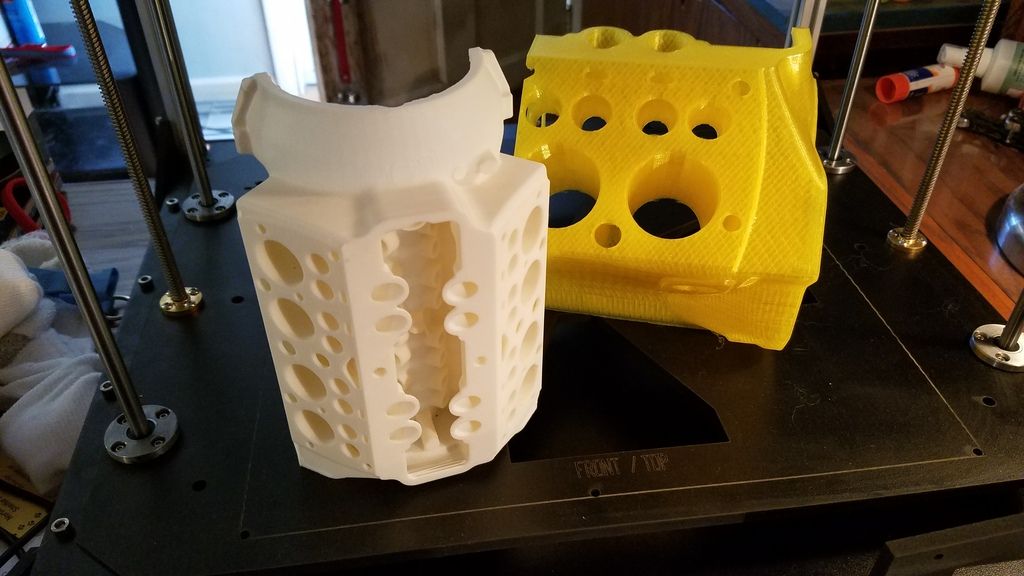
Here is the 3d print of Flat32's engine that will be investment cast in bronze. Its in 1/4 scale. The larger yellow section is half scale.

Henry Floored
Well-known member
My first real step and contribution to this subject is to actually build the best intake port into one of my original blocks. That includes my repositioned intake valve theory. I think there is power to be made there. It will have no effect on outward appearance and will still be compatible with all standard production parts except for the valve guides.
Again this is what I think the first real step towards doing this.
Again this is what I think the first real step towards doing this.
aonemarine
Senior Member
My first real step and contribution to this subject is to actually build the best intake port into one of my original blocks. That includes my repositioned intake valve theory. I think there is power to be made there. It will have no effect on outward appearance and will still be compatible with all standard production parts except for the valve guides.
Again this is what I think the first real step towards doing this.
Care to elaborate?
flatheadmurre
Well-known member
My first real step and contribution to this subject is to actually build the best intake port into one of my original blocks. That includes my repositioned intake valve theory. I think there is power to be made there. It will have no effect on outward appearance and will still be compatible with all standard production parts except for the valve guides.
Again this is what I think the first real step towards doing this.
Are you changing position/angle of the valve or just reshaping the runner and guide ?
Henry Floored
Well-known member
Are you changing position/angle of the valve or just reshaping the runner and guide ?
A little of both actually. I have a couple sacrificial blocks. I would like to tilt the intake valve towards the cylinder wall margin. This alone will force the intake port to "stretch" a little. I then would like create a gently curved intake port with no air damn in the valve pocket and a much kinder short side radius.
All this relieving business is done simply because it has been found that in a side valve engine we have have to encourage the flow to go sideways just as it passes the valve seat. Then we bounce the charge off the cylinder head to turn the rest of it down the cylinder.
I think I described this once as imagine taking your garden hose and spraying it full blast at 90 degrees to a solid wall. Messy!
No rotate to a 45 degree angle and do the same. What happens?
We are asking the intake charge to change direction of almost 180 degrees right when it's most important to keep momentum up and fill the cylinder.
We all know by first hand experience or by word of mouth that a supercharger wakes up a Flatty. They certainly do for the simple reason is a blower overcomes this basic restrictor in the Flathead's intake flow path.
With a supercharger the Flathead Ford starts to wander up near 1 hp per cubic inch where it should be from the get go.
Guys there is a reason why the best engine builders in the world are only getting 50 or so more hp out of a Flatty than me who sucks by comparison. If there wasn't something inherently wrong with side valve breathing the best would be wringing 300 hp out of a 276 incher.
The way to make any thought of a new block worthwhile to people is to give them the very best breathing they can get from a side valve engine.
Imagine a scenario where this "service block" if you will, just comes close to the best port job by a professional on a stock block. Combine that with being able to toss 100lbs of unneeded weight overboard. What impact would that have on average attainable performance for everyone?

flatheadmurre
Well-known member
Ther are metal 3D printers now. Might be an option.
--louis
The cost is up in the sky...you pay by the gram.