You are using an out of date browser. It may not display this or other websites correctly.
You should upgrade or use an alternative browser.
You should upgrade or use an alternative browser.
Model T Racing Thread
- Thread starter t-head
- Start date

twin6
Member
Famous Ford employee Frank Kulick.
The track looks like Point Breeze, Philadelphia circa 1910.
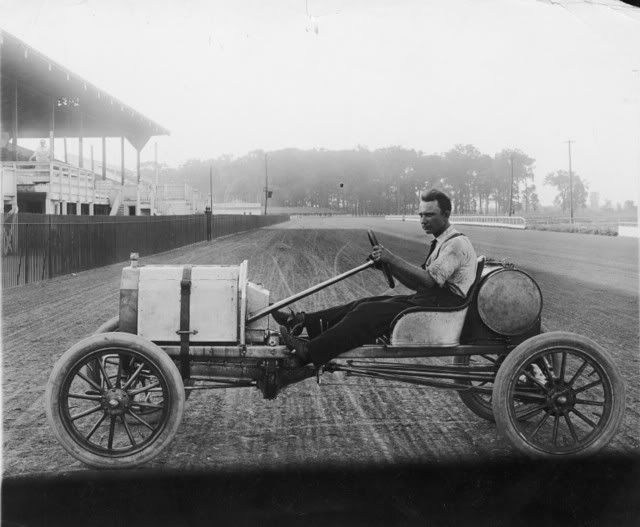
Kurtis - I have this as Michigan state fairgrounds, 1912. Nice to see some of the regulars from your thread.


t-head
Well-known member
The photo above, one of my favorites shows B. T. Barber of Iola, Kansas in the Ford that he raced to a third place finish in the feature race at Winfield, Kansas on July 4, 1913 and to second place over-all at Belleville, Kansas on August 28, 1914
Basil T. "B. T." Barber was born on May 27, 1885 at Sunnyside, Tennessee. He was already an experienced racecar driver by the time he moved to Iola, Kansas in 1910, holding the track record at Chattanooga, Tennessee for a number of years.
He worked as Iola's city electrician until he and a partner became the area Ford Motor Company dealers in 1912. A year later, Barber bought out the partner and eventually added Chevrolets, Durants, and even airplanes to the dealership. His other business interests included an Eveready service station franchise.
He was an avid flyer and opened Iola's first airport.
He continued to race cars for a number of years, competing on various well known tracks.
He sold his business interests in Iola in 1929 and spent nine years farming northwest of Iola near Genova, Kansas.
Barber suffered from asthma and was in poor health for several years before he passed away in the Iola hospital on March 30, 1958. He was survived by his wife, one son, and one daughter. B. T. Barber is buried in Highland Cemetery on the north edge Iola, Kansas.
Last edited:
t-head
Well-known member
The first photo of Murray Earl was taken on July 4, 1934, at the Kansas State Fairgrounds, Hutchinson, Kansas. His throttle stuck that day and he turned this car over on the south turn of that racetrack. He rebuilt the car and raced for years after.
The second photo shows the car earlier when he had a sponsor.
The engine appears to have a Fronty overhead.
The second photo shows the car earlier when he had a sponsor.
The engine appears to have a Fronty overhead.
Last edited:

Kurtis
Junior Member
Kurtis - I have this as Michigan state fairgrounds, 1912. Nice to see some of the regulars from your thread.
Good to see you here too Tim.
Thanks for the correction. I had a feeling i was wrong
Kurtis
Junior Member


t-head
Well-known member
Catalog information and photos of the second style of Robert Roofs 16-valve head the model B.
There was also a Model BB offered in 1921 with bigger 1 1/2" valves, higher compression and different exhaust manifolds which exit out the side of the hood like in photo five. Illustrations 6&7 show the BB racing head.
There was also a Model BB offered in 1921 with bigger 1 1/2" valves, higher compression and different exhaust manifolds which exit out the side of the hood like in photo five. Illustrations 6&7 show the BB racing head.
Last edited:

Roadster62
Well-known member
I guess it depends on the track and location, but these guys were running T's a lot later than I thought they did. When did the Model A & B powered cars really take over? 
The first photo of Murray Earl was taken on July 4, 1934, at the Kansas State Fairgrounds, Hutchinson, Kansas. His throttle stuck that day and he turned this car over on the south turn of that racetrack. He rebuilt the car and raced for years after.
The second photo shows the car earlier when he had a sponsor.
The engine appears to have a Fronty overhead.
t-head
Well-known member
I guess it depends on the track and location, but these guys were running T's a lot later than I thought they did. When did the Model A & B powered cars really take over?
Depending on where, they were completive up until WWII in the less populated parts of the county. As you know they came out with some incredible designs and on top of that they were incredibly light weight.
I took a while for the speed merchants to develop the equipment for the A, B and V-8 models and the country was also in the middle of the depression so many people kept running and perfecting their T's.
I know of a couple of surviving cars that were still fast in the early fifties.
Last edited:

Hoop
Well-known member
I spoke to "Faultless" who just recently registered. Some of you asked about his avatar. He apologizes ... he's still having difficulty posting.
So, until I get over to his place and see what's happening:
Carl has a bunch of T's. This is a repro Faultless body and not his first fast T. We'll have to wait for him to add specifics ... he talks Rajo, Frontenac, Gemsa, etc. Great guy.

So, until I get over to his place and see what's happening:
Carl has a bunch of T's. This is a repro Faultless body and not his first fast T. We'll have to wait for him to add specifics ... he talks Rajo, Frontenac, Gemsa, etc. Great guy.


t-head
Well-known member
T-Head
Nice pictures but of the second style of Roof 16 valve head, those are the Model B. This is the Model A Roof 16 valve that came first.
Laydon....... Thanks for picking up on that and for the photos. I will correct that post. I had forgotten all about this style head. I have seen this illustration before and thought that it might be strictly a racing head with no provisions for an exhaust manifold as in photo 1. Or being an artists rendering the flanges and bolt holes were omitted. I also noticed that this is dated 1918 whereas the Model B catalog is dated 1919.
The other thing to note is the Model A used the Ford intake and exhaust ports for eight intake ports which are covered by one intake manifold, photo 2.
In looking around the web I found this photo of what appears to be a Model A Roof with a proper manifold for a road car. Photo 3
Photo 4 shows the intake side of a display at Bill Smiths Museum.
Last edited:
t-head
Well-known member
The first two photos show more details of the Model B Roof.
The third photo with the unusual header shows what I believe is also a Model B and I assume that it is a later one judging by the improved rocker arm arrangement. The rocker arms were one of the weak links in the early heads.
The other problem was with air leaks around the pushrods into the intake ports at least in the Model A head. They corrected these leaks in the Model B, as the push rods go thru bosses in the ports but I would think this might have affected the size of the ports in some way.
The forth photo is of a cutaway where you can clearly see how this was arranged.
Last edited: