Lead or no lead, that is the question...

oldmotorsguy

Senior Member
I am currently selling a rebuilt Model A Ford long block on eBay, and I have several guys asking me about the valve seats. Specifically, they are asking (or more accurately, accusing) me whether I had the valve seats hardened so that unleaded gas could be used. My machine shop simply ground the existing block seats to match my new stainless steel hardened valves.

My buddy Phred suggested that tetraethyllead was actually not part of the gasoline formulary of the era for gas available at the pump, and I Googled this as well as Bing'ed the use of tetraethyllead back during the Model A era. As far as I can research, lead was an additive during 1928 to 1931, much like Marvel Mystery oil and STP are today. You physically had to pour it into your gas tank, but if you opted to use just the stuff out of the pump, Ford engineers of the day were OK with that. Accordingly, would it be accurate to say that the Model A engine was designed and engineered to run on 'unleaded' gas?

I would say that is a big 'yes.'

Oldmotorsguy.
 
Absolutely yes.
There is LOTS of documentation on when lead was FIRST added to gas from the pump, LONG after the introduction of the Model A. Ethyl was formulated to raise the octane much later in the 1930s for the higher performance engines.
Go to the oil company web sites to find documentation, yet Google should have found it for you already.
Bruce you are right about lead being added for higher performance, lead slows down the combustion rate of gasoline thus getting rid of the ping in higher compression engines, and unless you are running wide open or pulling heavy loads up long grades you dont need lead in your fuel, and as a side note did you notice they charged a nickle to put lead in the gas? and then they charged a dime to remove it? got to love those robber barons


ITS NOT WHAT YOU KNOW ITS WHO YOU KNOW
 
Your Model A engine is fine WITHOUT any special valve seats being installed. I prefer original blocks without valve seat inserts. Several guys have feard the loss of lead and had valve seats installed. Several weren't installed correctly and later came out while driving down the road.

High compression head or not, the Model A doesn't need special hardened valve seats.
 
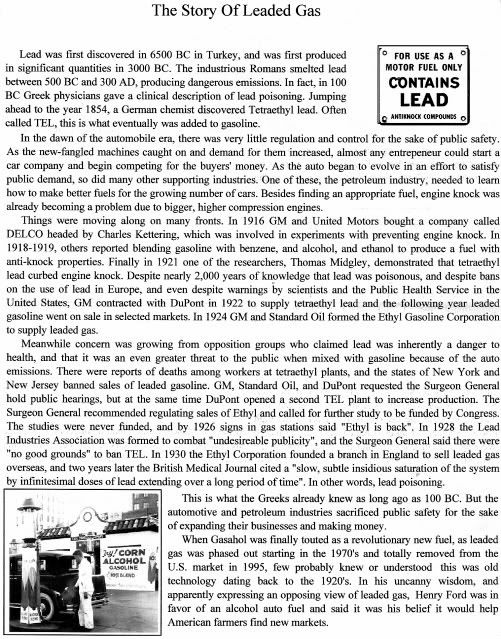
I had run across an very interesting article about Lead in gas. The quick part is lead was not generally available until the late 30's. During Model A production lead was not really available so the engine was not designed to run with lead.

To add to your problems, Lead leads to corrosive by products that help eat away your exhaust so adding lead is not needed and counter productive.

Here is a link to the whole story of lead in gas. It is interesting to note that there was a strong environmental outcry in the 1920's over the idea of using lead.

http://www.runet.edu/~wkovarik/papers/kettering.html

"Still facing competition from refining and high percentage solutions in the early 1930s, the Ethyl Gasoline Corp. decided to end exclusive contracts and sell the additive to most oil companies and distributors. By the late 1930s, tetraethyl lead could be found in nearly 90 percent of all American gasoline. Benzol blends were rare, Kettering's "Synthol" fuel had been forgotten, and attempts by Midwestern farmers to encourage ethyl alcohol as an anti-knock additive had failed.135"

If you wish to be further amazed look up the history of lead in paint. Some European countries banned the use of lead based paints in side living spaces and on cribs back in the 1800's I believe. The USA waited until the 1970's to ban the paint.
Now you need to put on hazardous waste outfits to remove the trim around windows that has lead paint. I am serious about the new rule for handling lead paint- it is nuts!
 
Lead does not significantly slow down the combustion rate of gasoline. While general flame speed does affect octane ratings, lead does not significantly affect it, the flame speed that is. It simply allows a higher compression ratio before the fuel will knock. Its purpose as being a valve seat lubricant was not even considered when lead came out. In fact, adding lead caused such a big mess in engines by coating everything that it had to be removed with what were known as scavengers. The scavengers reacted with the lead and allowed it to escape out the exhaust. The scavengers were known as ethylene dibromide and ethylene dichloride.

You don't need hard seats on a Model A in my opinion. It's just an extra money maker for the engine rebuilder.

Now lead did serve as a lubricant there's no doubt but most valve seat damage or rapid recession occurs under high speed, high power conditions that don't apply to the Model A. Low to medium speed engines under moderate loads do not suffer rapid valve seat wear.


Larry B.
 
Last edited:
Are you saying that pumps did not have lead in them, seem to me, i recall lead and unleaded back in the day, Im sure there was unleaded around, but if they did not put it in gas why do pump say unleaded today, why not just gas
 
I believe that before the late 30's there were some lead plants near population centers. So if you lived near the plants you might have had lead in your gas. They had some production issues like paying people to retrieve the reaction balls from the muck full of lead. Seems those people tended to go crazy and die for some reason.

It was not till the later 30's that lead was more wide spread. Then the auto manufacturers could sell cars with higher compression.
 
Are you saying that pumps did not have lead in them, seem to me, i recall lead and unleaded back in the day, Im sure there was unleaded around, but if they did not put it in gas why do pump say unleaded today, why not just gas


Are you the kid in the picture?

If you're the old man behind the wheel you ought to at least know what was at the pump about 25 years ago or so. Don't you remember when lead was taken out of the gas?

The term unleaded on the pump today is probably there for the benefit of the liberal environmental types. You know ... the kind that hate internal combustion engines of any type and would like to see your Model A crushed for scrap. They have a big problem with lead but of course they have no problem smokin' a big reefer or two while contemplating environmental hazards.


Larry B.
 
You don't need hardened valve seats with model A engines. They can cause lots more problems than they solve, especially when someone does a half assed job installing them and they come loose.

In most cases it doesn't do any good to tell people that they don't need hardened valve seats. Everybody thinks that they are an expert when it comes to model A's, even if they have never owned one.
 
I think the octane was 76 or around there in the 20's. I use to use Gulftane in the 60's as it was was without lead and the lowest octane on the market, and my 29 ran best on it.
 
Are you the kid in the picture?

If you're the old man behind the wheel you ought to at least know what was at the pump about 25 years ago or so. Don't you remember when lead was taken out of the gas?

The term unleaded on the pump today is probably there for the benefit of the liberal environmental types. You know ... the kind that hate internal combustion engines of any type and would like to see your Model A crushed for scrap. They have a big problem with lead but of course they have no problem smokin' a big reefer or two while contemplating environmental hazards.


Larry B.
I absolutely, unconditionally, love this post.
 
Even if the gas was eroding the seats, it would take a lot of miles to become a problem. I remember when the New Zealand Post Office converted their trucks to run on LPG. After several years, and a lot of miles, the seats and valves started crapping out, all of them at the same time. They had a LOT of miles on them before they got to that stage.
 
LeadinGasoline-1.jpg


Unleaded gas in the old days of my childhood was called ~White Gas, and dad used that in his little pump up blow torch to heat his soldering iron and to power our small scram jet u-control aeroplane us kids had a ball firing that thing up with a bicycle air pump.

skip.
 
Last edited:
So forgive me for my ignorance but in older movies when someone talks about 'ethyl gas" are they talking about leaded fuel?

I always assumed they were talking about alcohol. For example in the 1970s movie Duel "fill it up, ethyl"
 
Back
Top