
You are using an out of date browser. It may not display this or other websites correctly.
You should upgrade or use an alternative browser.
You should upgrade or use an alternative browser.
Is this disconnect original Ford?
- Thread starter atch
- Start date


atch
Senior Member
...BTW, those Float-a-motors are not factory, either. ��
OK; now you've brought up another issue I had never heard of. Namely the Float-a-motors. So I Googled it and see some pix. Are you talking about the half (+/-) of a silver washer and the bracket attached to the engine? I assume that there's a rubber donut in there between the bracket and washer (or somewhere). This assumption is based on the Bratton's pix.
I've only been in the Model A world less than three months and have learned something just about every day. I keep a very detailed mileage log and have driven it 1,213 miles in the first 83 days of ownership. This ain't no trailer queen and I didn't buy it to admire it. It is, however, a good running and nice car.

atch
Senior Member
Here's a photo of a restored-to-factory 1930 Tudor engine bay, courtesy of Brent Terry's shop.
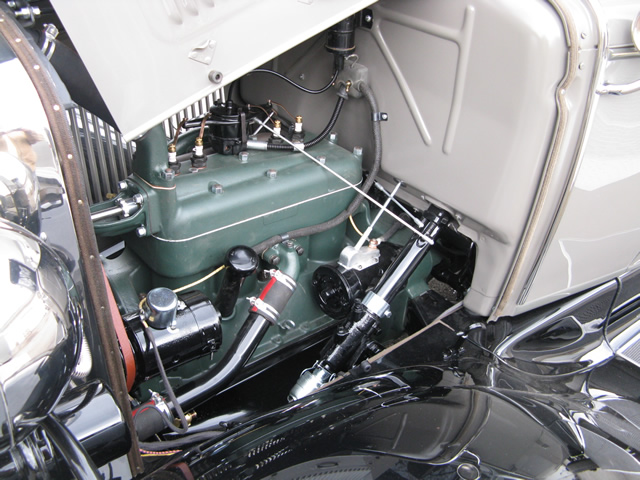
That's really beautiful. Mine will NEVER look like that. Except for in my dreams.

nkaminar
Well-known member
There are two rubber pads for each Float-A-Motor mount, one on top and one on the bottom of the bracket that is attached to the engine. There is a bolt that goes through all that has a Nylon lock nut on the bottom. The nut should be brought up snug but not more than that or it will defeat the purpose of the rubber pads.
The rubber pads get hard after a while and should be replaced when they do.
It looks like there is some kind of fuse or circuit breaker on top of your starter. This is a good thing as it will prevent a fire in case there is an electrical short. If it is a fuse you should carry a couple spares because if it blows it will shut down the engine. I could be wrong and it could be some kind of solenoid to eliminate the foot starter switch.
The metal tube that extends from the breather is also not original. It will route fumes to under the car where they have less chance of getting into the passenger compartment.
The main cutoff switch is a good addition as it will will allow you to shut down the entire electrical system in case of a short or for security or to keep the battery from draining down in case a light is left on or if there is another electrical drain somewhere.
Last edited:

IDSpud
Member
That is a sweet engine bay!Here's a photo of a restored-to-factory 1930 Tudor engine bay, courtesy of Brent Terry's shop.
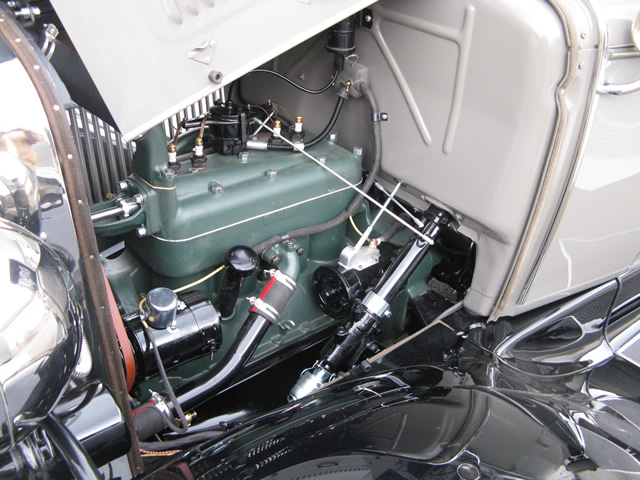

Keith True
Well-known member
That thing on the starter looks to be a modern solonoid to convert it to push button start.Can't really tell just how it is hooked up from that picture though.
Last edited:

Y-Blockhead
Well-known member
That thing on the starter looks to be a modern solonoid to convert it to push button start. Can't really tell just how it is hooked up from that picture though.
Very well could be. (Looks like Phillips head screw holding it on also).
I obtained an old solenoid starter switch for a Model A from somewhere in the past. it mounts to the top of the starter. I keep it around so when I cannot push the starter anymore, I will install it. I will post a picture a little later when I find it.
There is a fella in our club that uses his cane to push the starter anymore button.
Starter solenoid

Last edited:

Fullraceflathead
Well-known member
I'll bet Brent terry's restorations put a smile on Henry ford!!!
Usually when the rubber pads get compressed and hard the lower washers become loose and there ends up being a gap between the washer and the rubber, or the washer and the nut. (BTW, nylon lock nuts on the bottom like NK described are one way of snugging them up, I've also seen standard nuts with split washers (wrong - if you tighten enough to compress the split washer you have tightened too much) or standard nuts with jam nuts (that's how mine are set up). You can probe the rubber doughnuts with a screwdriver to see if they feel hard or if they give a little. It's hard rubber but should still feel like, well, rubber when you push on them.
But maybe this would be a good time to replace the rubbers anyhow, and that will give you some get-to-know time under the car and give you a known starting point. Check them every year and count on replacing every five to ten years or so. The kit is available from the suppliers, it also includes the rubber washer that goes under the FAM mount that attaches to the transmission.
And looking at your pix again (even though you didn't ask) - is that a large diameter wire that is tucked underneath the steering box clamp (maybe running from the disconnect to the starter motor stud)? I'm not sure it's a good idea to allow that, perhaps look at routing the wire differently or zip-tie it so it's not rubbing.
Last edited:
That is beautiful.Here's a photo of a restored-to-factory 1930 Tudor engine bay, courtesy of Brent Terry's shop.
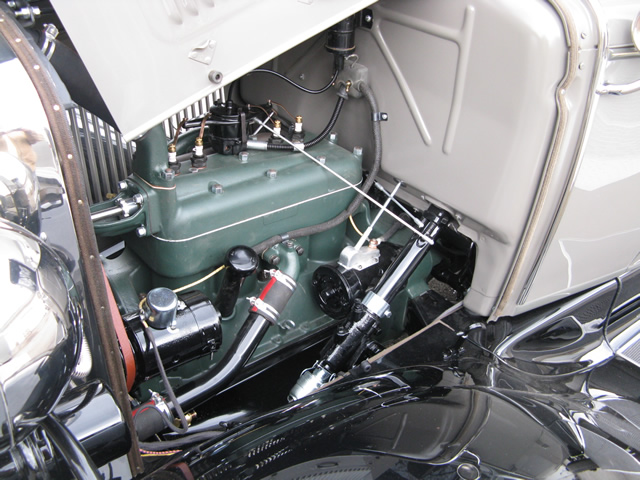

rotorwrench
Well-known member
The Float-A-Motor kit was developed quite a while ago and includes both the front engine mount and the two rear engine/transmission supporting mounts. Condition is based on visual inspection for splits or over compression of the load bearing rubber cushions. As they compress, the mounting starts to get sloppy.
One caveat of the Float-A-Motor kit is that when it gets sloppy, the engine starts to move around more. The torque tube drive has a tendency to push the motor drive assembly forward under hard acceleration and pull it back under hard braking. Some folks only use the two rear mounts to insure the motor won't move too far forward or aft. I don't know if the fan could hit the radiator or not but I don't disregard the possibility in certain conditions. Later Fords with torque tube drives had the same issues.
12-volt conversions can also have issues depending on what related components were modified to suit. Starters, horns, and electric windshield wipers are affected and some are easier to modify than others. Most folks use an alternator to do the battery charging so it's not uncommon to find 12-volt model As in the modern era. 12-volt 3-Ohm ignition coils work fine or a ballast can be used on 1.5-Ohm coils. Ammeters in the 30-amp range are readily available so that not a problem.
Last edited:
nkaminar
Well-known member
The consensus is that the standard (original) front engine mounts work better than the FaM front engine mounts. There was also a FaM mount that sat under the rear of the transmission that most people don't use.
To change the rubber pads, remove the Nylon lock nut then jack up the rear of the motor with a floor jack. Put a piece of wood between the jack and the pan.
To change the rubber pads, remove the Nylon lock nut then jack up the rear of the motor with a floor jack. Put a piece of wood between the jack and the pan.
Here is a picture of the starter solenoid.
https://trisisdesign.com/
https://trisisdesign.com/
Attachments

atch
Senior Member
Thanks for the advice folks.
I'll add replacing the rubber pads to my winter to-do list. I'll be under there installing engine pans anyway. Like most A's around here mine are missing. I live on a gravel road, though, and I want to minimize the amount of dust my engine can suck up through the carb.
Also on the list are adding an oil filter, lubing, changing all fluids, and a good scrubbing. I'll also follow Paul Shinn's videos and check the adjustment on the steering box and brakes. Within reach of where I'm sitting as I type are all three Les Andrews books, the Winnewisser book, the William and Paul McRee engine book, the Victor Page "Construction, Operation, and Repair" book, the Clymer "How to Restore a Model A Ford" book, along with about 30 laminated exploded view pages. I'll be perusing them as I go also.
atch
Senior Member
...And looking at your pix again (even though you didn't ask) - is that a large diameter wire that is tucked underneath the steering box clamp (maybe running from the disconnect to the starter motor stud)? I'm not sure it's a good idea to allow that, perhaps look at routing the wire differently or zip-tie it so it's not rubbing.
I'll definitely check into this.