My experiences (and some semi-scientific testing) suggest that inner fender louvers may actually be a detriment to cooling.
Given that the radiator is properly matched to the motor and the coolant movement works properly the only factor left is air flow through the radiator. At slow speeds the fan moves air through the radiator. At some speed the fan becomes a minor player as the air is moved by a difference in frontal pressure (through the grille) and the air behind the radiator in the motor compartment.
The issue is that fenders act as an air scoop, causing a high pressure area behind and on top of the wheel. Inner fender louvers might help with air release from the motor compartment when the car is stopped but at speed the excess pressure will move into the motor compartment and lessen or even stop air flow through the radiator. Fords through 1939 (except 39 Deluxe) had hood side louvers which allowed air flow that is not affected by the fenders.
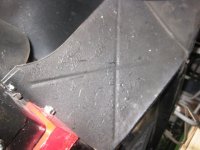
The 1939 Deluxe and 1940 Ford had a air dump at the back of the inner fender, and VERY IMPORTANT, a baffle type fender brace. This brace has a high air flow under it which causes a "venturi" effect to release pressure at the back of the fender where the air dump is. The problem is that it is only effective to about 50 mph or so. Above that the air will flow at pressure above it and inhibit cooling. The work arounds are to remove the motor pans and block the air dump, or to extend the baffle brace to the top of the fender.
Many of the under grille pans from 1937 on have lips that point down. These will also provide a "venturi" effect to help scavenge air from the motor compartment. Many street rod types (and restorer types too) do not realize the importance to cooling these panels have and forget to install them.
A good proof of this is that modern cars do not have louvers between the fender compartment and the motor compartment. If it were to help cooling the engineers in Dearborn, Yokohama, and Berlin would be using them now.


 ) But doesn't work too good at stop lights