Helicoil instalation in stud hole

glenn in camino

Well-known member
My B block needs a Helicoil. The stud is out but the hole is stripped. I haven't done one for a long time. I have all the stuff but I'd like some guidance please.

 
Hello Glenn,

I think the Time-Sert is a better deal for the deck of a Model A

Z

Z
 
All the Helicoil kits I have came with a tap, the helicoils, an insertion tool and instructions, including what size hold to bore.
 
Like everything else with car repairs, take your time and think it through. It is most important that the hole for the helicoil is drilled and tapped accurately or you will end up with a tilted stud and will not be able to get the cylinder head on. I used a piece of 2 in. thick hardwood with the appropriate size hole to accurately hold the drill vertical. This block of wood should have a second hole so that you can pass it over another head stud and bolt it down with the other hole lined up over the damaged area. Do not try to hold a portable drill vertically by hand. The drill will quickly grap hold and you will not be able to hold the drill straight. You will end up with an oversized hole at the top of the hole. To minimize this problem, use 3 or 4 smaller drill sizes leading up to the size drill that the helicoil kit gives you. This way you are only drilling a little bit out of the hole each pass leaving the helicoil drill to take a little more as the final pass. It is much easier to control the hand drill this way. I also recommend you make a jig to hold your helicoil tap properly to be sure it goes in straight also.

I have had good luck with helicoils but you have to be careful. Ed
 
. . . It is most important that the hole for the helicoil is drilled and tapped accurately or you will end up with a tilted stud and will not be able to get the cylinder head on. . .
Ed
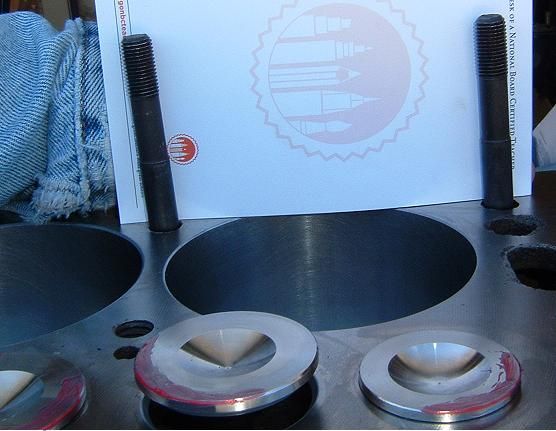
I asked someone to helicoil two holes on an engine I was working on while I went out to get more parts-washer solvent. This was my punishment for not doing it myself. Never assume. My bad.
Crookedhelicoils.jpg
 
Hello Glenn,

I think the Time-Sert is a better deal for the deck of a Model A

I agree about the Time-Sert. I just repaired 2 holes in a motor I'm building. I pondered how to avoid the problem MikeK posted about (keeping the holes perpendicular to the deck) and this is what I came up with.

http://www.amazon.com/gp/product/B00GUS6VZY/ref=oh_details_o09_s00_i00?ie=UTF8&psc=1

I clamped this little jig to the deck using a bar and 2 adjoining head studs. It worked great. I also purchased and used the tap guide bushing sold by Time-Sert to keep the tap square while starting the tap.

It worked great!. A little more expensive than Helicoil but a much better thread repair, IMO.

http://www.amazon.com/gp/product/B003WRJHMK/ref=oh_details_o05_s00_i00?ie=UTF8&psc=1

http://www.amazon.com/gp/product/B0025MUBUA/ref=oh_details_o08_s00_i00?ie=UTF8&psc=1
 

Attachments

  • IMG_20140114_182640_629.jpg
    IMG_20140114_182640_629.jpg
    33.9 KB · Views: 74
  • IMG_20140114_180223_654-1.jpg
    IMG_20140114_180223_654-1.jpg
    106.8 KB · Views: 72
  • IMG_20140114_180534_765-1.jpg
    IMG_20140114_180534_765-1.jpg
    74.4 KB · Views: 74
  • IMG_20140114_182437_381-1.jpg
    IMG_20140114_182437_381-1.jpg
    29.5 KB · Views: 70
I'd also recommend timeserts - Helicoils are the devils work and can cause more damage than you want to fix, if they come out when they shouldn't.

I've never had a timesert come out, but when they do, you can just put another one in the same hole.

I seen helicoils destroy a number of VW heads when they came out with a plug (They are a spring, and get bigger as they wind out!)
 
I have never used a "Timesert", it sounds like they are good. I'll need to check them out...but I have never had a Helicoil fail so it won't be real soon.

Answering your question, as you already have the Helicoils, here is how I install them straight.

A Model A head works as a great drill guide for the 29/64" drill required for the 7/16" Helicoil. The 29/64 bit fits the bolt hole in the head with little slop and provides for a vertical hole and following stud. If possible, use a drill press (I use a gearhead drill) or mill to start the tap and finish the tapping by hand to avoid running the tap against the bottom of the hole. Using the drill press or mill keeps the tap perfectly vertical (if the engine is out of the car). If you are very careful, you can get the threads straight by hand.
A side benefit to using the head is it keeps the drill cuttings from making their way into the cylinders if the engine is still in the car. After drilling, blow the cuttings from the hole before you remove the head with a pipe ended blowgun. (See third photo) Note: I use a damaged head but using a good head as a drill guide will not do any damage to the head.

Be careful to check the depth of the existing stud holes and make sure you do not drill any deeper than this amount. Be careful not to run the tap to tight against the bottom of the hole or you risk breaking the casting below the bolt into the water jacket.

Note the four bolts in the picture that shows the full head. These bolts are used to hold the head in position while drilling the block for the insert. These bolts can be dropped into any of the good holes to secure the head.

The close up of the drill bit shows how well the 29/64" bit fits the stock hole in the head.

I find myself doing a couple a month on customers cars.

Good Day!
 

Attachments

  • Helicoil Drill Guide.jpg
    Helicoil Drill Guide.jpg
    49.7 KB · Views: 244
  • Drill Fit.jpg
    Drill Fit.jpg
    42.9 KB · Views: 188
  • Blowing the chips from the hole.jpg
    Blowing the chips from the hole.jpg
    58.1 KB · Views: 203
Last edited:
The timesert info says the pilot hole needs to be 1/4" deeper then the insert. Wouldn't that put the hole thru into the water jacket (for a head bolt) ? Also would you use SS?
 
most of the studs already go into the water jacket !

I notice on the third amazon link showing the whole kit that the length of the inserts is a mere 0.600. At the bottom of the same page they show longer ones which is something to consider
 
Last edited:
Dave, what's the story with the recessed water outlet?:confused:

The head I use as a drilling guide was a cracked head...beyond repair. I cut the water outlet down because the quill of my gear head drill press did not have enough travel to clear the stock height of the outlet bolt holes with the tip of the bit and still reach the bottom of the stud pocket. I was always needing to reset the bit in the chuck. Cutting the head down allows for one setup of the bit. So it is just a time saver.
Good Day!
 
Last edited:
most of the studs already go into the water jacket !

I notice on the third amazon link showing the whole kit that the length of the inserts is a mere 0.600. At the bottom of the same page they show longer ones which is something to consider

Heh. Some insomnial engineer in the wee hours of the night calculated a "rule of thumb" regarding threaded connection. He balanced the shear strength of the annular thread section against the bending strength of that same helical section - and found that 4 threads seems to be a magic number. Less than this is NOT equal to the bolt/stud root of thread or the strength of the iron or steel the threads are made in. More than this is superfluous as the strength of the threaded connection is greater than the weakest diameter of the bolt/stud.

This relationship seems to hold true regardless of the numbers of threads per inch. (as the threads get larger, the bending strength of the thread is decreased inversely to the shear strength of same.)

Not to say that you might not want the threads "deeper" to simulate how it was made originally, or to assure full engagement without deformation - only four threads presupposes that ALL four carry the load. One deficient thread of four MIGHT lead to a cascade failure. More likely a local deformation so all theads carry the load.

Or to assure a nice "tight" fit of the stud in it's hole. Something about the "feel" of the stud as it's placed. I don't like them "loose" although it may result in a perfectly acceptable joint.

Also one can take assurance that a helicoil or Timesert installation is generally understood to be "stronger" than the original threaded stud hole installation. In some nuclear installations, helicoils are demanded as additional margin against stud pull out - and to present a "renewable" thread surface for an assured long life.

Joe K
 
OK.

Ford recently had 4 threads on their spark plug threads and had a lot of trouble with blowing plugs out...on the infamous Triton V8 that had greatly hampered access to the engine...
4 is not enough for me....
 
Last edited:
OK.

Ford recently had 4 threads on their spark plug threads and had a lot of trouble with blowing plugs out...on a V8 that had greatly hampered access to the engine...

So what was their solution? Sometimes these sort of problems are solved with helicoil.

I once did a helicoil repair of an outboard motor spark plug (on the back of a rowboat transom and in thigh deep water, heh. With the boat moving around in the wake of passerbys. Makes you wish to keep your tools in your hand and not at the bottom of the lake.)

Joe K
 
Heh. Some insomnial engineer in the wee hours of the night calculated a "rule of thumb" regarding threaded connection. He balanced the shear strength of the annular thread section against the bending strength of that same helical section - and found that 4 threads seems to be a magic number. Less than this is NOT equal to the bolt/stud root of thread or the strength of the iron or steel the threads are made in. More than this is superfluous as the strength of the threaded connection is greater than the weakest diameter of the bolt/stud.

Hi Joe,

Very interesting! I had always been taught that when using similar materials that for a full-strength threaded stud or bolt connection that 1.5 times the minor diameter of the threaded OD section in depth was the minimum requirement. My guess is that with most nuts the 4 thread depth is probably a lot closer to what we find in the field than 1.5 times the diameter of the bolt. Thanks for the illumination!

Chris
 
Back
Top