
You are using an out of date browser. It may not display this or other websites correctly.
You should upgrade or use an alternative browser.
You should upgrade or use an alternative browser.
Fuel guage question
- Thread starter LM44S
- Start date


JayChicago
Well-known member
Agree. That is an excellent explanation.Thanks Mickd for that excellent explanation.

Mickd
Member
Well, Glad we sorted it out. The only reason I knew that was that I couldn't get mine right, so I made it a point to sort it out because I wasn't gonna let it defeat me ��.
I've got a couple of old gauges, senders and early Ford workshop manuals here too. That helped.
Don't know much else though !
I've got a couple of old gauges, senders and early Ford workshop manuals here too. That helped.
Don't know much else though !

mgm60
Member
Rather than start a new thread on this often discussed fuel gauge, sending unit problem, I'll jump back into this one. Thanks to Mickd for the technical explanation in how the sending units work with the gauges. But has anyone figured out how to get the modern sending units to work with the old gauge to give at least a close reading?
My 36 has original gauge and older rheostat sending unit in the picture. Gauge reads half full when sending unit is in the full position. Bought a replacement you see in the picture from Dennis Carpenter and bench tested. Gauge reads 1/4 tank when sending unit is in the full position. So that was a step backward.
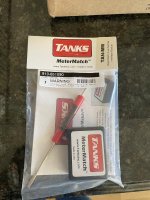
Read all I could about this problem on Ford Barn, including this thread. Bought this variable resistance Metermatch device from Tanks. Does not do anything to influence the reading on the gauge.
Reinstalled my old sending unit and now it doesn't work at all.
My next step is to build a blocking plate for where the sending unit goes and leave a whole for a stick. When I'm curious I can pull out the stick, get a reading on fuel level and decide if a trip to the gas station is necessary.
Scratching my head, and staring at the stick....
Mark
Attachments



JayChicago
Well-known member
mgm60 Maybe your float is hitting top of tank before sender moves thru its full range of travel. You could try shortening the float arm.
Mickd
Member
Can you get your hands on a multimeter to read the ohms 4(resistance) value of the sender unit. Connect one probe on to the body of the sensor and one on the terminal post, then read the resistance with the float fully down. It should read around 73 ohms (gove or take a few ohms). Then lift the float to the top ( full) & read the resistance then. That should now be around 10 ohms. If you don't get those readings, then that sender is unsuitable. Simple as that.
I bought one from Dennis Carpenter a few years back now, and it was the wrong sensor. I ended up finding one on ebay, but I can't remember now who the company were.
So remember if it's not a 73 to 10 ohm reostat it's no good to you.
Also you more than likely will need to bend the float arm a bit to suit your tank.
What I did was to measure the internal height of the tank (drop a measuring tape in the hole where your sender will go and measure it that way). Then I grabbed a piece of wood about a foot square, screwed it to the wall and fixed the sender to the top of the piece of wood with a single screw then traced an arc on the wood following the movement of the float with "Empty" mark at the height of the tank.
Then I marked it half way, then marked where 1/4 of the arc would be, then 3/4. I then moved the arm up & down to ensure it would read correctly on the gauge. That's when you'll see how much to bend the arm.
I'll do a drawing in a minute and stick it up here because that explanation probably reads a bit messy.
Cheers
Mick


JayChicago
Well-known member
All good tests. But my point was the aftermarket senders are generic, the float arm needs to be adjusted/bent to fit your particular tank. Need full movement without the float being stopped by the floor or roof of the tank.JayChicago, I've tested it out of the tank so I can see the full range of the float arm while connected to the gauge. Also tested the gauge and it is good. The needle pegs to the top of the range when the sending unit wire to the gauge is grounded.
Mickd
Member
All good tests. But my point was the aftermarket senders are generic, the float arm needs to be adjusted/bent to fit your particular tank. Need full movement without the float being stopped by the floor or roof of the tank.
Yes Jay. That's what I found too.
In fact, I adjusted (read that as bent) my float arm so's it read empty well before it was at the bottom. Better to have a gauge tell you you're empty when you've still got some in there than the other way around !

AbbottInstrument
Member
Rather than start a new thread on this often discussed fuel gauge, sending unit problem, I'll jump back into this one. Thanks to Mickd for the technical explanation in how the sending units work with the gauges. But has anyone figured out how to get the modern sending units to work with the old gauge to give at least a close reading?
My 36 has original gauge and older rheostat sending unit in the picture. Gauge reads half full when sending unit is in the full position. Bought a replacement you see in the picture from Dennis Carpenter and bench tested. Gauge reads 1/4 tank when sending unit is in the full position. So that was a step backward.
Read all I could about this problem on Ford Barn, including this thread. Bought this variable resistance Metermatch device from Tanks. Does not do anything to influence the reading on the gauge.
Reinstalled my old sending unit and now it doesn't work at all.
My next step is to build a blocking plate for where the sending unit goes and leave a whole for a stick. When I'm curious I can pull out the stick, get a reading on fuel level and decide if a trip to the gas station is necessary.
Scratching my head, and staring at the stick....
Mark
The answer is both yes and no. Yes we absolutely can calibrate your OEM King-Seeley fuel gauge to function with a modern sending unit but there are a number of variables to be accounted for so it is not as simple as "do this and this"