
You are using an out of date browser. It may not display this or other websites correctly.
You should upgrade or use an alternative browser.
You should upgrade or use an alternative browser.
fordomatic fluid
- Thread starter Brian54
- Start date

KULTULZ
Well-known member
Multi-Vehicle Synthetic Transmission Fluid
Multi-vehicle transmission fluids are becoming more and more popular in the marketplace. Oil marketers design these fluids for a wide range of automatic transmission types. While they are not licensed by any specific auto manufacturer, they are designed to provide superior performance and protection. They are formulated with the latest additive technology and their performance is typically supported by extensive field testing. Most multi-vehicle transmission fluids utilize synthetic base oils.
SOURCE - https://team.valvoline.com/diy/how/specs-choosing-right-atf-your-vehicle
INSERT -
TYPE F Transmission Fluid
This fluid meets old Ford specification and is not commonly recommended for today’s transmissions. This may be the fluid of choice of older Ford classic cars, racing or hydraulic applications.
SOURCE - https://www.castrol.com/en_us/united-states/home/motor-oil-and-fluids/atf-oil-uses-types.html
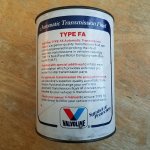
There is no FORD SPECIFIED FA ATF. It is an aftermarket term.
Unless the fluid container displays the manufacturers license no. (FORD-GM-MOPAR) (to show blending compliance) , it is not factory approved, period.
*************************************************************
And the CAPT. AHAB - MOBY DICK SYNDROME has to be forgotten as whale oil was (is) not compatible with modern (1967- ) transmissions.
DESCRIPTIVE ARTICLE CONCERNING WHALE OIL USAGE -
http://www.secondchancegarage.com/public/725.cfm
Attachments


Last edited:
KULTULZ
Well-known member
Kultulz, what EXACTLY do you use, and where do you get it?
I personally only use MOTORCRAFT AT FLUIDS. It is readily available on AMAZON and such. I usually go to a MOTORCRAFT DISTRIBUTOR to buy.

LOWRIDER
Senior Member
I just use the type F and green antifreeze in my pre 80's cars. Ford already has changed the color and content of coolant twice in my 2012 and 2005, orange, pink, gold. What did they do, hire someone from Sherwin Williams?
My sister was a chemist at a small oil company that supplied different type lubricants to shops and manufacturers in the metro Detroit area. She received a call one time that a cutting oil they supplied didn't work like it should. When she talked to the foreman he said "this new stuff is blue and doesn't work like the old red stuff". No problem. She had a batch made up the same way and just added a dye to make it red. Guy called back and said it works great now.

Gene F
Well-known member
My grandfather brother pull a stent driving a tanker truck. For premium they used to get up on top of the tanker with a gallon jug of red dye and a ladel before they left on the delivery. Hard to tell if there were additives in there or not. This was like a zillion years ago.
Attachments


KULTULZ
Well-known member
The oil companies are happy to prolong the myth that oil "wears out" when it fact it never wears out. Contaminates are what makes oil unusable and proper filtration captures those contaminates.
How does one renew the detergent/dispersant packages ...

Using bypass filtration there are 18 wheelers that go over 300,000 miles between oil drains.
True, but ...
They are subject to frequent oil analysis, filter changes and make-up oil keeps the detergent/dispersant packages good.
To me, it is a lot cheaper to frequent quality oil/filter changes (especially today's engines) rather that pay repair/replacement costs.

GLAmes
Senior Member
How does one renew the detergent/dispersant packages ...
True, but ...
They are subject to frequent oil analysis, filter changes and make-up oil keeps the detergent/dispersant packages good.
To me, it is a lot cheaper to frequent quality oil/filter changes (especially today's engines) rather that pay repair/replacement costs.
My sample analysis tells me when the additive package is low. It never is, mainly because at a bit over 500,000 miles this engine burns and leaks about a qt ever 2500 miles so the makeup oil, as you stated, renews it. Filter and analysis for me is in the $50 range. I change the filter and do analysis at 15,000 mile intervals. Oil filter and new oil is about $115 and I don't have the advantage in knowing the health of my engine or if there are contaminates present. Without analysis you are more likely to encounter repair/replacement costs. Therefore it is not cheaper to just frequently change the oil.
KULTULZ
Well-known member
Without analysis you are more likely to encounter repair/replacement costs.
True.
Therefore it is not cheaper to just frequently change the oil.
Well, that is a matter of opinion and I don't see an IMO in your statement.
What was being described in the discussion above was HEAVY DIESEL and fleets use that method to save $$$. If an engine or two fails, it is absorbed into operating costs.
Is your vehicle gas or light diesel?
BTW - Good thought on filter change with extended drain intervals ...

GLAmes
Senior Member
Well, that is a matter of opinion and I don't see an IMO in your statement.
OK. IMO spending $50 every 15,000 miles costs less than spending $115 every 5000 to 6000 miles.
GLAmes
Senior Member
What was being described in the discussion above was HEAVY DIESEL and fleets use that method to save $$$. If an engine or two fails, it is absorbed into operating costs.
Is your vehicle gas or light diesel?
Actually that method is used by small fleet owner/operators many of whom only have one truck. Large fleets like Swift or Wal-Mart don't do analysis. They just buy new trucks when the old ones get to 600,000 miles or so.
Mine is a medium duty diesel, 5.9 Cummins.

rotorwrench
Well-known member
Most modern motor oil has the microscopic polymer plastic added to it so that is will have more viscosity hot that it will when cold. That stuff wears out withing about 3000 miles. Comparing motor lubricants to ATF is not a good idea. Motors make combustion byproducts and transmissions don't.
Transmissions rely on clutch plates and bands to hold against torque so the fluid is made to aid in achieving that goal as well as lubricate bearing surfaces and valves. Clutch plates have evolved a lot over the years. Ford started out with bronze on steel for friction and slowly evolved to composite linings on steel. Most ATF products have friction modifiers to ease the lock up of friction surfaces and make the shift softer and less harsh. Ford Type F has no friction modifiers to speak of and makes for harder and possibly more harsh friction lock up. Ford wanted to make sure that there older designs than still used metal on metal friction lock up would not slip much. Slippage ruins these types of friction plates fairly quick. Racers like fast and hard shifts so type F is still used for that purpose as well.
Transmissions rely on clutch plates and bands to hold against torque so the fluid is made to aid in achieving that goal as well as lubricate bearing surfaces and valves. Clutch plates have evolved a lot over the years. Ford started out with bronze on steel for friction and slowly evolved to composite linings on steel. Most ATF products have friction modifiers to ease the lock up of friction surfaces and make the shift softer and less harsh. Ford Type F has no friction modifiers to speak of and makes for harder and possibly more harsh friction lock up. Ford wanted to make sure that there older designs than still used metal on metal friction lock up would not slip much. Slippage ruins these types of friction plates fairly quick. Racers like fast and hard shifts so type F is still used for that purpose as well.
Last edited:
Gene F
Well-known member
Rotorwrench makes a good point. If I may add... In the ATF world I always heard that the Type-F formula was more gripppy, and the new formulas were more slippery BY FAR.
I have been told that when selecting lubricants you should go in this order:
1 select a formula (when in doubt ask the MFG)
2 viscosity
3 a brand you trust
4 consider price
It seems that most people work this list backwards. I know my Dad always did! LOL LOL LOL
I have been told that when selecting lubricants you should go in this order:
1 select a formula (when in doubt ask the MFG)
2 viscosity
3 a brand you trust
4 consider price
It seems that most people work this list backwards. I know my Dad always did! LOL LOL LOL
Just installed a new Y block in my father's 1956 F-100 with a Fordomatic transmission. Overhauled the transmission while it was out. What is the transmission oil capacity? We had added an auxiliary cooler, so will start with recommended amount, and and part litres afterwards. Thanks in advance

fordor41
Well-known member
a lot of Mopar products don't have dip sticks. You can buy them on Amazon. the filler tube is there, somewhere, or no one could service the trans, even at a dealership. Ford VST's are buried under all the intake plastic duct work. have to hunt to find it.That's an interesting read considering other sources say oils and fluids have no expiration. And how does that jive with my wife's last minivan, a Toyota, her current mini van, a Chrysler both of which have no fill port (dipstick) and no manufacture's service interval? My 2019 Ram also doesn't have a service requirement for the transmission fluid. It does not have a dipstick either, thus no fill port.
KULTULZ
Well-known member
Why I keep doing this is beyond me ... just keep asking for it.
ALL lubricants have a shelf life, those lubricants for late applications being more critical.
SOURCE - https://go4trans.com/technical-tran...ife-and-storage-rules-for-transmission-fluid/
Late trans are sealed for a reason, they are electronic. Solenoids are subject to damage if exposed to outside air. The manufacturer(s) does not want the owner to be pulling a stick exposing the trans to air and dirt while under drive-train warranty.
Fluid level and quality can be checked by other methods.
You use the manufacturers called-out fluid (or it's correctly called out replacement) that the manufacturer calls for or if rebuilt, what the kit manufacture calls for (and get that in writing).
There is no multi-vehicle motor oil/ATF/coolant and there is no 20,000 mile oil change.
BTW - Plastic containers are porous. Over time, atmosphere will enter the sealed bottle. You open a container of brake fluid, not use all of it and sit it on the shelf, it is compromised.
When you shop parts or lubricants, you choose the recommended quality replacement. Then you shop price.
ALL lubricants have a shelf life, those lubricants for late applications being more critical.
All manufacturers of lubricants for car components usually indicate date of manufacture and expiring date on the container/package for a reason! Commonly, the shelf life of transmission fluids does not exceed more than 5 years from the date of manufacture. However, this period is specified for tightly closed and sealed (and stored under recommended conditions) products.
Fluid manufacturers say that their products can be stored at temperatures between +10 and +25 ºC. Higher temperatures can lead to premature oxidizing processes. Temperatures below recommended limit may cause fall-outs of precipitation and appearance of deposits. In case, when the container with transmission fluid is opened, the storage room is wet or unheated, there is a strong fluctuation in temperatures, thus transmission fluid may lose its properties before its time (change in viscosity, oxidizing, etc.)
SOURCE - https://go4trans.com/technical-tran...ife-and-storage-rules-for-transmission-fluid/
Late trans are sealed for a reason, they are electronic. Solenoids are subject to damage if exposed to outside air. The manufacturer(s) does not want the owner to be pulling a stick exposing the trans to air and dirt while under drive-train warranty.
Fluid level and quality can be checked by other methods.
You use the manufacturers called-out fluid (or it's correctly called out replacement) that the manufacturer calls for or if rebuilt, what the kit manufacture calls for (and get that in writing).
There is no multi-vehicle motor oil/ATF/coolant and there is no 20,000 mile oil change.
BTW - Plastic containers are porous. Over time, atmosphere will enter the sealed bottle. You open a container of brake fluid, not use all of it and sit it on the shelf, it is compromised.
When you shop parts or lubricants, you choose the recommended quality replacement. Then you shop price.
KULTULZ
Well-known member
Just installed a new Y block in my father's 1956 F-100 with a Fordomatic transmission. Overhauled the transmission while it was out. What is the transmission oil capacity? We had added an auxiliary cooler, so will start with recommended amount, and and part litres afterwards. Thanks in advance
You go by the called-out refill amount in the SHOP MANUAL or other quality LUBRICANT GUIDE.
Does the cooler have a heat source to keep the fluid from being over cooled?
GLAmes
Senior Member
There is no multi-vehicle motor oil/ATF/coolant and there is no 20,000 mile oil change.
Only in your mind. Prestone makes an anti-freeze that is compatible with all colors. My pickup, which used to average about 75,000 miles a year, has been on a 30,000 mile oil change schedule with 15,000 mile filter changes for 7 years. I used to believe the blarney about extended oil drains, then I started getting my oil analyzed. I found that most of us pour perfectly good oil into the recycle barrel. It is the oil companies that benefit, not our engines.
KULTULZ
Well-known member
Only in your mind.
Prestone makes an anti-freeze that is compatible with all colors.
Just wondering, how long were you a professional auto tech?
I began in 1966.
There is no ... ??? ... well let me clarify that ... there are MULTI-VEHICLE COOLANTS ... but their being compatible with or as a replacement, no, especially with today's tech.. Will PRESTONE offer a repair policy if the system fails because of incorrect coolant usage? Try and collect on that one.
What one does with his/her/it/mutant car is not the debate here. People pick this stuff up and run with it and once experiences failure(s) beyond DRIVE-TRAIN WARRANTY cry about the car manufacturer.