flathead V8 - what year do you think?

51f1truck

Junior Member
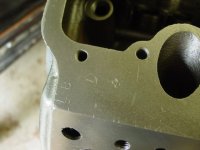
I am toying with the idea of restoring another flathead. I have a second engine, different than my '52 8BA. It is almost complete, and I have started to disassemble and clean. Below is a picture. It has the 21 studs and the crab style distributor. On each head are some number.. 68-6049 on the passenger head and 68-6050 on the drivers side. Any thoughts on how I can identify what the year vehicle this engine would be correct in?

lisalast005.jpg
 
34-36 mtr. 42 dist+timing cover,47 fuel pump possibly a 41 to 48 cast iron intake manifold. At a quick look. ken ct.
 
Probably a 35 or 36 commercial engine with late crab distributor and 47-48 fuel pump as Ken ct says. The 68 prefix on the heads should indicate dome top pistons. If it has dome top pistons correct heads should have a 48 prefix. 68 prefix were a replacement head, not a production head. If flat top heads, should have a 40 prefix on the heads. No way of telling what has been done to it over the past 75 years.
 
Probably. They made a change in 1936 to insert bearings during the model year. Could be either. Only way to tell for sure is to drop the pan.
 
The motor mounts are 1935. Is there a triangle shaped vent on the bottom, forward of the oil pan? If so it's 35/36 and guessing by the mounts I'd go 35.
 
Probably. They made a change in 1936 to insert bearings during the model year. Could be either. Only way to tell for sure is to drop the pan.

Insert bearings came out in October 1935. Same time as the flat top distributor coil and new distributor. Don't know where it started being called a "late 36" distributor.
 
It appears that the crab distributor is spaced out from the front cover utilizing hex nuts to make up for cam clearance.
 
And why are so many socalled early 36's have the domed coil and 35 style points setup as mine does a May car built in 36.It was a slow change over to the flat top dist in 36.ken ct.:)
 
It appears that the crab distributor is spaced out from the front cover utilizing hex nuts to make up for cam clearance.
I noticed that hoakey deal, some big "O" ring or such behind it to keep in cam gear oil? & what about the vacum? I would make a spacer, juggle front covers or dist. to get it right.
Reason I am anal about it is I run a Weber cam and someone had done this job badly enough to mess up the drive slot in the cam. I am suspicious of my timing being full advanced to run decent, could leingthen miunting holes to slots but what about vacum passage?
But I digress, hope your drive slot is OK. I would love to see close-ups of that adaption when you get that far. Somethin new every day...
BTW, my motor was stamped, some say more were not marked than were:
 

Attachments

  • DSC04271.JPG
    DSC04271.JPG
    59.7 KB · Views: 64
"Insert bearings came out in October 1935. Same time as the flat top distributor coil and new distributor. Don't know where it started being called a "late 36" distributor."

Lawson is correct.

Unfortunately the wrong "late 36" information is so widespread that it has become accepted. Most websites give the wrong dates, and it's difficult to convince people otherwise.

Production began in September and the engines introduced in October of 1935.

... I have an October '35 engine and transmission .... and people will still insist that the engine must have been swapped.

(sigh)
 
I'm not into 35-36 stuff but aren't the motor mount pads on them about the same level as the center of the water outlet ? Your pic shows them to be below - that would be 33-34 in my book .I am looking at two 33-34 LH motormounts in my hands - one with the 40- # and one without as both are the same and both are common and they match what is on your motor . The camera angle is very clever at not showing some important details . It looks like the drains are angled out so that eliminates 32 . 33-36 BLOCKS fall into 3 categories 33-34 and 35-36 babbit or insert main . The 33-34 will not be vented and that is easy to tell by looking under the intake { not as messy as pulling the pan } for a pipe in the right front . It it has it is a 35-36 . 33-34 blocks are different in other ways also but this is a tell all . The 2 types of 35-36 blocks should be easy to tell also as the crank is different as is the width of the main cap bolts. Some but not all insert blocks will be stamped LB on the intake surface . The bolt on stuff on your motor looks scrambled but that stuff can be switched around . The question is " what year " and I would look under the intake for starters to see if it is vented . The block is what counts here . The exhaust isn't anything I am familiar with and is definately NOT for a 33-36 passenger car .
 
The exhaust is I believe '49-53 of some sort...distributor adaptation is clever but a wide open oil leak...heads non-production replacements from Ford. Need to see BOTTOM of block and/or inside valley to start, maybe a main cap off next if...
Nothing in pic dates the block, and the assembly is mongrel. Pre-1937 is only certainty here!
 
Well it has the recesses between the water outlets and the timing cover, so it isn't a 32 or a 33 block.
 
Well it has the recesses between the water outlets and the timing cover, so it isn't a 32 or a 33 block.
Has anyone actually seen one of the 33 blocks without the recesses ? I see that one is listed in the 33-34 V-8 club book but I have never seen one in person or in a pic nor have I heard of anymore ?
 
This thread generated some interesting discussion so I am posting some updated photos and info.

The block was stamped "L-B" with a 5 and Y along with it.

The crank is vented. You can see the vent tube in the photo below.
parts002.jpg


parts001.jpg


Also the crank had replaceable insert bearings, not poured babbits.

When taking this flathead apart, I was impressed with how clean it was and the pistons looked liked new. I was able to simply push them out the top, telling me that a rebuild had been done and there was little time on the engine since the last rebuild. Unfortunately, like many old flatheads I have worked with, the block had a crack from the intake valve into the cylinder. That basically will kill this attempt at another flathead rebuild for me... :mad:

Oh well, I was hoping to save it. But the scrap man will get the block and crank, the rest of the parts will go on Ebay. If any one sees anything they need, just drop me a message.

Another flathead bites the dust ...!

Fred
 
Fred, That being an LB block makes it somewhat valuable to the restorers. That crack is probably very fixable by the metalok process. If you're intending to sell it for scrap metal, why not offer it to an early Ford restorer for the same money? Alternatively, carry on with your original rebuild plan, get the crack repaired, valve grind, set of bangles into the deglazed cylinders and you've got a good engine. Whatever, please don't sell it to the scrapman! Brian
 
In the first of Fred's updated photos above, just to the left of the vent tube, there appears to be a small hole in the block just above the middle of the camshaft gear. I found a similar hole (~1/4") in my early '38 21-studder and initially figured I must've drilled it for some forgotten reason about 50 years ago. Now I'm not so sure I did it back then. Does anyone know what this hole is for if Henry intended to be there? I tapped and sealed it with a 3/8"-16 bolt. Thanks.

Jack E/NJ
 
In the last of Fred's updated photos, I really don't see a hole. So Fred, am I seeing a hole that's really NOT there in the first photo? Thanks.

Jack E/NJ
 
Back
Top