
You are using an out of date browser. It may not display this or other websites correctly.
You should upgrade or use an alternative browser.
You should upgrade or use an alternative browser.
Engine block I.D. pictures
- Thread starter 38 coupe
- Start date


rotorwrench
Well-known member
The 41A block was a replacement block for the 221 cid engines starting in late 1944. Production was side by side with the 59 series blocks but they aren't completely the same. The 41A has characteristics of the ealier 221 and the later 239. It may not have very thick cylinder walls but it can be bored to 239 specs without problems unless it has core shift or corrosion.

gmanrides
Senior Member
Thanks 38 coupe and all contributors for the wealth of information. Here are a few pictures of what we believe to be a 38 221 Canadian block 24 stud 3.06 bore. It has 81 cast in front of right bank, flat intake surface, drilled and tapped 3 oil ports at rear and one below dipstick tube, dimples in pan rail, with long crank snout. It also has a sleeve in the fuel pump rod bore.
Attachments


Last edited:
I supposed I have a 1932 V8 but I'm not sure now : correct 1932 front motor mounts, cast iron heads, aluminium crankcase, single barrel intake, 1932 generator, ... but later fuel pump !?
Someone take off some parts like the starter, the carb, the ignition, the ******, the rear axle and the seat before I bought the car.
Someone take off some parts like the starter, the carb, the ignition, the ******, the rear axle and the seat before I bought the car.

DavidG
Well-known member
The fuel pumps went through lots of changes in the early V8 years so a later fuel is an indicator of nothing more that it is a later fuel pump. Whether or not your engine was manufactured during the 1932 model year is determined by the engine block itself and not by the vintage of the attached parts attached to the block. The two defining characteristics of a '32 block are the location of the water drain ***** and the extent of the front machined surface of the block. Both of these characteristics are shown in photos earlier in this thread.

DavidG
Well-known member
Here's a photo of the front of a very early '32 V-8. The boss immediately above the timing gear cover (which itself is unique as it lacks the ribs of the later covers) relates back to the first version of the timing gear cover (and distributor) which were recalled in a service campaign shortly after '32 model public introduction day.
Attachments


Bored&Stroked
Well-known member
Here's a photo of the front of a very early '32 V-8. The boss immediately above the timing gear cover (which itself is unique as it lacks the ribs of the later covers) relates back to the first version of the timing gear cover (and distributor) which were recalled in a service campaign shortly after '32 model public introduction day.
That is cool David - have never seen that very early 'smooth' timing cover. How was the distributor different?
DavidG
Well-known member
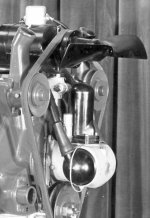
As requested, the photos below are of the first '32 timing gear cover and the matching distributor. Several of the recalled distributors have survived the normal Ford practice of destroying such parts, but the timing gear cover shown may well be one of only two escapees.
Attachments



VeryTangled
Well-known member
As requested...
More please?!? Anything you think we need to know.

AZ Chris
Member
Rather than start a new thread, I figured this would be a better place.
Recently got this block and trying to ID it. From everything I can find it appears to be a 239 from a 39-41 (closer to 41?) truck based on the stamp on the left rear of the block 99T-638628 and the lower water passage.
From what I can gather this is a good block but one question is whether parts for a "59" block will fit properly.

chuck stevens
Well-known member
Are 32 heads very rare?
DavidG
Well-known member
Not particularly (about $100+ a pair for the two most common varieties). There were three versions depending on when they were produced during the '32 model year. The first version had cast-in part numbers followed by either RH or LH (as though that was not obvious from where the water pumps attached). The second version excluded the RH and LH and occurred early in the model year. The third version had no part numbers and was adopted about mid year.
The first version might command a price premium as it is the rarest of the three, although it's appeal is likely to be limited to those with early engines (all of whose components are rare and expensive).
The first version might command a price premium as it is the rarest of the three, although it's appeal is likely to be limited to those with early engines (all of whose components are rare and expensive).
rotorwrench
Well-known member
Rather than start a new thread, I figured this would be a better place.
Recently got this block and trying to ID it. From everything I can find it appears to be a 239 from a 39-41 (closer to 41?) truck based on the stamp on the left rear of the block 99T-638628 and the lower water passage.
From what I can gather this is a good block but one question is whether parts for a "59" block will fit properly.
If it has bulges on each side of the pan rail with core plugs then it is early 39/40 type. If it has no core plugs on the pan rail and has a raised appearance on the intake deck then it would be 41/42 type.
If it has the 29A con rods then it is a direct interchange for rotating assemblies with the 59 series. The 59 stuff will fit it though as long as you use all the right parts. The only real difference then would be that it has thicker cylinder walls and the earlier type valve angles.
AZ Chris
Member
If it has bulges on each side of the pan rail with core plugs then it is early 39/40 type. If it has no core plugs on the pan rail and has a raised appearance on the intake deck then it would be 41/42 type.
If it has the 29A con rods then it is a direct interchange for rotating assemblies with the 59 series. The 59 stuff will fit it though as long as you use all the right parts. The only real difference then would be that it has thicker cylinder walls and the earlier type valve angles.
Thanks. It has the raised intake deck and the rotating assy was swapped out of a 59 block. The valve angle shouldn't matter on the thicker block, should it?
rotorwrench
Well-known member
The valve angle will depend on the heads you use. If you have and older 99, 09, 19, or 29 type block (1939 through 42 239-CID), you can either use the old original 99T, 81A (big A heads), or other early type pre-war heads that are non-59 series with no problems. If you use later 59 series heads or some of the aftermarket heads, you might have to do a little bit of relief in the valve areas of the chambers to make sure they don't make any contact in there. You can convert everything to 8BA style too if you want to use a 4-inch Mercury type crankshaft.
They used to make tools to do the valve relief work but they are getting hard to find. A little work with a die grinder might do the trick too as long as you go at it in a scientific manner.
They used to make tools to do the valve relief work but they are getting hard to find. A little work with a die grinder might do the trick too as long as you go at it in a scientific manner.