electic pump

bobsmanstuff

Senior Member
My 53 is still 6 volt. I'd like to put an electric fuel pump just to fill the bowl. If I use a toggle switch, what would be the best way to wire it up? Thanks

 
A momentary push button switch would be best. Provide 6V from your ignition wiring.
A toggle switch to turn on may be forgotten and run all the time. For constant on, best way is to have and an oil pressure safety switch.

520515


Glenn
 
You need a pump that is "open" in the off position so the mechanical pump can still pull fuel through it. They make pumps both ways, open or shut in the off position. Mount it close to the tank and install a filter between the tank and the pump.
 
I dont start mine very often and when it has sat for a while I need to crank it a bit to get the gas going again. A friend suggested I get a one way valve to keep the fuel bowl full but I havent tried it yet. I dont know about a '53 but a '38 needs a very low pressure pump or a regulator. I put an electric on it once and blew gas all over the place (duh).
 
One problem is the fuel evaporates out of the float bowl through the vents if it sits for a long time, no matter what kind of check valves are in the fuel pump. The carb gaskets, dry out and shrink and thenthe carb needs a rebuild. The evaporated fuel leaves a a varnish that plugs up fuel passages. It best to just go out there and start it once a week. Stomp on the brakes too to reset the residual brake pressure to keep the wheel cylinders from seeping. You can't let a carb set like you can a modern fuel injected car, you should use them at least once a week I'm guilty of it too, too many projects.
 
If you use a toggle switch, hook it to the “on” side of the ignition. When you turn the ignition switch off, no more power to pump, it shuts off and won’t keep pumping. I had to add a fuel pressure regulator from Holley because my pump is a 6 volt, 5-8 lbs of pressure. The model 94 carb doesn’t need much pressure, mine is set at 3 lbs. I don’t use the mechanical pump.
 
Mechanical fuel pumps often have a hard time drawing fuel THROUGH an electric pump that is turned off.

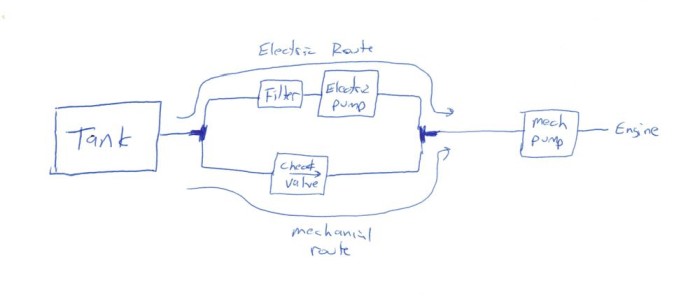
This is a way you can use a check valve (one way valve) to plumb in an electric pump. When the pump is turned on, it feeds the engine fuel. When it is off, the mechanical pump is able to freely draw fuel without issue. No fancy plumbing or wiring required.

mBkHyeA.jpg
 
Mike: If possible, please repost your sketch a little smaller. For some reason, I can't enlarge the viewing area of my computer screen so I can read the entire post. Also, please post info. as to the part # for your check valve. Thanks, Jim
 
Here you go Jim.

Mike: If possible, please repost your sketch a little smaller. For some reason, I can't enlarge the viewing area of my computer screen so I can read the entire post.Thanks, Jim

520707


A check valve as shown would not seal against backflow to the tank after the engine has been shut off for a short time. If you got a check valve that did work, I.e., very tight and sealed against the valve seat; you would have to overcome this resistance with just the mechanical pump. It will not work for this situation. I did this stuff for a living.

Glenn
 
More parts more potential problems. Keep it simple! The original system worked okay if driven often. There is a design problem with the fuel pump being mounted high on the intake; it is harder for the pump to suck the extra air out of the line and lift the weght of the fuel up hill to prime the pump when it dries out. They do not make very good air compressors; they are designed to pump liquid. Then if you come along and alter the original engineering by installing a larger 5/16" line back to the tank for a go-fast flathead, it is even harder for the pump to purge that extra volumn air out of the line. You will notice that all later V8 engines have the fuel pump mounted very low on the side of the block. The fuel tank is in the trunk floor or along the frame rail, it is almost level with the fuel pump, this helps prime the pump. The best solution for an old car that is hard to prime after it sits awhile is an electric priming pump. Unless you want to burn up your starter cranking-and cranking. That is really hard on the starter; it overheats it. Even if the electric priming pump were to eventually fail it will fail in the open position so there is no downside to having one. After the electric pump primes the system and you switch it off you're running on the original pump that puts out the correct pressure the carburetors were designed for. Plus, I like the look of that old-timey glass bowl full of clean fuel.

I have a swimming pool sixed fishpond with a large pool pump to run a waterfall. The pump is above the ponds' water level by probably 2'. It will not prime the pump unless I close a valve on the intake side, fill the pumps' filter reservoir to the top with water. Turn it on and then slowly open the valve on the intake side. So, I tried a check valve on the intake side at the water level to prevent it from draining back when the pump was off. It just caused more problems with the pumps vacuum trying to pull the check valve open. The neighbor has a larger pond. He was cold storage refrigeration engineer (before he moved out of CA) that designed all of the refrigeration plants' plumbing. He mounted his pump lower than the water level. It self-primes, being lower than the water level, gravity feeds it like a Model A gas tank. If we lose electricity, when it comes back on his pump will prime and mine might not. That's another project I should be working on.
 
I dont start mine very often and when it has sat for a while I need to crank it a bit to get the gas going again. A friend suggested I get a one way valve to keep the fuel bowl full but I havent tried it yet. I dont know about a '53 but a '38 needs a very low pressure pump or a regulator. I put an electric on it once and blew gas all over the place (duh).

The fuel pump should not allow the fuel to flow back when in storage. Thus, a check valve is not necessary IF the fuel pump has been rebuilt properly.
 
Here you go Jim.


FQEp1Vo.jpg


A check valve as shown would not seal against backflow to the tank after the engine has been shut off for a short time. If you got a check valve that did work, I.e., very tight and sealed against the valve seat; you would have to overcome this resistance with just the mechanical pump. It will not work for this situation. I did this stuff for a living.

Glenn

If you study the diagram, the check valve will keep the pump from simply circulating back to the tank... yet when the pump is NOT turned on, the mechanical pump on the engine will still be able to draw through the check valve. Simply turn the pump on when you need it, and off when you don't!

The bold parts in the pic are Tee's. Fuel can go in either direction.
With the pump turned on, the fuel takes the top path. The check valve keeps it from simply returning to the tank.
When the pump is turned off, the engine draws fuel through the check valve.
Very simple to set up, and pretty much foolproof.

I wish dad would have done this years ago... Would have saved a lot of time along side the highway changing out fuel pumps! LOL
 
Last edited:
Before I found a flow through pump, this is what I used. Gas flows from right to left. Check valve is on top (white). Pump is not a flow through pump, so when it is off, the mechanical pump will not pull gas through it, but will pull it through the bypass line on top. (picture 1)

When I installed the flow through Airtex E8902, I wired mine to the map lite switch. When the switch is on the light is on and so is the fuel pump. When the ignition is off the switch is dead. I use the mechanical pump 99% of the time. Only use it to fill the float bowl after the car has sat for a lengthy period of time, or to clear vapor lock bubbles. (picture 2)
 

Attachments

  • DSCN5857.jpg
    DSCN5857.jpg
    65.3 KB · Views: 296
  • DSCN9177 w arrows.jpg
    DSCN9177 w arrows.jpg
    57.8 KB · Views: 50
  • DSCN9992 arrow.jpg
    DSCN9992 arrow.jpg
    48 KB · Views: 52
Last edited:
Yes. I put a small toggle switch in an existing hole under the dash on the right of the steering column ( RH drive). It is momentary in that it is sprung and has to be held to activate the pump and is only used for priming.

GB
 
Before I found a flow through pump, this is what I used. Gas flows from right to left. Check valve is on top (white). Pump is not a flow through pump, so when it is off, the mechanical pump will not pull gas through it, but will pull it through the bypass line on top. (picture 1)

When I installed the flow through Airtex E8902, I wired mine to the map lite switch. When the switch is on the light is on and so is the fuel pump. When the ignition is off the switch is dead. I use the mechanical pump 99% of the time. Only use it to fill the float bowl after the car has sat for a lengthy period of time, or to clear vapor lock bubbles. (picture 2)


Rube would be proud ! ;)
520711


edia.giphy.com%2Fmedia%2Fl0HlB8fSRD13liRgI%2Fgiphy.gif
 
Last edited:
A momentary switch works good to fill the fuel bowl, but won't do you much good if you live in Vapor lock country.
 
Back
Top