
Early 29 vs Late 29 Radiator Design?

Looking through the Brassworks radiator replacement options, I noticed they offer both an "OEM" and "Late 29" option with the primary difference being a wide-mouth water inlet port versus a thin tube.
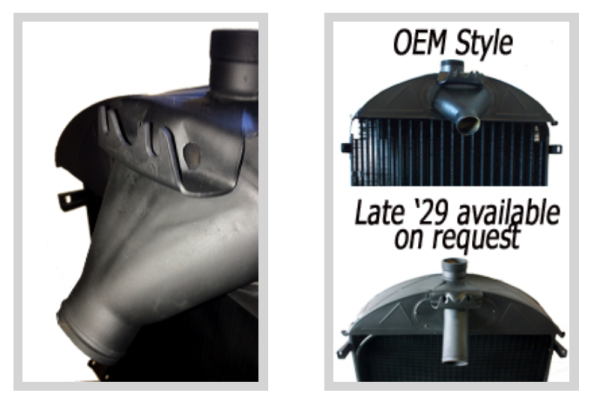
duVLPru.png


I was curious if anyone knew the reason for the change.

I'm sure that cost and build time led to the simpler tube, but I'm also wondering if one or the other had better performance.
 
I would be willing to bet that just about any change other than outer style changes were done either to:

(a) Changes to fix a known bug from the original design
(b) Changes to make the part and thus the car cheaper
(c) Changes to speed up or smooth out assembly of the car which translates to "cheaper" to produce


IIRC, the earlier radiator was costly to produce. It had some novel features such as the wide water inlet, and oval shaped tubes.

Ford was negotiating a contract with the Flint, MI supplier for the 30-31 Model year radiators, which did not have the same advanced features and were more of a "mom & pop" radiator which was like being made for at least one other car company: round tubes and the straight water inlet primary among these. Ford reasoned that the taller radiator with more "surface area" would compensate for the advanced features.

To "transition" to the new radiator, Ford agreed to use of available stock of the funnel top and henceforth (late '29) use the 30-31 details in normal radiator production.

This may be covered in the "Ford Model A" by DeAngelis. IIRC, he shows the tube patterns of the radiator changes.

Joe K
 
Wide top aides thermosiphon system,the A was a combination pump/thermosiphon system.Thermosiphon refers to hot water rising and cold water settling.There were a few subcontractors making radiators for Ford,McCord being one of them.28/29 radiators had round tubes and are quite heavy compared to new ones.
 
Just another reason to add the Restoration Guidelines and Judging Guidelines to a Model A enthusiast library. There is a whole section on Cooling with three pages having to do with just the radiator.


There is too much information to be copied here for specifics. Until Jun 1929 Ford made all the radiators, after that there were three more manufacturers (Long, Flintlock, McCord). tanks changed, some had cast inlet and outlet, the number of tubes (87, 94, 100).
 
That is generally thought to be true. Although one has to be sure the repop is made AS THE ORIGINALS WERE gauge of tube and cross section, to be sure.

An interesting aside - during the "funnel top" era, Ford did not have issues with radiator fluid being lost down the overflow pipe. As they got experience to the "newer design" radiator, problems with loss of fluid were noted - and instruction in the Service Bulletins (April 1930 p. 450) were added to "bend" the overflow pipe out of the stream of water coming up from the pump - and a production change on the radiator itself.

Today many complain about the pumps moving too much water and cut down the impellers or add a thermostat or orifice to reduce this.

Purchase of a funnel top will probably make the problem go away completely.

Joe K
 
wide neck also resists cracking. radiator under a lot of stress from vibration,frame movement and wind,the upper radiator hose/neck helps support the assembly.
Riley cured the water overflow issue by slowing down the water pump,the speed the water flows through the radiator cant be altered,the balance between the top tank and core can be slightly altered by extending the tube,but slowing the pump is a far more effective cure.
 
Back
Top