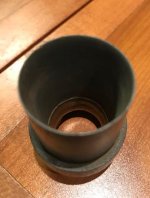
Different Model A Venturi

Joop

Well-known member
..
Found this at a Swap Meet today.

Same as Zenith but with brass insert.

Does not look home made.

What is it for.

Thanks


..
 

Attachments

  • IMG_0539.jpg
    IMG_0539.jpg
    34.8 KB · Views: 58
  • IMG_0538.jpg
    IMG_0538.jpg
    32.5 KB · Views: 64
  • IMG_0540.jpg
    IMG_0540.jpg
    32.4 KB · Views: 59
  • IMG_0541.jpg
    IMG_0541.jpg
    21.8 KB · Views: 57
  • IMG_0543.jpg
    IMG_0543.jpg
    34.6 KB · Views: 39
  • IMG_0544.jpg
    IMG_0544.jpg
    40.5 KB · Views: 33
Last edited:
since venturi is smaller maybe it is for a British engine ...

Although Henry would have used all pot metal unless there was a manufacturing problem which required brass for the smaller opening.

Brass was expensive
 
Last edited:
Added some pictures
 

Attachments

  • IMG_0543.jpg
    IMG_0543.jpg
    34.6 KB · Views: 44
  • IMG_0544.jpg
    IMG_0544.jpg
    40.5 KB · Views: 40
Last edited:
The carburetor for the AF engines did have a smaller orifice venturi (and smaller jet orifices as well).

Here is an original, April 1931, document from Zenith, France indicating the size of the AF single venturi. See the blue arrow indicating that the venturi of the carburetor for the AF engine is "18" compared to the venturi for an A and AA engine is "21.5" (look under the "Diff" column):
408245


"Diff" = Diffuseur, the french word for venturi

So based on the measurements that you show of your mystery venturi, it seems like it is not a venturi for a Model AF engine.

Brad in Maryland
 

Attachments

  • fullsizeoutput_1a74.jpg
    fullsizeoutput_1a74.jpg
    41.3 KB · Views: 419
Last edited:
Yes I concur with Brad the smaller engine was 18mm dia venturi ( approx 0.7 inch). Suspect that the venturi in the OP is someone's experimentation.
 
Just found this one in a pile of carburetor parts.
 

Attachments

  • 20240817_115955.jpg
    20240817_115955.jpg
    38.4 KB · Views: 83
Might this be a part intended for use on an air compressor conversion running on two cylinders? Or maybe just a restrictor to improve economy on some sort of stationary power unit that would run constant rpm? From what I can tell, the Ford industrial engines used the standard Zenith but other engines in things like combines used unique carburetors. This might have been a bandaid to make the Zenith work better for those applications.
 
I can picture that as well. On second thought though, it might actually increase fuel consumption over the stock venturi. Smaller opening would mean higher velocity at a given rpm, which would pull more fuel through the jets. Might help low end and throttle response though.
 
A friend here in Mathews just found a brass one sitting in his show case. Now I've seen two in less than a week.
 
Back
Top