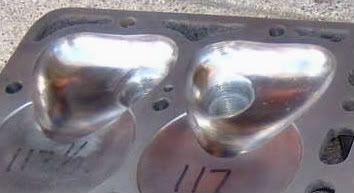
Cylinder Head Combustion Chamber

Glenn C.

Well-known member
Just noticed here the other day, that the combustion chambers on some of the new high compression heads are coming out not polished. Casting in the combustion chamber area is very rough. This condition will do nothing for performance, other than to collect carbon deposits. After awhile and under some load conditions, "backfiring" will occur. IMO I think a person should take the time to grind and "polish" this area to a smooth condition as possible, to improve the "flame front" for combustion. The same proceedure should be used on the original standard heads also.

Are all the cylinder heads coming out this way, or am I just unlucky ?
 
Back in the 80's I saw a stock Olds engine a guy was rebuilding. He polished the heads and piston tops to a very smooth finish. He didn't properly clean the honed cylinders and wore out the new rings in very few miles. When he pulled the heads, they and the piston tops had the same layer of carbon that any non-polished engine would have. I'm not sure what to make of this, but I wonder how much good or bad polishing actually does?
 
As compared to a particular grit piece of sandpaper how rough a surface are you talking about?

As for polishing, tests have shown that polishing the combustion chamber and piston top can increase horsepower by as much as 6 %. I have confirmed this with my dyno tests.
 
Brumfield Super Head, CC'd & Polished
DSCF0020-1-1.jpg
 
Larry.....Almost like the sanding pads that would be used for a large pad floor sander. A lot coarser than 30 for sure. I think the picture posted by MikeK, is the way it should be. It's now going to be challenging to grind and polish the chambers
to the fine quality as shown in the previous posting, without damaging the sealing face. I guess if that happens, a person can still drop the head back on the surface grinder to clean up a slight bit of damage.
 
Yep, for the inexperienced it is a challenge and a chamber can be ruined as well as marring up the gasket surface. For the experienced it's mainly just time consuming. Mike K. paid me a significant extra amount for his polished & blueprinted Brumfield Head. In addition, he loves his wife 'cause he bought one for her car too!

A head with an "as cast" chamber as rough as you describe will inhibit performance and provide a surface for carbon to cling to much easier. It should be considerably smoother if intended to be used "as cast"; not necessarily as smooth as one that has been polished but smoother, i.e., much closer to Ford's original "as cast" finish for example.
 
Last edited:
I have always wondered what effect some roughnes has on increasing turbulence, thus improving economy. Any data to confirm this?
 
The action of a proper quench and proper chamber shape should provide all the turbulence necessary. Roughness has some effect on turbulence but it also impedes the air flow which is not good.

Polishing the chambers improves the fuel economy as well as the horsepower by a small percentage.

Now there is a process known as dimpling the combustion chamber but the resulting surface is not like a poorly made rough casting. The surface is more like a golf ball, i.e., little uniform dimples but otherwise smooth. Some people think the practice of dimpling is absolute b.s. and others say that it puts wet flow back into the air flow and improves combustion. I have not experimented with dimpling and I don't think there would be much of a benefit on a low RPM, low compression engine like a Model A if there's any benefit at all.
 
Back
Top