
You are using an out of date browser. It may not display this or other websites correctly.
You should upgrade or use an alternative browser.
You should upgrade or use an alternative browser.
Con Rod Nuts
- Thread starter DBSHELTON
- Start date
Jack Shaft
BANNED
the original fasteners and cotter pins? yes
This is kinda new to me. I am doing both the engine in my Huckster and a spare engine that I have. The spare engine has the chewed up nuts that look original. All rods were .001 to .0015 so I left clearance as is. I only replaced the nuts with new nuts and cotter pins from either Bert's or Snyder's (Cat't remember). The Huckster engine clearance was .002 to .003 so I went ahead and took out shims to get to .001 to .0015. It has a longer castellated nut that looks much more substantial than the stock nuts so I reused them.
All the rod babbits look great in both engines.
Next I will tackle the mains.
BTW spare engine oil pan had no sludge the Huckster had very little sludge. I think that is a good thing.
All the rod babbits look great in both engines.
Next I will tackle the mains.
BTW spare engine oil pan had no sludge the Huckster had very little sludge. I think that is a good thing.
Last edited:
Jack Shaft
BANNED
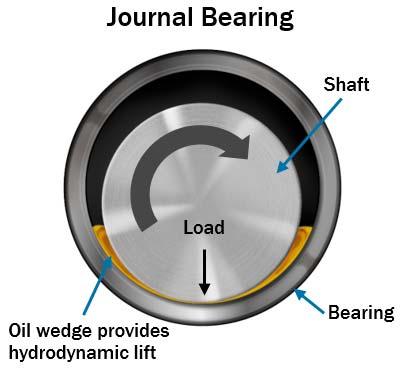
The hydrodynamic principle is fixed at .001 per inch of shaft diameter this clearance allows the oil to support the crankshaft.Using modern diesel grade engine oil with higher load characteristics aides the principle. When using the stock model a crankshaft (non counterbalanced,but dynamically balanced) the torsional vibration at high rpm causes as much as .001 flex in the crankshaft,accelerating bearing wear.

redmodelt
Well-known member
If at 35 the nut only has to move a small amount to get the cotter pin in, then yes I would turn till it goes in. If you can's see the hole then I sand down the nut and try again. Yes it is bit more work, but as the studs can't be replaced and once the threads are pulled, the rod is junk.
For sanding down the nut; I use 400-600 grit paper on a flat hard surface. Pulling the nut across it for example 3 times, turn 180 and 3 more times then test fit. Repeat as needed, but as you get close reduce the number of strokes across the paper.
For sanding down the nut; I use 400-600 grit paper on a flat hard surface. Pulling the nut across it for example 3 times, turn 180 and 3 more times then test fit. Repeat as needed, but as you get close reduce the number of strokes across the paper.
Steve Rinaldo
Member
Just something for you to think about. I ran Tech centers for 3 different car companies in my working life. Engines haven't used cotter pins and castle nuts for many many years. Check Mcmaster Carr catalog and you will find several designs of all metal locknuts, not nylon. An example is high vibration distorted threads. If the will work on 700 HP engine , they will work fine on an A. I've had them on my car for over 20 years. Steve

Patrick L.
Well-known member
I usually tighten them to 30# and twist until the cotter fits. That ends up about 35-40#. If I need to sand a nut I set the paper on sheet of glass and then measure to make sure they were sanded square.
I also try my best to keep the 2 shim packs the same thickness. If they don't want to peel apart I sand them and measure them to make sure they are sanded evenly.
I also like to set the clearances [rod and main] at .0015" [ a bit tighter on the rear].
I also try my best to keep the 2 shim packs the same thickness. If they don't want to peel apart I sand them and measure them to make sure they are sanded evenly.
I also like to set the clearances [rod and main] at .0015" [ a bit tighter on the rear].

Synchro909
Well-known member
I pulled the oil pan to check/adjust bearing clearance. The nuts on there are pretty chewed up so I have a set on new nuts and cotter pins. When reassembling, do you torque the nuts to 35ft/lb and then tighten more to line up the hole for the cotter pin?
Those nuts are some weird size that I at least don't have a spanner to fit. The same probably applies to many others so they use what they have. The result is chewed up nuts. I think on the next engine I have apart, I'll file them down till the next size down spanner will fit. The beauty of metric is that there is a spanner every 0.040" so not much has to come off.
As for fitting the split pin, I go along with those who use modern self locking nuts and no split pins.

katy
Well-known member
Those nuts are some weird size that I at least don't have a spanner to f
IIRC they are 19/32".
Synchro909
Well-known member
IIRC they are 19/32".
OK, who has a spanner that size???? That converts to 15.08 mm. That is only 0.003" over 15mm. It would just take a lick to get them to 15 mm and every decent set of metric spanners has a 15mm.
Big hammer
Well-known member
Check out Metwrich, they fit standard and metric, they fit loosely but instead of rounding the corners they grab the flats. Best money I've spent on tools !

Bruce of MN
Well-known member
Check out Metwrich, they fit standard and metric, they fit loosely but instead of rounding the corners they grab the flats. Best money I've spent on tools !
Do you have another spelling? Google doesn't recognize 'metwrich'.

Big hammer
Well-known member
Sorry for the spelling, thanks SAJ ! Metrinch
katy
Well-known member
OK, who has a spanner that size???? That converts to 15.08 mm. That is only 0.003" over 15mm. It would just take a lick to get them to 15 mm and every decent set of metric spanners has a 15mm.
Being that 15mm is so close, try a few different 15mm wrenches or sockets, you may find one that fits snugly, not too tight, not too loose.

Boston Bruce
Senior Member
Just something for you to think about. I ran Tech centers for 3 different car companies in my working life. Engines haven't used cotter pins and castle nuts for many many years. Check Mcmaster Carr catalog and you will find several designs of all metal locknuts, not nylon. An example is high vibration distorted threads. If the will work on 700 HP engine , they will work fine on an A. I've had them on my car for over 20 years. Steve
This...forget about using the castle nuts and cotter pins.
Jack Shaft
BANNED
Cotter pins do not hold torque.
Boston Bruce
Senior Member
Now fighting chewed up square main bolts. God I hate this crappy design!
You need an 8 point socket set.