
BUBBAS IGNITION
Well-known member
We get over 100 emails each and every day and some days 15-20 phone calls regarding ignition issues etc.
And thats fine ,as thats what we do for a living and certaintly dont mind helping anytime we can.
The highest problem is coil problems, so maybe this post will help.
Basically a coil is a coil is a coil etc and hasnt changed much especially when talking a standard oil filled coil either 6 or 12 volt.
There are three types used on all our cars.
1- A 1.5 ohm primary resistance ( pretty standard coil to be used with a 1.5 ressitor) Contact points usually..
2- A 3-4 ohm primary resistance coil ( internal resistor ) used on the four cylinders . Many use them on a V8 as well but we dont suggest it , based on inductance and overall design of the coil.
3- A .3-.5 ohm coil ( less than one ohm) This coil must have electronic module control to handle the current. Suggested use would be using a GM HEI control or MSD box etc. Higher than normal current draw..
Pretty standard with contact points is to use a 1.5 ohm coil with a 1.5 ohm ballast resistor. Interesting that the use of a 1.5 ohm resitor drops approx 6 volts allowing six volts at the coil. Meaning that a 1.5 ohm coil on a six volt car just wouldnt need the resistor.
Coil testing is pretty easy with a volt ohm meter.
Hook the meter across the positive and negative terminals to measure the resistance of the primary.
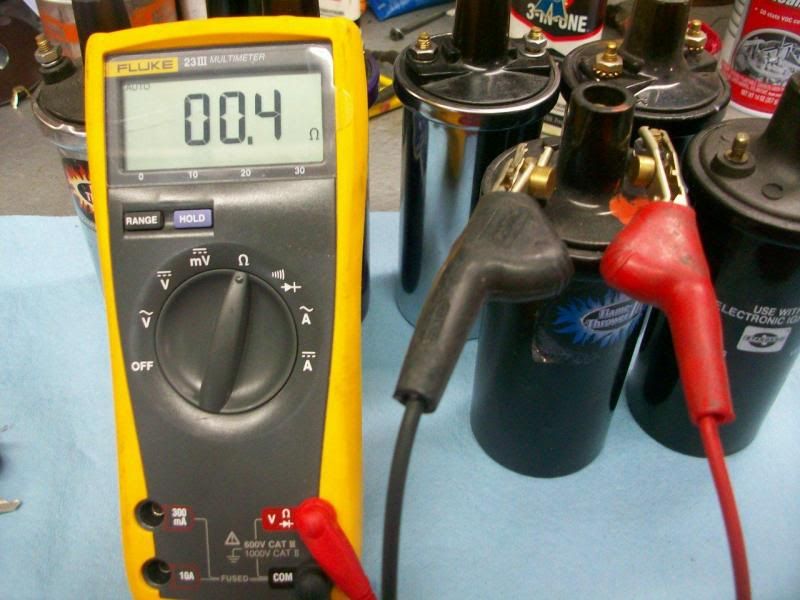
This is a low ohm coil for electronic ignition system and high current only !
Secondary resistance is measure by hooking to one of the primary terminals and the center output tower of the coil.

There may be 50 coils in the shop and most of them are very good and useable IN THE CORRECT APPLICATION. !!

A COUPLE NOTES:
A flathead seldom needs wide plug gaps and high energy ignition based on the fact that no matter what you do to the engine it will still be a flathead with valves in the block and somewhat low compression ratios.
Ignition output is always based on actual needs of the plug tip in the combustion chamber. A high output coil ( marketing issue) will only provide what the engine asks for. If a engine idles using 5000 volts and a high output coil is installed it will still idle using 5000 volts.
Higher current means higher heat somewhere in the system. Ever wander why NASCAR allows two MSD ignition system per car???? Very high current draw = high heat and control failures from time to time.
You need to watch my video series of "teknical" tips and spark output testing here:
http://www.lindertech.com/bubbasgarage.htm
And thats fine ,as thats what we do for a living and certaintly dont mind helping anytime we can.
The highest problem is coil problems, so maybe this post will help.
Basically a coil is a coil is a coil etc and hasnt changed much especially when talking a standard oil filled coil either 6 or 12 volt.
There are three types used on all our cars.
1- A 1.5 ohm primary resistance ( pretty standard coil to be used with a 1.5 ressitor) Contact points usually..
2- A 3-4 ohm primary resistance coil ( internal resistor ) used on the four cylinders . Many use them on a V8 as well but we dont suggest it , based on inductance and overall design of the coil.
3- A .3-.5 ohm coil ( less than one ohm) This coil must have electronic module control to handle the current. Suggested use would be using a GM HEI control or MSD box etc. Higher than normal current draw..
Pretty standard with contact points is to use a 1.5 ohm coil with a 1.5 ohm ballast resistor. Interesting that the use of a 1.5 ohm resitor drops approx 6 volts allowing six volts at the coil. Meaning that a 1.5 ohm coil on a six volt car just wouldnt need the resistor.
Coil testing is pretty easy with a volt ohm meter.
Hook the meter across the positive and negative terminals to measure the resistance of the primary.
This is a low ohm coil for electronic ignition system and high current only !
Secondary resistance is measure by hooking to one of the primary terminals and the center output tower of the coil.
There may be 50 coils in the shop and most of them are very good and useable IN THE CORRECT APPLICATION. !!
A COUPLE NOTES:
A flathead seldom needs wide plug gaps and high energy ignition based on the fact that no matter what you do to the engine it will still be a flathead with valves in the block and somewhat low compression ratios.
Ignition output is always based on actual needs of the plug tip in the combustion chamber. A high output coil ( marketing issue) will only provide what the engine asks for. If a engine idles using 5000 volts and a high output coil is installed it will still idle using 5000 volts.
Higher current means higher heat somewhere in the system. Ever wander why NASCAR allows two MSD ignition system per car???? Very high current draw = high heat and control failures from time to time.
You need to watch my video series of "teknical" tips and spark output testing here:
http://www.lindertech.com/bubbasgarage.htm


