
You are using an out of date browser. It may not display this or other websites correctly.
You should upgrade or use an alternative browser.
You should upgrade or use an alternative browser.
babbit tolerance? .000?
- Thread starter mike657894
- Start date
- Status
- Not open for further replies.


Railcarmover
BANNED
Ford used over 40 different steel designs during the model a .They sampled during a heat and tested after cooling and treatment,employing the largest number electric furnaces in the world in the upset and spring shop..brinell hardness was just one of them..they even performed failure analysis..

Purdy Swoft
Well-known member
I've read that some are considering increasing the clearance on the rear main bearing to three thousands . the rear main bearing is around an inch longer than the front and center main bearings .
I've read that some are considering increasing the clearance on the rear main bearing to three thousands . the rear main bearing is around an inch longer than the front and center main bearings .
I've read that this extra clearance is a 'crutch' to keep from seizing the rear main in an inserted engine. Anything to that?

Patrick L.
Well-known member
I've had too many bearings rattle at .003" [ every day engines]
On the 'A' I tend to tighten the rear bearing a bit more thinking helps with leakage.
Where another engines, such as big block Chrysler's, I increase the rear clearance [.0035"] which helps with rear flange breakage under hard use.
On the 'A' I tend to tighten the rear bearing a bit more thinking helps with leakage.
Where another engines, such as big block Chrysler's, I increase the rear clearance [.0035"] which helps with rear flange breakage under hard use.
Terry Burtz Calif
Senior Member
Brent,
My copy of A-6015 has EI 12403 3/28/1929 incorporated with no Brinell hardness mentioned.
Your copy of A-6015 has EI 13436 7/10/1929 incorporated with the Brinell hardness note added.
My copy of A-6015 has EI 12403 3/28/1929 incorporated with no Brinell hardness mentioned.
Your copy of A-6015 has EI 13436 7/10/1929 incorporated with the Brinell hardness note added.
Railcarmover
BANNED
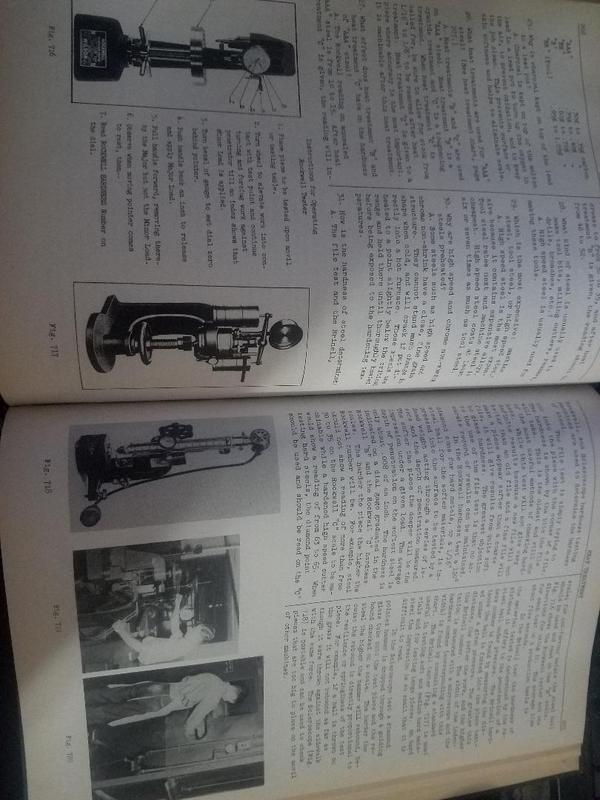
Ford was teaching Brinell and Rockwell hardness testing techniques to trade school boys in 1934..
Railcarmover
BANNED
I've read that this extra clearance is a 'crutch' to keep from seizing the rear main in an inserted engine. Anything to that?
Does this issue have anything to do with inserts designed for pressurized systems?

rotorwrench
Well-known member
The only way to affect a specific hardness on the old cast iron formula was to carefully control what was added in the mix at the foundry. If you look at the note. It mentions taking a reading on a scrap block since the Brinell test leaves a larger mark than Rockwell. Casting technology is a lot different now than it was back then. They were trying to insure uniformity in the casting process. Ductile or "nodular" cast iron had not been developed yet.
Jim Brierley
Well-known member
I set all mains at .0025" on my inserted race engines, with a groove to feed the rear at 2 different spots. First I ever heard Patrick L's story about extra clearance helping rear flange breakage!
Railcarmover
BANNED
I set all mains at .0025" on my inserted race engines, with a groove to feed the rear at 2 different spots. First I ever heard Patrick L's story about extra clearance helping rear flange breakage!
So the rear main starves? that the cause of failure? stands to reason.do you have a problem with rear main leakage with two grooves?

George Miller
Well-known member
If you use 0 clearance you will never get the engine to turn. If it would it would melt the babbitt, there would be no oil flow. O clearance is BS
Kohnke Rebabbitting
Well-known member
If you use 0 clearance you will never get the engine to turn. If it would it would melt the babbitt, there would be no oil flow. O clearance is BS
" Agree "
Herm.
Kohnke Rebabbitting
Well-known member
So the rear main starves? that the cause of failure? stands to reason.do you have a problem with rear main leakage with two grooves?
With out the right kinds of grooves, you have bearing failure.
The biggest cause of flange breakage, is that the Babbitt wasn't peened,, or lack of knowledge how to do it right.
Many shops don't peen at all. I have also seen videos of peening, that should have been left to Luck.
You have to peen the ends of the bearings also, the thrust.
Herm.
Attachments


Patrick L.
Well-known member
I raced for Chrysler for a number of years and built the engines. Sudden left off of power would snap the cranks at times at the rear flange. Increasing the rear main clearance stopped it. Also letting off on the power slower probably had a lot to do with it too. [smiley face]

mike657894
Well-known member
I raced for Chrysler for a number of years and built the engines. Sudden left off of power would snap the cranks at times at the rear flange. Increasing the rear main clearance stopped it. Also letting off on the power slower probably had a lot to do with it too. [smiley face]
there has to be some good stories. what years and what cars and classes? I always dreamed of racing cars as a kid still do. but im just a stiff with a job.
I dreamed of f1 when I was a kid. I have a loose plan to get a used fwd race car for the beginner class at the local circle track when the kids grow up.
mike657894
Well-known member
in the video where he gets its going it doesn't drag much. he states some thing like 120lbs of force required to turn it. just lets off a short chirp and is rolling over. I would say my well broken in engine takes about 50lbs to move the crank. not measured so that could be way off.
Jim Brierley
Well-known member
Railcarmover, I'm not sure the rear bearing would run dry, just don't want to chance it. On my insert engine I run a 1-piece Burtz seal, and it stays dry. I also run a babbitted mains engine on the salt using a rope seal, and it drips a little but not much. Ran 167 mph on babbitt in 2013, no problems with the engine, just turbo failure, so no record.
Patrick L.
Well-known member
there has to be some good stories. what years and what cars and classes? I always dreamed of racing cars as a kid still do. but im just a stiff with a job.
I dreamed of f1 when I was a kid. I have a loose plan to get a used fwd race car for the beginner class at the local circle track when the kids grow up.
There are some good stories/memories. But,,,,
Last edited:
- Status
- Not open for further replies.