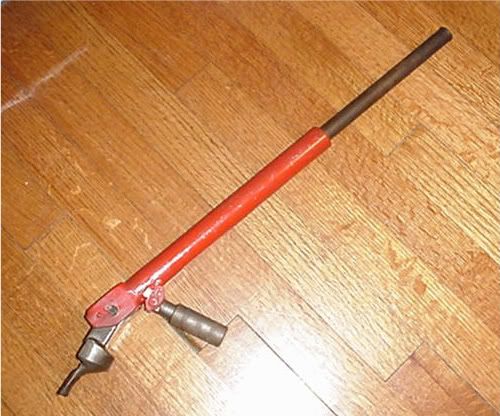
Am I useing my flathead tools wrong

saints

Member
Im pulling the horse shoe clips out of a 8ba I bought the other day and I have been breaking the tabs off of them and not evan budging the clip.....Ive done the same things on other engines but not as bad.....
I hook the tab and with the tool up right I hit down with a hammer and bam tab comes off
use the one at the bottom....is there a better way of getting them out
Picture010-1.jpg
 
Don't need hammer....use bottom hook to pry out the tabs. Hook is up side down in picture from position when in use. Intake maniforl flange fitts in "U" shaped part of hook.
 
Do you have the forked bar for taking the pressure off of the tabs; pry the spring down before pulling the keeper.
The hooked tool is for pulling them, but normally don't need a hammer. Penetrating oil first, might help.
Dick
 
oh crap ive been hammering the flat top of the tool......well thats why I humble myself and ask......I have a bar for the springs.... where do you pry on the tool or do they come out some what easy
 
The block is relieved just above the spring so the keeper goes up into it. That keeps it from falling out during normal operation. Use your long bar to slide into the spring with while spaning the valve stem, enter the spring closest to the head, pry the spring down so the keeper can come down out of the block. Some will fall out, some could be badly stuck. The keeper has to come down first. Penetrating oil could help if it gunked up too badly. Normally you shouldn't have to hammer on tool but some can be very difficult. Hope this helps. Dick
bobH is correct, the fork on the bar grabs the guide & spring and pry down on both at the same time. The guides are what stick in the block. Penetrating oil from the top .
Sorry for lack of complete explanation. Dick
 
Last edited:
Walt (I think) once posted on the old barn, his procedure for disassembly - especially for the old crusty ones that haven't been run lately, are rusty, and are difficult. Maybe he could chime in, here ?? I haven't done it in awhile, and I've probably forgotten important steps, but the part I remember is that the hook tool isn't even needed - those clips will fall out in your fingers. The 'trick' is to get the guide moved down. As I recall, retainers off, first. Spring out, second. Valve out, third (on 8ba, not pre-48 with mushroom's). Then, brass rod & hammer the guides down. Then remove the horseshoe clips. If mushrooom's are installed, there is another step, not needed for 8ba's. I'm sure the experts will correct what I've missed.... JMO
(Last one I did was old & crusty. It was stuck real good. But, I didn't hurt any parts, and for sure didn't bend any horseshoe clips.)
 
does the top tool have a fork on the right?? right side of the pic??....maybe that fits under bottom of spring, etc. on the guide??....can pull the spring up so the valve keepers can be removed, etc??....good luck.....Mike
 
This is a tool I have that was designed to remove flathead valves.

IF the valve is not stuck in the guide, it can be lifted and the tool slipped under the valve. The upper end of the tool is a slide-hammer which is used to knock the valve guide down enough to remove the horseshoe clip.

The entire valve assembly can then be levered out.

It is more helpful/applicable to mushroom style valves (will work on both styles), BUT I posted it because it demonstrates the need for one of the removal steps ... tap the guide down.

Edit: By the way, it sounded like someone was suggesting that spring pressure holds the clip in ... the spring, actually, does not touch the clip and, with the valve closed, does not press the clip. Sheer orneriness holds it in.


speedking.jpg
 
Last edited:
When using the KD "C-shaped pry bar" keeper remover, I've found putting a piece of pipe on the end gives you more leverage and torque which helps. It seems with the shorter handle, if puts the force more so on the tab instead of the tool and causes the tab to rip.

I also happen to have an All Power-brand tool that grips the end of the keeper tab with serated teeth. The more pressure that is applied, the more the teeth clamp down on the tab. It also works well for the handle is a lot longer than the KD tool.


Good luck.
 
"When using the KD "C-shaped pry bar" keeper remover, I've found putting a piece of pipe on the end gives you more leverage and torque which helps. It seems with the shorter handle, if puts the force more so on the tab instead of the tool and causes the tab to rip.

I also happen to have an All Power-brand tool that grips the end of the keeper tab with serated teeth. The more pressure that is applied, the more the teeth clamp down on the tab. It also works well for the handle is a lot longer than the KD tool."


You won't have to work that hard if you take the advice a couple of us have posted and tap the valve guide down a little. If the valves are completely frozen tight, it does take some muscle to get everything apart.
 
If your guides are frozen in place by rust or carbonization (and most are) the Hook is going to break alot of clips because the guide has to move down to get the clips out.
 
"When using the KD "C-shaped pry bar" keeper remover, I've found putting a piece of pipe on the end gives you more leverage and torque which helps. It seems with the shorter handle, if puts the force more so on the tab instead of the tool and causes the tab to rip.

I also happen to have an All Power-brand tool that grips the end of the keeper tab with serated teeth. The more pressure that is applied, the more the teeth clamp down on the tab. It also works well for the handle is a lot longer than the KD tool."


You won't have to work that hard if you take the advice a couple of us have posted and tap the valve guide down a little. If the valves are completely frozen tight, it does take some muscle to get everything apart.

Hoop:

Thanks for the tip. I did have one motor that I tore down in which the valve assemblies were so gunked, stuck, frozen, rusted, etc. that trying to tap everything down was doing damage. If the valve was open, some of the heads would bend instead of the moving the guide down.

I also have a slide hammer-type valve guide/assembly remover that forces the entire assembly out the block from the bottom.

Tim
 
" ... so gunked, stuck, frozen, rusted, etc. that trying to tap everything down was doing damage. If the valve was open, some of the heads would bend instead of the moving the guide down."

Absolutely. The tool that I posted above really only works on the easier ones. It'll bend valves if anything is stuck tight.

And with the valve closed and frozen in the guide, ... man.

Is the picture of the dude in your avatar someone after they've got done tearing-down a really stuck flathead?
 
Tim,

We can always hope that we'll end up looking that good.

I get a chuckle out of some of the posts about unsticking engines ... especially the "soak'em and be patient" ones. Some folks have never seen a STUCK engine.

(War stories by special request.)
 
Tim,

We can always hope that we'll end up looking that good.

I get a chuckle out of some of the posts about unsticking engines ... especially the "soak'em and be patient" ones. Some folks have never seen a STUCK engine.

(War stories by special request.)

My dad always has a funny one liner about things like:

They don't make enough [add your favorite penatrating oil] in the world to get that thing unstuck.

After doing a hard one, I know understand why some builders charge so much for tearing one down. It can try to patience of even the most saintly, especially when head bolts start breaking off.
 
I have had some (I say some, because it does not always work) success with inlet valves by putting a tire iron down the inlet port and levering the guide down. It only needs to move down a little bit and the horseshoe clip can be removed easily.

8BA style valves are much easier than the early style as they can be done like in the first video. If the keepers are removed with a conventional spring compressor or more careful than just hammering the valves can be reused.

Mart.
 
Hoop>>>Edit: By the way, it sounded like someone was suggesting that spring pressure holds the clip in ... the spring, actually, does not touch the clip and, with the valve closed, does not press the clip. Sheer orneriness holds it in.>>>

The spring indeed touches and holds the guide retainer in the block recess by design. Sheer orneriness might hold it in too but not by design. 8^)

Jack E/NJ
 
Back
Top