8BA using coolant and getting hot

Barillarospeed

Senior Member
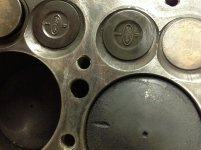
My 8BA starting using water and getting hot last week. I have been running this engine about a year and it has always run cool. This past weekend I took the car out on about 160 mile trip and it was very hot and humid. Car ran up around 180 for awhile and then slowly kept creeping up to about 220 before I could get out of traffic. Stopped for lunch and let it cool off. Once on the road it heated up really quick and got up to 240. I let it cool and removed the 160 thermostats and there was no water in the upper hoses. I filled it with water and it ran about 215-220 until I got home. The engine had 130-140psi of compression in every cylinder cold at WOT before I pulled it apart. I noticed when I drove home the gauge on the right head would jump very fast from 215-240 then drop back to 220, I pulled the heads and this is what I found. Is this a normal place to crack. Engine runs great and I can't tell that these "cracks" go into the valve seats. The head gaskets don't show that they had been leaking but I only run water in the car. Every other flathead I have seen was cracked from the valve seat to the cylinder. Any advise? Thanks, Jim
 

Attachments

  • crack.jpg
    crack.jpg
    69.6 KB · Views: 151
  • crack 2.jpg
    crack 2.jpg
    72 KB · Views: 144
  • crack 3.jpg
    crack 3.jpg
    75.2 KB · Views: 147
  • crack 4.jpg
    crack 4.jpg
    71.9 KB · Views: 146
The crack from bolt hole to water jacket are very common and not a problem. Maybe heads should have been re-torqued??
 
have heads resurfaced litely, and check valve clearance, it looks like a couple of intakes are starting to burn, intakes should be black and if they start to turn tan they are starting to burn, and exhausts are supposed to tan, and if the exhaust start to turn black there starting to burn, were any of the spark plugs snow white? if so that's a clue to water leaking into the cylinder, most heating problems are caused by a bad radiator, buy or borrow an infra red heat gun, shoot it at the top of rad, it should be hot there, now try the bottom, it should be warm, if hot at the top and cold at the bottom there is no or poor circulation thru the rad
 
Last edited:
I haven't retorqued heads in awhile. Spark plugs all looked similar and don't seem to be burning water butit had to go ssomewhere.
 
The following is some info I posted several times before. I really think an infrared heat gun is an almost indispensable $30 tool. After I did this, I had the occasion to check one of my O/T SBC's. It had a 180 degree thermostat. The gun showed 187 degrees on the manifold just before the thermostat housing and 178 degrees on the radiator hose attached to that housing. With one of these, you know exactly what is going on and don't have to do any guesswork. Just sayin'.

"Today I had the occasion to move my stock '51 around readying my shop for conversion to a winter storage facility. Just as a test, I let the old girl sit and idle with the heater off for 20 minutes. I then shot several areas of the engine with my infrared heat gun. I recorded the results. I then turned on the heater and let it run another 10 minutes. The results were as follow :


  • Top of Radiator, Bottom of radiator, Front of Driver's Head, Back of driver's head, Front of other head Back of other head

    Heater Off 175 157 173 175 182 174
    Heater On 175 174 176 177 184 184
My engine has 180 thermostats and the only engine work I have performed on it since I got it in 1987 was to recore the radiator. I have never had any kind of overheating problems with this car.

This was not at all a rigidly controlled experiment, but I really tried to be consistant. For example, I tried to shoot both heads right between the 2 bolts in the middle on each end."

I think the interesting thing here is that I had an 18 degree drop through the radiator (without the heater), while you got 3 degrees. I have to agree with the guys that suggest the radiator may need attention (unless you had the heater on).
 
The cracks that form between the bolt holes & deck ports are common but not always harmless. The exhaust port between the middle cylinders is right down under there. I've seen situations where the crack extends down into the exhaust port and leaks water there when hot. The ones between intake valves are likely OK. Cracks will also eventually make it difficult to keep the bolt hole and bolt interface free from problems with torque up and seepage. The block really should be pressure tested to insure there is no problem in that area.
 
Last edited:
put it back together get a can of zotight or same type block sealer the kind that you disconect the fan belt & upper rad hose .follow inst belive it or not this stuff works you got nothing to loose but a couple of dollars for the sealer don,t use any sealer that you pour into the radator
 
I had a same type of problem with 3 cracks in the block. I used a product called Blue Devil. I found it on the shelf at Auto Zone. Follow the directions. The cracks seem to be sealed. I have 2 add on temp gauges and the bank with the cracks is running cooler. One of my cracks just started to go down the cylindar so I am replaceing the engine this winter but this is a temp fix for me and it seems to be holding.
 
With the cracks in those bolt holes, I'm thinking if you reuse bolts it will keep putting more stress on those cracks as you torque and retorque those bolts down. Maybe switching all bolts to studs with a good thread sealant on all that go into the water jacket, would help that leaking situation and put less stress on those cracks. Just a thought.
 
Last edited:
Back
Top