
You are using an out of date browser. It may not display this or other websites correctly.
You should upgrade or use an alternative browser.
You should upgrade or use an alternative browser.
Radio Static
- Thread starter Old Henry
- Start date

Pete
BANNED
That is good info, but, limited in efficiency of total rfi elimination.
That info is limited to reducing noise from arcing at contact points. Another arcing
source is alternator brushes. This can be almost totally eliminated by a COAXIAL type capacitor in SERIES with the alternator output lead.
The majority of the noise comes from the high voltage section of the ignition system and is radiated directly through the air and picked up by the radio antenna.
The most cost effective way to eliminate that noise is carbon wire or resistor plugs.
This method will cut the spark plug current by as much as 10 milliamps.
The most effective method is using a completely shielded ignition system as is used in aircraft. This is also quite expensive.
Probably the next most efficient system is the one used in Corvettes which is basically a bunch of tin shields over all ignition parts.
Modern car radios are quite sensitive in order to pick up more stations so if you install one in an old car that has little or no rfi suppression you can expect a lot more static than would be had with an old original tube type radio.


rotorwrench
Well-known member
In the later 40s early 50s they had one on the generator too and even the fuel sender. They even had an apparatus that was placed in each front wheel hub cover. I never figured that one out. As Pete mentioned, the piston engined aircraft are all set up with shielded ignition high tension leads which screw onto each spark plug. With a copper wire conductor and magneto ignition there was little choice and still being able to receive & transmit clean communications signals & intercom. You can even hear the electric motor on the boost pumps if you don't put a choke on them.

L78CHEVELLE
Senior Member
Henry, I just installed a rebuilt radio in one of my 1940 Fords that has no condensers and the radio does not pick up anything electrical from the car. I do have some old radio capacitors I got from Radio Shack back in the early 80s that are labeled 40 amp 0.5 MFD at 50 VDC. I don't have a clue what any of this means, but I would say this is for a 12 volt system if that matters with one of these.

Old Henry
Well-known member
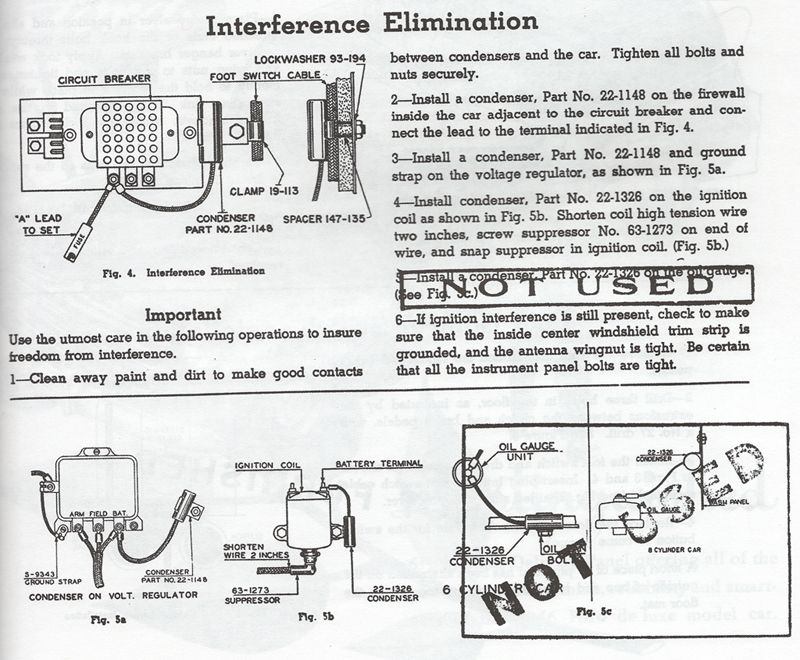
I have RC-1 condensers installed as shown, and have had no static problems.
Thanks. That's what I needed to know. I'll get some Monday from NAPA and see if they help.
My stock AM radio has not actually got the static. It's the headphone amp in my glove box that's not connected to the car that's picking up the ignition. It's not even a radio and has no antenna yet it still picks it up when the radio does not. I use it to amplify the signal from my mp3 player to play through the radio speaker.
Hope the condensers work. Thanks again for the tip.
Pete
BANNED
"40 amp 0.5 MFD at 50 VDC"
That is a coaxial capacitor. It will carry 40 amps and it is rated up to 50 volts.
Coaxial capacitors are designed to be used in SERIES with the lead you are trying to suppress noise from. The case needs to be grounded.
Ordinary capacitors go from the lead to ground.
That is a coaxial capacitor. It will carry 40 amps and it is rated up to 50 volts.
Coaxial capacitors are designed to be used in SERIES with the lead you are trying to suppress noise from. The case needs to be grounded.
Ordinary capacitors go from the lead to ground.
Last edited:

BILL WZOREK
Well-known member
Old Henry:
Not trying to be a SMART A** but isn't static the way Henry built the car & part of the enjoyment of driving & making up your own words to the song that you can't hear because of the static ??? LOL
Not trying to be a SMART A** but isn't static the way Henry built the car & part of the enjoyment of driving & making up your own words to the song that you can't hear because of the static ??? LOL

47COE
Senior Member
My stock AM radio has not actually got the static. It's the headphone amp in my glove box that's not connected to the car that's picking up the ignition.
The headphone amplifier could be getting the static through its power lead. Putting a choke (inductor) in the amplifier's power lead would take care of that.
Tom

Old Henry
Well-known member
The headphone amplifier could be getting the static through its power lead. Putting a choke (inductor) in the amplifier's power lead would take care of that.
Tom
This is my set up other than the CD player has been replaced with my mp3 player.

As you can see, the amp is powered by a 9 volt battery pack I made out of 6 "D" battery cells and is not connected to the car 6 volt battery source. You can see all of the chokes I already have on all lines that are not blocking the static.
Funny thing is that the static is greatest when the engine is first started and decreases over time and speed (20-30 minutes/miles) until it's all gone until I pull into the garage again at idle and it's back.
I think before I install all of the condensers I'm going to disconnect the generator and see if that eliminates the static. If so I'll know that it's the source and may eliminate it by putting a condenser on it somewhere.
Last edited:
The first thing you have to do is listen carefully to the type of noise/static that is produced. A loud TAC TAC TAC that speeds up and slows down with engine RPM is called radio frequency interference and travels through the air from the spark plug leads and is received by the radio via its antenna or power cable. To reduce this a set of resistor plug leads can be fitted but on a pre 1960s cars I prefer to fit resistors on the plug lead ends on the spark plugs. Sometimes a bit hard to find now. These will not effect your ignition performance. Other noises such as a whirring sound that speeds up with engine RPM can be caused by the generator or alternator brushes. A capacitor mounted on the generator body and connected to the armature terminal can help here. Also capacitors on the voltage regulator armature terminal . Yes you could disconnect the wires on the generator to prove this point. Most other items don't really cause problems on our old fords. Be a detective and analyse that noise. Regards Kevin.
rotorwrench
Well-known member
A garage tends to focus RF noise back into the system. You can pick up all sorts of RF noise inside a building just from the flourescent lamp balasts and stuff like that.
Old Henry
Well-known member
I have RC-1 condensers installed as shown, and have had no static problems.
Installed the three RC-1 capacitors. Only the one on the regulator helped some but only slightly noticeable. Haven't been able to find a suppressor like is recommended coming out of the bottom of the coil. I suppose that would help if I could find one. Don't want to leave my solid copper spark plug wires nor go to resistor plugs so may be stuck with the static. Fortunately, as I said before, it is somewhat temporary, decreasing over time as I drive until all but gone so I do eventually get static free.


Used to get the filters, looked like a coil wound thing with metal over the top to mount it (kinda like a small electric fuel pump without fittings) and run them inline to to power to our stereos to eliminate Alt noise when we had amps/etc, turned on.
Radio shack and every car stereo place had them, they did the job.
Funny someone mentioned the wire suppressors, while scrounging through my cabinet today for a fuel filter, I found a set, still wrapped up, for a 6cyl...price embedded under the plastic was 4.95...lol!
Radio shack and every car stereo place had them, they did the job.
Funny someone mentioned the wire suppressors, while scrounging through my cabinet today for a fuel filter, I found a set, still wrapped up, for a 6cyl...price embedded under the plastic was 4.95...lol!
Old Henry
Well-known member
. . .Funny someone mentioned the wire suppressors, . . .
Sure glad somone did. I didn't know what they were called. Found an NOS set on eBay that I bought to see if they help. I'll let you know.


