old Henry's engine

There were some pistons sold by Speedway (three ring types in sizes less than .125" oversize) that were discontinued. I figured they must have had some problems with those or they would still be available....

You may be referring to the 3-ring hypereutectic cast pistons with metric rings that Speedway discontinued a couple of years ago. My understanding is that the pistons were fine, but the company stopped producing them for business reasons. I wish they were still available, because I'd definitely use them in my current project.
 
Got my new pistons in today.

IMG_5283_zps47b7bb27.jpg


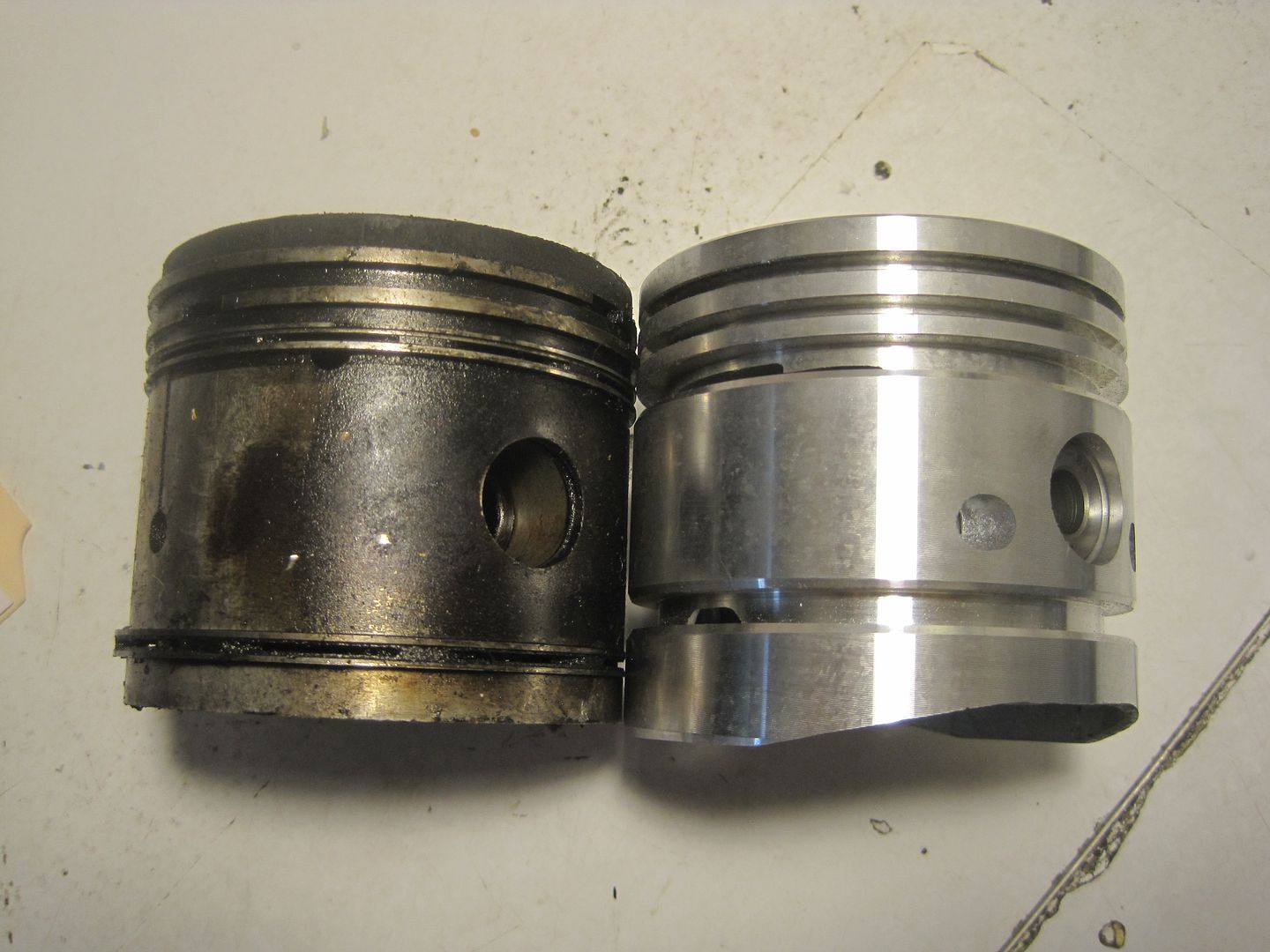
They sure are beefy compared to the very light ones Doc put in 3 years ago. I know he was going for light but this time I told him I wanted to go for reliability and durability so he said get these. He thought my old ones were heavy. These are even a little heavier. Old ones - 17.9 oz. New ones 19.3 oz.

Original piston on the left. New piston on the right. Intermediate light 3 ring not shown.

IMG_5284_zps5116af39.jpg
 
Last edited:
Hi Henry,don't forget to have the rotating assembly balanced, and also have the crank and rods crack tested , good luck with it,Colin.
 
Delivered the pistons to Doc yesterday. He's starting to put it back together. I'm pretty darn excited. Still get a real bad aching to drive. Not as bad as the first few weeks but still can hardly wait to get back "on the road again." (Thank you Willy)
 
I hate to make you worry but the weight of differant pistons really thro the balance of the crank off. Here is an exsample, a friend of mine had a 39 merc, original engine, ran as smooth as a kittys ear but was useing a little oil. He had a shop rebuild the engine that didn't really know flatheads. They started to bore the engine and a string of steel came out of the hole. Then thay relised the engine had steel sleeves, so thay boned the block with a Sunnen CK-10 automatic cyl hone to .030 with the sleeves in the block. I don't know where thay got rebuild kit but the pistons were alot heavier than the originals. They called me to come to there shop and listen to it. The engine had a bad vibration. I ask the if they replaced the clutch and PP and thay had with a rebuilt one someplace. I told them the only thing thay could do at that time was pull the flywheel and PP and have it balanced. thay did and it wasn't off very much, so they stripped the whole engine and had everything balance, that;s when thay found the pistons were so heavy the balancer had to remove alot of weight off the crank. That's why I have all my engines balanced. Walt
 
henry your machine builder should know to balance the engine as a rotating assembly from clutch pressure plate flywheel crank rods pistons and front crank pully you will notice a great viberation free engine dont do 1/2 a job my 2 cents worth:)
 
Don't know much about balancing other than my son's tricks (https://www.youtube.com/watch?v=OCpyHLnKQJI). Hope Doc Roger does. Don't know how he'd do it without running the engine which he's not going to do before I take it back and install it. Hope it goes OK. Gotta put a lot of trust in a guy that's worked as a machinist in a diesel mechanic shop for 40 years and been rebuilding flatheads all that time. Keeping my fingers crossed. Thanks for your thoughts and prayers. :o
 
I had just my flywheel and clutch balanced when the flywheel was faced and redrilled. Made a noticeable difference in the smoothness of the engine.
 
A Christmas tree...wow
Was kinda disappointed that he didn't try and balance a Flathead on his chin though lol
Good luck with your motor!
Randy
 
Probably a little too far along in the process, but if you're using a good modern ring set, you do not need 4 rings on each piston! Leave the bottom ring off! With a three-piece oil ring and everything set at the proper specs, that 4th ring is just extra drag. Four ring pistons are out-dated. old, old school technology for an automobile.
 
Don't know much about balancing other than my son's tricks (https://www.youtube.com/watch?v=OCpyHLnKQJI). Hope Doc Roger does. Don't know how he'd do it without running the engine which he's not going to do before I take it back and install it. Hope it goes OK. Gotta put a lot of trust in a guy that's worked as a machinist in a diesel mechanic shop for 40 years and been rebuilding flatheads all that time. Keeping my fingers crossed. Thanks for your thoughts and prayers. :o
The crankshaft is balanced out of the engine on a special machine. Bobweights are made up to simulate the pistons, rings, etc and the machine detects out of balance areas when spun.
 
The pistons and con rods are balanced on a weigh scale. All the rods must weigh the same as the lightest one both small ends and big end are weighed but separate. the pistons are also weighed in a similar manner . All must weigh the same as the lightest one. and so on and so forth. It`s a little complicated but well worth the extra effort. Your flathead will love you and be ready for many miles of happy motoring.:D
 
The pistons and con rods are balanced on a weigh scale. All the rods must weigh the same as the lightest one both small ends and big end are weighed but separate. the pistons are also weighed in a similar manner . All must weigh the same as the lightest one. and so on and so forth. It`s a little complicated but well worth the extra effort. Your flathead will love you and be ready for many miles of happy motoring.:D

I know Doc is very sensitive about matching weights as he described to me where the piston is ground off to reduce its weight to make them all match. He has always seemed almost over meticulous for detail and precise measurements so I have to trust that he will make the engine "as good as it can possibly be" as I instructed him.
 
Tiquer has the straight skinny. They usually remove metal from key areas on the heavy parts to get a mach. The crankshaft is rotated in special journals and can be done with flywheel & clutch. This link is a video of a basic balancing job. It doesn't explain much but you can see them weigh and adjust all the parts then record component weights of the reciprocating assemblies in order to adjust the mandrels for weight then install them in specific locations on the con rod journals of the crankshaft prior to spinning the machine up.
http://www.youtube.com/watch?v=zli_leFnotI

I used to do turbine rotors for aircraft engines and we did them the same way. There is always a place to remove material on the heavy side. A good balancer figures everything before grinding anything. You can also see them polishing the crank journals. Those new Scat cranks are probably a little rough fresh out of machining.
 
I know Doc is very sensitive about matching weights as he described to me where the piston is ground off to reduce its weight to make them all match. He has always seemed almost over meticulous for detail and precise measurements so I have to trust that he will make the engine "as good as it can possibly be" as I instructed him.
Sounds like your guy is onto it.
 
Probably a little too far along in the process, but if you're using a good modern ring set, you do not need 4 rings on each piston! Leave the bottom ring off! With a three-piece oil ring and everything set at the proper specs, that 4th ring is just extra drag. Four ring pistons are out-dated. old, old school technology for an automobile.

Back up your comment with facts.

R
 
Probably a little too far along in the process, but if you're using a good modern ring set, you do not need 4 rings on each piston! Leave the bottom ring off! With a three-piece oil ring and everything set at the proper specs, that 4th ring is just extra drag. Four ring pistons are out-dated. old, old school technology for an automobile.

"Old school technology" Can you tell me if there is anything on a 70 year old car that is not old car technology? Where are you getting this advice on leaving the 4th ring off? Maybe you can post your source.
 
"Old school technology" Can you tell me if there is anything on a 70 year old car that is not old car technology? Where are you getting this advice on leaving the 4th ring off? Maybe you can post your source.

Hi all!
I have been reading this interesting post! When I rebuilt my engine the mechanic that did the grinding told me NOT to install the fourth ring so It could lubricate more oil.
But, I thought...why this?? If piston were designed with four rings. Finally I forced him despite his suggestion to leave it as the original.

I think i did the correct!! what do you think????

Thanks for posting interesting info...

Harylufa

When Doc Roger initially suggested the three ring pistons 3½ years ago I was uncomfortable mainly because it departed from Ford's tried and proven design. Not knowing any better and Doc being very persuasive that the lighter three ring pistons were better with less friction I consented. Now, only 30,000 miles later, one of those light three ring pistons came apart. Don't know the causal relationship but it's pretty suspicious. I'm glad we're going back to the heavier 4 ring pistons. May be worse but I feel a whole lot better about it.

So far I've seen strong opinions both ways that seem more emotional than rational so I really don't know that it makes any real difference.

Good to hear from you again Harylufa. It's been a while.
 
About 40 or more years ago, I was helping an old Ford mechanic pull a 59A motor apart and remarked that I had seen several pistons on these engines where the top ring had broken and crawled over the other segments of the ring, ruining the piston. His reply was that Ford tried the 4 ring piston because of oil consumption with the 3 ring. The fourth ring caused the walls to remove too much oil and the top ring would run too dry, get overheated, break and crawl over itself. He said that because improvements in ring construction and better oils available, he left off the 4th ring and never saw top rings burn up again and oil control was good. Since then, I have followed his advice and left off the 4th ring or ran a 3 ring piston without any noticiable increase it oil consumption or piston slap from no 4th ring. His claim was that Ford hired Olds engine engineers during the war and they came up with the 4 ring design. I don't know if it is true or an old wive's tale but as I said I have built lots and lots of flatheads since that time using his advice and have had no problems. That might give somebody food for thought.
 
Back
Top