If the crank is cross-drilled to the rod throws and pressure fed, there will be a constant spray mist of escape oil from both sides of each rod throw bearing as the crank rotates. This is more effective than dippers, as it works at both very low rpm that doesn't pressurize a dipper, and above the rpm where dippers will blow the tray dry (~3500 rpm). There is absolutely no need to revert to a solid dipper tray, it is better off with drain holes as a windage tray.
The valve chamber floor holes found in a B will permit some crankcase spray to migrate up, but rather poorly. It was not uncommon to make those holes way bigger in dirt track engines. The valves were relatively quiet because the much larger mushroom end stock valves and the big surface on stock non-adjustable lifters spread out the contact pressure, resulting in a slower crush of whatever oil mist or film was introduced into the lifter gap when that cam lobe was on it's heel. Modern small ended valves will definitely make more of a click unless the ends are relatively flooded with oil. Exhaust valves rely on a constant wet oil splash or feed to dissipate heat, both from the end of the guide in the chamber, and from the extending valve stem within the spring.
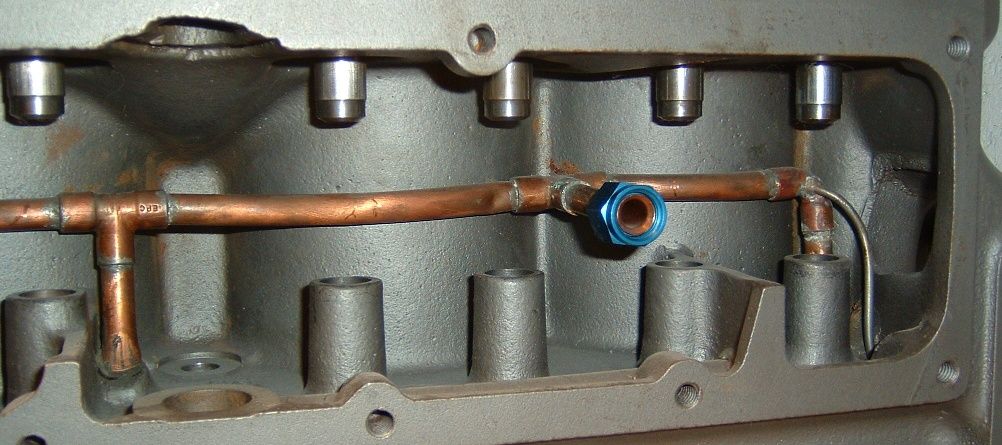
IMHO, the best way to positively oil the valves in an positively pressurized A or B engine with no open feed to a lifter tray in the valve chamber is with the use of a spray bar. That bar (tube) can be brazed to the inside of the valve cover. The cover on a B can cross-drilled to supply the spray bar from the oil runner at the bottom. Only 4 tiny holes, drill size 72 or 74, one pointing at the center of each exhaust valve spring will be plenty. They will actually squirt more of a solid stream than spray. That stream will be intermittently interrupted and broken into a coarse spray by hitting the moving exhaust spring. You will have direct exhaust valve cooling, oversplash to the adjacent intake valves, and, the forward overspray from the front one will also serve to oil the cam gear if the base of the valve chamber is drilled for direct drainage.
FWIW, I believe the B side-cover with filter made by Stipe employs a spray bar. I have never personally seen one of the Stipe setups so I do not know how many holes, what size, or what direction he uses.