modernize my 31 A

Autotronic Controls Corp = MSD.
I agree with you Brent, there where some missed comparisons along the lines. I only put the MSD in because it's been sitting on the shelf for the last couple years with nothing to do. Figured I might as well us it. As far as mixture goes I believe it would help (mask) rich or lean (within reason) if said mixture was right at the point the stock ign had trouble firing it. How do you think it would "exacerbate the condition" in a lean condition. Just wondering.
 
If points were so good ford would still be using them and mechanical brakes. Hell,many cars are back to 16 inch tires; what retro steps will Detroit take next;maybe 3 speed trans?

In this discussion is that really what you want to hang your hat on?

I guess we should change to independant front suspension instead of the straight axle, struts in place of the rear springs. Pull the engine out because what car has a flat head engine? Remove the carb and use fuel injection, how about a computer. Don't all the cars now have computers? and the styling, Detroit doesn't make any car with the the front area of an A.

I don't want a Ford Focus I want a Model A. This site is supposed to be about the restoration of Model A's.
 
As the United Nations General Assembly finally reaches resolution agreement on Syria, they now turn to an "ignited" hotspot :eek: in the ol' barn regarding "ignition" systems, after sparks flew in "heated" :mad: discussions.

It is hoped that diplomatic efforts will continue. ;)
 
As the United Nations General Assembly finally reaches resolution agreement on Syria, they now turn to an "ignited" hotspot :eek: in the ol' barn regarding "ignition" systems, after sparks flew in "heated" :mad: discussions.

It is hoped that diplomatic efforts will continue. ;)
I hear they have asked NASCAR for help !!..
 
Autotronic Controls Corp = MSD.
I agree with you Brent, there where some missed comparisons along the lines. I only put the MSD in because it's been sitting on the shelf for the last couple years with nothing to do. Figured I might as well us it. As far as mixture goes I believe it would help (mask) rich or lean (within reason) if said mixture was right at the point the stock ign had trouble firing it. How do you think it would "exacerbate the condition" in a lean condition. Just wondering.

Well that is just it, ...let's say if the fuel/air mixture is 12.0 or less (rich), then the multiple sparks will help light the mixture as it is in turbulence where it will still have time to burn cleanly at TDC. That to me means it will "mask" the problem of being too 'fat' or rich. If the mixture is too lean (i.e.: < 13.4+) then with one spark you are depending on flame travel (under pressure) to light the rest of the entire fuel load which would be much slower than if there are multiple sparks allowing the swirling mixture to explode faster as it passes by the spark plug. Remember that ignition within the cylinder is much like pouring gasoline on the ground and then throwing a lighted match at it. That gasoline on the ground does not all ignite the moment the lighted match reaches the fuel. The flame takes a millisecond to travel throughout the entire area of fuel to light all of those vapors.

Compare that if you had two buddies with lit matches and all three of y'all threw your matches into different areas of the same amount of fuel. The entire amount of fuel on the ground would light faster with the three matches because the flame would have less distance to travel before all of the vapors were ignited. Fuel inside of a combustion chamber is swirling around and so with multiple sparks, a different area of fuel is being ignited which allows the entire load of fuel to be lit sooner.

Now with the above said, if the lean fuel mixture were to completely ignite slower because of the singular spark, this would possibly result in enough time for the piston to near TDC where the power loss would not be as detrimental however if the entire mixture were to completely ignite earlier (because of the MSD) before the piston reached TDC, not only would there be a loss in power but there could be bearing damage as a result. Granted we are speaking of milliseconds, but this would be noticable on a dyno graph, --especially in an unefficient chamber design. That is why I say that a lean fuel mixture is worse with an MSD than what it would be with a single spark.
 
Congrats, FordBarners, no one got real "TWISTED" during this discussion!:D Great reading to practice my reading and comprehension skills.;)
If I have a sleepless night, I'll read this thread backwards and see what I glean from it. Also, among my "hidden talents," I can read upside down from years at the parts counter ordering stuff from the now obselete parts catalogs.:eek: Bill.W.
 
Brent. Please post your dyno test i would love to see it.

Nahh, I'm done. Posting those graphs would prove nothing to you as you were not there to validate. For all you knew I could show you two pulls on a Vega engine and claim one was a Model A engine with, and one was without electronic ignition and who would be the wiser? Dyno testing results are only as honest as you are when performing the actual test. James & I are not scheduling dyno tests to have something to boast or brag about, we are doing it as a means to confirm theories he & I have discussions about. Therefore posting any of that info is just hearsay and really means nothing unless an unbiased party can substantiate what actually took place. This thread has pretty much run its course where I'm bored with it so it is time for me to move on.

.
 
Brent. I agree graphs prove nothjng , the word and experiance of men mean more dont you think. When you and james do the test would you let us know the results, we here respect and look foward to your comments.
 
IgnitionTester.jpg


Condenser1.jpg


Condenser2.jpg


Condenser3.jpg


Just the facts mam!:D

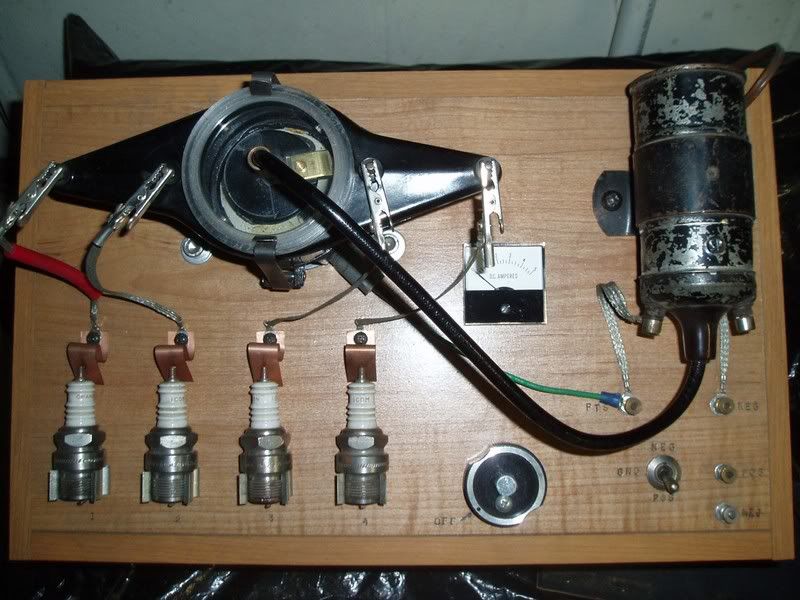
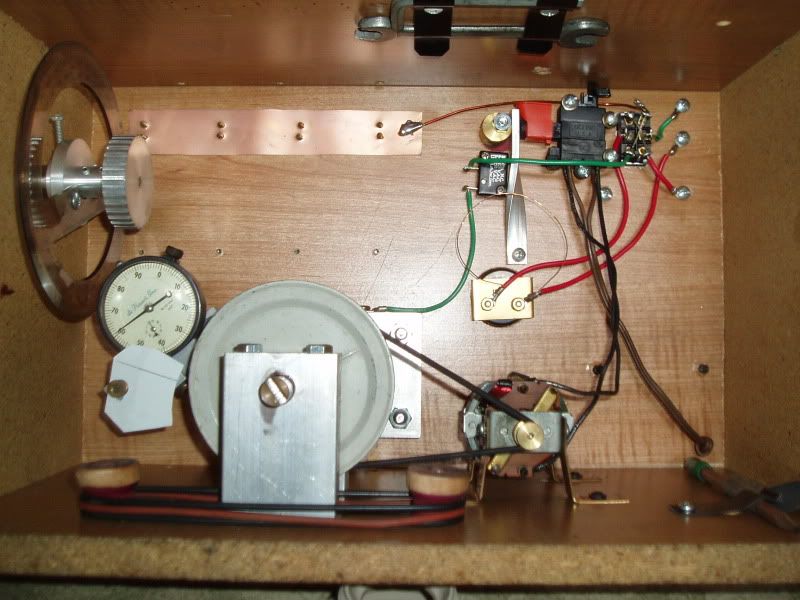
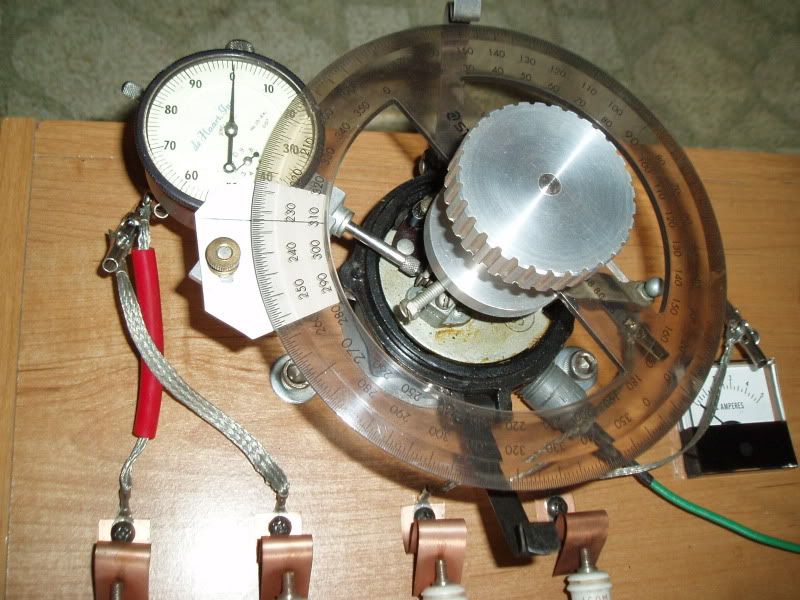
The first picture shows a machine I made about 10 years ago to check the Model A ignition system, mainly to help check the accuracy of a rebuilt distributor. I have a degree wheel to check the accuracy of the cam first, then I connect my scope to check the pattern.

The pattern shows that the stock ignition system does NOT just produce a single instantaneous spark, but a spark that continues for a period of time. The first high spike on the left shows the energy needed to ionize the air gap between the spark plug electrodes. Once the spark path is established it takes less energy to continue the flow of electrons. The coil and condenser form a tuned circuit as represented by the oscillations on the scope. You can see the spark continues for several oscillations until the energy has dropped to the point it can no longer jump the gap. When that happens you will see a jump in the spike which is actually higher than the line where the plug quit firing. This however is not enough to ionize the gap and start the spark again, so the coil and condenser continue to oscillate until the energy dissipates as shown by the long lower line. On the right side you will see a drop in the line, which indicates when the points close to reenergize the coil. The left side of the scope shows when the points open and the rapidly collapsing magnetic field in the coil starts the electron flow.

So, you can see that the stock ignition has plenty of energy to reliably fire the plugs in a Model A. Modern cars have high energy ignition needed to fire the much wider gap used on the spark plugs. The wider gap is needed to better fire the lean fuel mixtures modern cars use. As long as the stock ignition fires the plugs I don't see where having an electronic trigger replacing the points is going to improve the reliablity, fuel mileage, or horsepower, so I see no point in changing from a very reliable stock system.

My 28 Phaeton gets just over 22 MPG on the highway trips, and driving a Phaeton with the top up and no side curtains is just about like pulling a small parachute down the road.

I don't expect to change any minds here, as it's plain to see from the posts so far that both sides have their heals firmly dug in. If the electronic ignition can add fuel economy or horsepower it would have to be shown on a dyno. I just wanted to present a few facts to help the undecided make an informed decision. Just the facts mam!:D

BTW, the red plastic sleeve on the #1 plug wire is so the inductive pickup will work. It won't work when touching a bare spark plug wire.

f30aa6ce.jpg


99988948.jpg


Here's a picture of the degree wheel and dial indicator being used and a picture of them stowed in the bottom of the cabinet.
 
Last edited:
Tom you wrote. The modern cars have high energy ing needed to fire the wider gap plugs.when i was considering the ing system the one thing i heard was you could run your plugs at a wider gap for better millage, like modern cars. (you have just supported that). No one on here has said the stock points system does not have enough fire for a model a. Just that from there experience they have got better h/p millage and relibility. We use a 1976 ford f-600 for many years it was in the shop repairing the dist new points or condenser or just adjustment, cost a lot for repairs and down time. We had a electronic chip installed 5 years ago , it cranks and runs great has not been back it shop for this . Try this test hold the plug of a stock a and you will get a jolt then try one with ign in it , mabe you can get of the ground afterword .
 
Jerry, but a wider gap doesn't give better fuel mileage. Computerized fuel injection can give better fuel mileage. I run with my GAV fully closed and it runs fine. This is as lean as I can make it and still have it run right.
 
Tom. I dont have any data to prove . All i have is what experienced mechanics and other a owners have told me about the difference in there a when they changed to electronic ign . And with a wider plug it helps on fuel. And the difference i have seen in my a. Thanks and god bless
 
The spark comes from the coil. If the right performance coil and a wider gap at the spark plug is used, you can have as hot or hotter spark than electronic. The only problem with original style points that would cause them to have to be replaced to make it home would be if the rubbing block wore off completely. I have read enough posts here and on ahooga about module failure with electronic ignition that tells me that I don't want it. I agree that electronic is better for modern cars that were designed with safe guards to use it, not necessarily so with model A's . I'm not a purist, so that has NO bearing with me. In the worse case, I could replace points or whatever, easier than I could replace the electronic module and wiring. I get good milage use from original points, I have been using the same points in my 31 tudor for the past 12 years and have never had a problem. I really don't claim to know much about electronic ignition. I prefer to run a system that I can fix. Having to buy two electronic systems so that I will have parts to repair it when it fails, just don't make common sense to me. Just my thoughts and I'm not trying to tell anybody what they should do. I just know what works for me and thats all that i'm going to say about that!!!
 
Jerry, but a wider gap doesn't give better fuel mileage. Computerized fuel injection can give better fuel mileage. I run with my GAV fully closed and it runs fine. This is as lean as I can make it and still have it run right.

Tom,
Nice pics of your creation and explanation. When I look your work/input, I see, in my minds eye, a very meticulous, organized, smart guy:)!
However, using too many words sometimes they (words) get in the way of common sense. I'd bet that you would agree that something/anything with MANY parts would be prone to 'more problems' with RELIABILITY than something with FEWER parts, no:confused: Common sense,eh.
Well, that's all that I have ever claimed , and think that most here are claiming, with installation of elect ign module setup. No moving parts to be lubed/adjusted to wear out versus points/condenser. Yeah, if either system is NOT properly installed you can not expect them to work as intended. But, to say that points system ...has more "reliability" defies common sense.
BTW- Anyone claiming 'better horse power and better gas mileage' should qualify that with testing results....or...state flat out that that is their feeling/opinion only, IMO.
Lastly, it is my experience that my model a engine starts much quicker/better with elect ign vs stock that I've used forever priorly. And, when I run my engine rpms up real HIGH occasionally...my elect ign has never missed a beat vs stock ign that I couldn't get to handle that situation (point bounce/etc) satisfactorily.
 
Last edited:
I just can't understand people wanting to fix something that isn't broke!!! Or they try to make the car into something that it wasn't!! Maybe they shouldn't have bought a Model A then???? If I'm on the road or any where and something goes wrong I want to be able to fix it with a screw driver and a match pack, Not having to buy or try to find odd ball parts!!! If you want a Jag, or a new car then just go buy one then!!!! Leave the classic's alone!!!!!!
 
Tom,

However, using too many words sometimes they (words) get in the way of common sense. I'd bet that you would agree that something/anything with MANY parts would be prone to 'more problems' with RELIABILITY than something with FEWER parts, no:confused: Common sense,eh.
Well, that's all that I have ever claimed , and think that most here are claiming, with installation of elect ign module setup. No moving parts to be lubed/adjusted to wear out versus points/condenser. Yeah, if either system is NOT properly installed you can not expect them to work as intended. But, to say that points system ...has more "reliability" defies common sense.
BTW- Anyone claiming 'better horse power and better gas mileage' should qualify that with testing results....or...state flat out that that is their feeling/opinion only, IMO.
Lastly, it is my experience that my model a engine starts much quicker/better with elect ign vs stock that I've used forever priorly. And, when I run my engine rpms up real HIGH occasionally...my elect ign has never missed a beat vs stock ign that I couldn't get to handle that situation (point bounce/etc) satisfactorily.


Well let us get the rest of the story.

The points really do not have many moving parts. They also have a history of not really wearing very fast. They do not just fail without miles of warnings if you are listening. Rarely is the failure something you can not overcome with a few simple tools. They might limit you speed, but quite frankly the speed must be over 65 MPH cause I have never found a problem. Keep in mind my brother and I think nothing of running our A's at high rpm for extended periods of time. BTW, our experience shows you should expect to get in the low to mid 20 MPG with your Model A that has points.
The truth is, I do not think you will out live a properly rebuilt points distributer. 99% of the cars will probably run for several generations of the family with an untouched properly restored distributer (unless it is one of the rare cars that gets run thousands of miles a year). Keep in mind my brother 31 coupe is still running the same used points that came on the car back in 1970 so that is close to 40 years of running on a set of used points. Is 40 years unreliable?

As for the electronic ignition, it works great if the electrics are 100%. The electronics can not take over voltage, it will fail you get to buy a new one. It needs to have a certain minimum voltage or it will fail to make spark. No hand cranking a marginal battery, call your tow truck. If you are running 6 volts then you are very close to the cut off voltage for working and a marginal ground will give your system issues.
If they make the boards RoHS compliant then they are using Tin based solder then you have more problems.

So what you have are two systems that will do everything the A owner would want. The problems comes from the fail modes and the recovery. If the points or battery/ charging have an issue then the points system is most likely going to be repaired quickly on the road. You will be able to drive home.
If you have a battery/ charging problem or a failure of the electronic module (yes this happens) then you get a tow home. So when that battery gets down because the alt or generator has a charge problem you will hit a voltage where the electronics will cut off. The points will let you go till the battery is pretty low.

Keep in mind having an alternator does not mean more reliability. Mechanics loved the switch to the alt cause they failed more often so they made more money. Then you throw in most A alt installs have belts too loose to provide a decent charge rate you have more chances for the battery voltage to slide down.


In summary,
Both systems will run a fairly stock A the 60 MPH the car was designed to run all day long.
Both systems can be very reliable if they are properly installed.

BUT

The electronics do not like bad voltage conditions and can not be easily limped home. There are some conditions that can fail the electronics.
The points are more tolerant of bad voltage conditions and generally you can find a way to limp a points system home. It is rare to ever have a total failure of the points system that could not be fixed/ rigged along the road.

 
My lord!!:eek: Dew's ONLY question was, "WHAT IS THE BEST WAY TO ADD ELECTRONIC IGNITION TO MY '31 A.":) He needed input from electronic systems users, not a lot of gobbeldy goop about the merits of "points" vs "electronic."
My opinion: Overall, electronic systems are far superior to old type rinky dink points systems.:p
Should I decide to do ANY upgrade to my "bone stock" '29, I won't "open a can of worms" by asking for advice, I'll just do it!:D
Confession: Mine is not totally "bone stock," as I have added a leakless/greaseless water pump and a 6 blade plastic fan,:eek: and I hope I don't get lectured!:eek::eek: Bill Williamson
 
Back
Top