In line electric fuel pump

Habusailor

Senior Member
Does an inline electric fuel pump allow flow through it when not running? I am thinking of adding the electric pump as a boost pump to be sure fuel is flowing to the carburetor but still use the manual when the engine is running. It would also be a backup if the mechanical failed


Sent from my iPhone using Tapatalk
 
don't have a definitive answer for you, but...

i've heard some have check valves and some don't. careful reading of the description before purchase may be warranted and maybe even a chat with the sales people.

for a start one might want to google something like, "do all automobile electric fuel pumps have check valves".
 
I searched: "Can electric fuel pumps be used with mechanical fuel pumps"? This is the response. Yes, electric fuel pumps can be used with mechanical fuel pumps. This combination allows for improved fuel delivery and starting performance. Here are some key points to consider:
Compatibility: Electric fuel pumps can work with mechanical fuel pumps, especially in applications where the mechanical pump may struggle to pull fuel from a remote tank.
1
Practicality: Adding an electric pump can be beneficial for starting engines, especially in vehicles with long fuel lines or those that require more fuel pressure.
1
Installation: Electric fuel pumps should be mounted close to the fuel tank to ensure efficient fuel delivery.
1
Regulation: It is recommended to use a regulator to maintain the correct fuel pressure when using both pumps.
1
Safety: Be cautious of potential fuel leaks and ensure that the electric pump is not running when the mechanical pump is not in use to prevent any potential issues.
1

In summary, using an electric fuel pump alongside a mechanical fuel pump is a viable option for enhancing fuel delivery and starting performance in various applications.
My 35 is set up in just this way. The electric pump is bolted to the frame, in the fuel line. The mechanical pump, on the engine is still there and working. I switch the electric pump on for starts, then let the mechanical take over. Sometimes i forget to shut the electical pump off after startup. There is no difference in engine sound or performance.
 
SOME electric pumps can be used for your application. You can test which ones by blowing through them. You will need to limit the pressure to around 2 PSI
 
The pump you choose may or may not have a check valve, but whether it will work when not energized can depend on how it's plumbed into the fuel line system. I installed one in a buddy's '37 Hudson Terraplane and plumbed it in "parallel" to the main fuel line. Works as we hoped it would.
 
I was phone company mechanic for 30-years and I used to take all the old parts catalogs home when we upgraded them once a year. The Airtex Fuel Pump has a section that lists the pumps in order and shows all their specs. Most are closed when not in use, but a few are open. But then you need low fuel pressure for early Ford carbs so that limits number even more. That leaves just a couple of them.

You "do not" want a pump that puts out 6 lbs. of pressure or you will need to put a pressure regulator in the system to cut the pressure down. Those aftermarket fuel regulators are junk; they do not regulate fuel pressure that low. I've had a couple of them on a '66 Mini Cooper S and it would just occasionally shut the fuel off when I was driving. I bought another new one and it did the same thing. So, it's better to get the correct fuel pump pressure to begin with. You just want around 2 lbs. or there abouts on a flathead, otherwise the carbs flood over. When the engine starts you can then turn off the electric pump and run it off of the stock pump, which can then draw the fuel through the "open" electronic pump, it has to be open. That's especially good for priming the system if the cars sits for a long time. What I don't know is if they have a 6-volt pump with 2 lbs. of pressure. I'm not feeling well today, or I'd go out and get the catalog and look for you. These paper catalogs are now over 15-years old, but they contain info that has been eliminated from some of the newer computer versions.

You need to mount all electric pumps as close to the tank as possible. I've seen them mounted up by the engine and that is a big no-no. Plus, it looks like crap. Mount it close to the tank and put a large fuel fitter "between" the tank and the pump. My favorite filter looks like the bottom of an old ford 1960s fuel pump with the screw on filter. They make one that is just the fuel filter portion of the pump with a cast aluminum mount. It's a huge filter and you can unscrew it and replace it without taking the fuel lines loose. It's the hot setup, one of Fords better ideas. Old fuel tanks have all kinds of junk in them, so you want a good-sized filter like this one.

I went to buy a "regular" 24F battery yesterday and the kid at the counter didn't know what I was talking about. I couldn't believe it; they changed the part number system after Ford batteries have always been either 24F or 27F since 1957. I've had a 66 Shelby GT-350 sitting in the garage for over 40-years. This weekend I finally dragged it out, drained the fuel and replaced it, put a new battery in it and then tried to start it. I think the fuel pump has given up or the carb inlet is stuck closed. It will run if I pour some gas down the carb. I didn't feel well so that's as far as I got on it yesterday. This is what happens when you have about a dozen cars that sit for years.
 
Last edited:
I searched: "Can electric fuel pumps be used with mechanical fuel pumps"? This is the response. Yes, electric fuel pumps can be used with mechanical fuel pumps. This combination allows for improved fuel delivery and starting performance. Here are some key points to consider:
Compatibility: Electric fuel pumps can work with mechanical fuel pumps, especially in applications where the mechanical pump may struggle to pull fuel from a remote tank.
1
Practicality: Adding an electric pump can be beneficial for starting engines, especially in vehicles with long fuel lines or those that require more fuel pressure.
1
Installation: Electric fuel pumps should be mounted close to the fuel tank to ensure efficient fuel delivery.
1
Regulation: It is recommended to use a regulator to maintain the correct fuel pressure when using both pumps.
1
Safety: Be cautious of potential fuel leaks and ensure that the electric pump is not running when the mechanical pump is not in use to prevent any potential issues.


pbsdaddy, ChatGTP is great, but not infallible. Before relying on what it tells you, vet the advice against your own common sense and other sources if available. The above advice is general in nature, and apparently assumes parallel installation? I've found that I have to ask the same question in several different ways in order to get a straight answer from AI.
 
Last edited:
Restored a 1935 Model 48 with the 85 HP V-8.

Installed a flow through 6-volt fuel pump in the engine compartment about 12 inches from my mechanical pump between the new tank and the mechanical pump.

Installed an in-line fuel filter between the tank and the electric fuel pump. What this solved was the times when the prime was lost on the mechanical pump and killed my battery attempting to get it re-primed by cranking.

The pump specs were 6-volt flow-thru. You can blow air through it so no issue with the mechanical pulling fuel through it.

Set up a fused toggle switch under my dash that easily allows running it as needed.

Relearned (from my early days driving a 1965 Buick) that pumping the accelerator pedal three or four times prior to cranking the engine also helps give quick starts.

This has been my experience and it has worked fine now over two years.

Additionally installed a 6-volt AGM Red Top Optima battery. With this battery and with the electric fuel pump, not once has it failed to start. Hope this helps you.
 
Scubchief60 nailed it other then electric pumps push better then pull fuel. placing the pump back near the tank is a good idea for this reson . One other thought is to be sure the power to the electric pump swtch is cut off when the ignision switch is off so if you forget to turn it off it will not keep running when the car is parked.
 
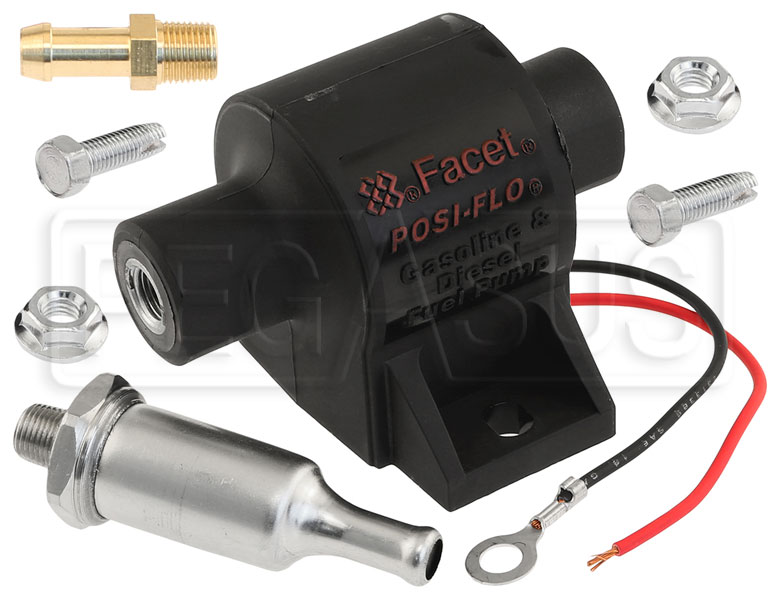
I run one as a primer/emergency pump in my 40 Ford. It's a flow through made by Facet, low PSI.

https://www.pegasusautoracing.com/productdetails.asp?RecID=9616
Facet Posi-Flo 12v Fuel Pump Kit, 1/8 NPT, 1.5-4 psi


FAC-FEP04SV-FULL.jpg

Brand: Facet-Purolator
For moderate fuel requirements of engines up to about 100 horsepower, a single Posi-Flo fuel pump is usually sufficient. Facet fuel pumps have low power requirements (about 1.5 amp at 12 volts) and operate without troublesome seals or diaphragms. Built-in pressure relief means no flooding after shutting down a hot engine. Facet pumps are compatible with gasoline, alcohol blends (up to and including E85), diesel, biodiesel, and fuel additives.
Maximum fuel delivery 23 gallons per hour. Maximum pressure 1.5 to 4 psi. Typical flow 10 gallons per hour at 1.5 psi. 1/8 NPT female ports. Facet Posi-Flo pumps feature a black composite chassis for quieter operation than the equivalent cube-style pumps.

This pump does not have an anti-siphon valve or a one-way check valve, so fuel can be pulled through the pump in either direction when the pump is off.
Facet pump number 60104. This pump has the same performance as the Facet cube-style pump 40104 (Pegasus Part No. 1102). The FEP kit packaging includes a 1/8 NPT to 5/16" hose barb outlet fitting, a 5/16" hose barb to 1/8 NPT 74 micron inlet filter, and mounting hardware.
Beware of counterfeits! We only sell Genuine Facet pumps - not the unreliable foreign knock-offs sold elsewhere.
 
pbsdaddy, ChatGTP is great, but not infallible. Before relying on what it tells you, vet the advice against your own common sense and other sources if available. The above advice is general in nature, and apparently assumes parallel installation? I've found that I have to ask the same question in several different ways in order to get a straight answer from AI.

A good point for sure. However, in this case, it does match my personal experience. I did add that part in.
 
Fordbarner Michael Driskell at Third Gen car parts sells the one most old Ford guys have used over the years.6volt flow through,supposedly low pressure.
 

Attachments

  • DSCN9177.jpg
    DSCN9177.jpg
    56.9 KB · Views: 171
Post #17 is the proper way. The bypass will allow the mechanical pump to draw fuel straight from the tank and bypass the electric pump. The check valve will only allow the fuel from the electric pump go toward the engine and not circle through the bypass.
 
Back
Top