
You are using an out of date browser. It may not display this or other websites correctly.
You should upgrade or use an alternative browser.
You should upgrade or use an alternative browser.
Wire wheel balancing
- Thread starter langus480
- Start date

Synchro909
Well-known member
Getting a buckled wheel to run true is not so easy but can be done. It takes careful shrinking of the appropriate spokes and maybe stretch others. It takes experience to get it right. I'm sure there will be places about over there that will do it for you.
Balancing: It won't be many posts before someone says to use Dynabeads (or whatever they are called over there). They are small bead that go in the tyre and automatically balanace the wheel as you drive. I haven't used them - I use an old free running front hub to mount the wheel and by trial and error, add weight to the top when the wheel stops moving till it stays where I put it (90° off where it stoped.)
Balancing: It won't be many posts before someone says to use Dynabeads (or whatever they are called over there). They are small bead that go in the tyre and automatically balanace the wheel as you drive. I haven't used them - I use an old free running front hub to mount the wheel and by trial and error, add weight to the top when the wheel stops moving till it stays where I put it (90° off where it stoped.)

I have never been able to get the beads into my tires.
Two other ways to balance.
1: Do it yourself using a HF balancer. I have been using this for years and works out well. https://www.harborfreight.com/search?q=tire balancer
2: The other way is to bring the mounted tire and rim to a tire company that has the mounting equipment to do a high speed tire balance. I have also done this and it works well.
Honestly I'm also looking to get my wire wheels straightened. There's a couple that are noticably out of round and I actually got stopped by a guy once that said that my wheel was falling off
I got a chuckle out of your comment...that is bad when someone stops you to tell you your wheel is about to fall off...


Bob Bidonde
Well-known member

Bruce of MN
Well-known member
Charlie Stephens
Well-known member
If you added your general location to your profile someone might recommend a shop to do the work for you. You could also contact local clubs for recommendations. I always felt that the things were only done once and required tooling and knowledge were best left to someone else.Hello,
I recently purchased a Model A and was curious regarding the wire wheels.
Are the wire wheel assemblies easy to true up?
Are they easily able to balance and if so how would one go about balancing the wheel?
Charlie Stephens

rotorwrench
Well-known member
Wheels with welded spokes can be difficult to true. If the rim is bent then it may be better to replace it. Bending spokes may or may not true it back to serviceable specs.

1crosscut
Well-known member
To balance tires Dyna Beads worked well for me. Getting the beads in can be challenging though.
I found that using a jack under the axle start with the tire lowered so it is pretty squished against the ground. Attach the tube to the valve stem and start flowing the beads in. When they slow going in bump the jack up a bit creating negative pressure and the beads will start flowing again. Repeat as needed until all the beads are in.
I found that using a jack under the axle start with the tire lowered so it is pretty squished against the ground. Attach the tube to the valve stem and start flowing the beads in. When they slow going in bump the jack up a bit creating negative pressure and the beads will start flowing again. Repeat as needed until all the beads are in.
Synchro909
Well-known member
To balance tires Dyna Beads worked well for me. Getting the beads in can be challenging though.
I found that using a jack under the axle start with the tire lowered so it is pretty squished against the ground. Attach the tube to the valve stem and start flowing the beads in. When they slow going in bump the jack up a bit creating negative pressure and the beads will start flowing again. Repeat as needed until all the beads are in.
I've never used the beads but wondered about doing that to get them in. Makes perfect sense to me.

springerpete
Well-known member
I have used stick on weights on the back side of the rims. They are very secure and balance well. Balance job was done with spin machine at local garage. Weights are painted wheel color so the hide well. Bill

The Master Cylinder
Well-known member
To balance tires Dyna Beads worked well for me. Getting the beads in can be challenging though.
I found that using a jack under the axle start with the tire lowered so it is pretty squished against the ground. Attach the tube to the valve stem and start flowing the beads in. When they slow going in bump the jack up a bit creating negative pressure and the beads will start flowing again. Repeat as needed until all the beads are in.
That is probably the best way I have heard of yet fot installing beads. I am going to try that next time, if I remember. Not something you have to do very often.

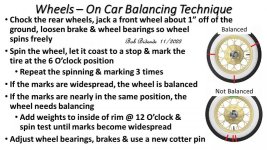
This slide should help you.
Nice picture.
I know in the Overhaul shop balancing Tailrotor Blade and Hub assemblies, we would have to perform the task in a room with "Still Air" meaning even the Air-conditioning couldn't be on.
I wonder if this also would apply to the tire/wheel assemblies?
rotorwrench
Well-known member
Nice picture.
I know in the Overhaul shop balancing Tailrotor Blade and Hub assemblies, we would have to perform the task in a room with "Still Air" meaning even the Air-conditioning couldn't be on.
I wonder if this also would apply to the tire/wheel assemblies?
When I was in the military, we had the Marvel balancer equipment to perform static balance on rotors. In civilian practice, I just balance it with my trusty Chadwick Helmuth Vibrex kit with the Stobex to get the clock angle. Bell had a ball bearing balance set but it was a Pita to use. I would use it to do the initial track setting on the old Bell 47 machines that still had adjustable pitch links. Most are fixed now days.
On motorcycle wheel assemblies, I use the same set up that I true the spoked rims with. If the wheel/tire assembly doesn't try to rotate in any clock angle setting then it's good to go. On car wheel assemblies, a person just needs an old bubble balancer to static balance. If it is properly static balance then it should run true in a computer balance machine unless the rim is bent. I used to use an old Micro like the one in this link. https://www.ebay.com/itm/1962805215...ZOLh0vs4ddZKN/nB0/CLi6|tkp:Bk9SR_DmwPnKYwlike
Last edited:
When I was in the military, we had the Marvel balancer equipment to perform static balance on rotors. In civilian practice, I just balance it with my trusty Chadwick Helmuth Vibrex kit with the Stobex to get the clock angle. Bell had a ball bearing balance set but it was a Pita to use. I would use it to do the initial track setting on the old Bell 47 machines that still had adjustable pitch links. Most are fixed now days.
On motrorcycle wheel assemblies, I use the same set up that I true the spoked rims with. If the wheel/tire assembly doesn't try to rotate in any clock angle setting then it's good to go. On car wheel assemblies, a person just needs an old bubble balancer to static balance. If it is properly static balance then it should run true in a computer balance machine unless the rim is bent. I used to use an old Micro like the one in this link. https://www.ebay.com/itm/1962805215...ZOLh0vs4ddZKN/nB0/CLi6|tkp:Bk9SR_DmwPnKYwlike
Performed quite a bit of T&B with the Chadwick and also static balance with the Marvel. 27 yrs aviation has taught me to do things right the first time and not have to spend time fixing sloppy work...