
You are using an out of date browser. It may not display this or other websites correctly.
You should upgrade or use an alternative browser.
You should upgrade or use an alternative browser.
Binder engine pictures
- Thread starter 1crosscut
- Start date
Recently I acquired two diamond block binder engines. They are self contained units sitting on their own frame with radiator, control panel and clutch/pulley assemblies. Does anyone have pictures of these being used?
Which color diamond? Green? Red? Black? i forget how many color diamonds there were, but each was a specific series, both flathead and overhead.
40, aren't those colored diamond engines International and not Ford? I assumed 1crosscut was referring to when Ford engines were used. We'll see soon.
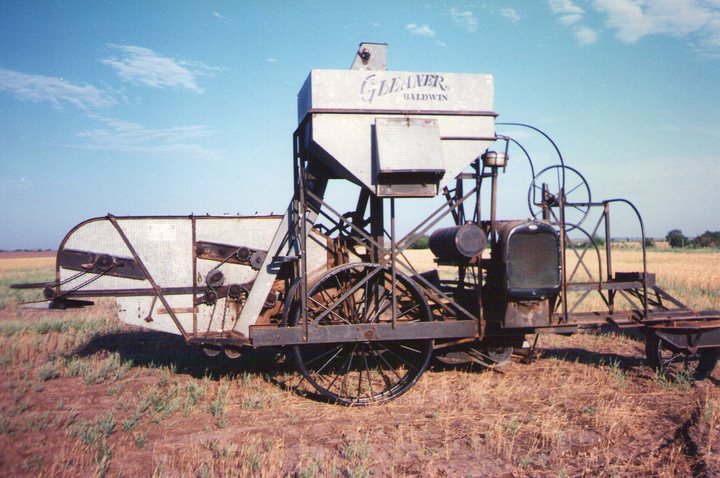
You're right! When I saw "diamond" and "binder", I flashed back to my youth in Minnesota. We called International trucks "binders" or "corn binders", and their engines were "Diamonds". I didn't think about the little diamond cast into A and B blocks. 'A' engines were used on Gleaner brand combines in the late '30's, but I never saw any engine used on a binder. The binder mechanism was always wheel driven.

1crosscut
Well-known member
Can you post a picture of what you have?
Here are some pictures of the two engines that I have.
Attachments


1930 coupe
Senior Member


Y-Blockhead
Well-known member
Here are some pictures of the two engines that I have.
Very cool, looks like they have a mag ignition.
Gold Digger
Well-known member
Mine has a dual point Mallory distributer.


updraught
Well-known member
OK, for us not farm informed, what's a binder?
Thanks
Jim
Some nice pictures and video, even a description for city folk ...
http://www.mtfca.com/discus/messages/179374/211997.html?1305808714
Our biggest factory, back in the day, was the Sunshine Harvester factory.
There are still heaps of the remains of these on farms here. They had a large export market too.
https://en.wikipedia.org/wiki/Combine_harvester

BILL WILLIAMSON
Well-known member
We used to play on a HUGE, WOODEN Grain harvester, that was towed by a BIG Tractor! We would pretend it was a SHIP, complete with the "PILOT WHEEL"!!
Bill Child
Bill Child
1crosscut
Well-known member
OK, for us not farm informed, what's a binder?
Thanks
Jim
I probably have used the wrong term in calling them binder engines. Here is a link (thanks Vince) that give a better idea as to a typical use for them.
http://www.fordgarage.com/pages/gleanerbaldwinnr.htm
1crosscut
Well-known member
Very cool, looks like they have a mag ignition.
Yes one of them has a Mallory distributor. I think it's correct. I don't have a distributor for the other engine. I know nothing about the Mallory's but will need to do some studying up on them now.

Randy in ca
Well-known member
I was just about to post the above link to Vince Falter's page regarding these engines used on grain Combines. For anyone wondering, Binders were pre-combine machines pulled by either a team of horses or a small tractor and used to cut and tie the grain into bunches which were then pitched into a threshing machine to separate the grain from the straw. The Combine combined these two operations making for a much less labour intensive operation.
BILL WILLIAMSON
Well-known member
GREAT explanation, Randy,I was just about to post the above link to Vince Falter's page regarding these engines used on grain Combines. For anyone wondering, Binders were pre-combine machines pulled by either a team of horses or a small tractor and used to cut and tie the grain into bunches which were then pitched into a threshing machine to separate the grain from the straw. The Combine combined these two operations making for a much less labour intensive operation.
There was a LOTS of evolvement in harvesters, much like the evolvement of Hay Baling Equipment, where hay was gathered with Buck Rakes & fed into a STATIONARY Baler.
Bill Farmboy

Tony Hillyard
Senior Member
That's a really interesting piece of social history, thanks.

Beater
Well-known member
I was just about to post the above link to Vince Falter's page regarding these engines used on grain Combines. For anyone wondering, Binders were pre-combine machines pulled by either a team of horses or a small tractor and used to cut and tie the grain into bunches which were then pitched into a threshing machine to separate the grain from the straw. The Combine combined these two operations making for a much less labour intensive operation.
yes and no.binder was what was pulled by horses or a tractor, and yes cut the wheat and " bound" it into bundles ,which were put into stooks later. Stooks are 3-4-5 bundles gathered up by hand and stood up grain end up to help the grain dry and or stay dry.this machine was replace with a modern day swather. same job cuts and lays the crop in a swath rather than putting it in bundles and then stooks.
early thresh machines had no motor to run it, so no powered wheels, so needed to be pulled field to field with horses or tractor. so you have a thrash machine and a traction engine to move it and to drive the thrasher with a belt. the next step was to put an engine on the trasher to drive it run it but not self propelled. so you still needed the tractor to pull it around the next step was to COMBINE the tractor and thrasher so it became a self propelled thrasher, or as has come to be commonly know as a combine.
so we do it basically the same way, swath the grain, and leave it lay in swaths until it is cured, and then come along with the combine and pick it up and thrash it. for this style of harvest the combine has whats called a "pickup header" on it.
so now in the south first the combine was upgraded and got whats called a "straight cut header" put on it. in the south things dry better and faster with more heat so there was no need to swath the wheat first to let it dry. so it was basically like putting the swather header on the combine. one pass, cut and thrash the grain. now days we have different grains that cure faster, and for the most part in the wheat harvest its almost all straight cut headers on combines. we still swath things like canola and barley,lentals,flax.
there are many around that used the A engine
Last edited:
updraught
Well-known member
Probably why the Sunshine harvester was called that. It would have needed hot dry conditions (ideal conditions for sunburn and dust). It was mainly exported to Africa and Argentina and made harvesting virtually a one man operation on a smaller farm. I like the video here:
http://www.nma.gov.au/online_features/the_sunshine_harvester/explore_the_harvester
Anyway, this seems to be a Gleaner
http://www.yesterdaystractors.com/cgi-bin/viewit.cgi?bd=harvest&th=35047
http://www.nma.gov.au/online_features/the_sunshine_harvester/explore_the_harvester
Anyway, this seems to be a Gleaner
http://www.yesterdaystractors.com/cgi-bin/viewit.cgi?bd=harvest&th=35047