Blower motor center main cap

Yes the girdle stays there. You have to modify the oil pan. I have a friend here that did this with a girdle he bought when King was making them. On his though I seem to remember the girdle came drilled & tapped for the oil pan holes

using the previous oil pan screw holes is probably the way to go and if we make another we will probably change the design.

as far as cost, I do CNC machine repair for them and they do machine work for me (basically), so I would have to ask if they would like to reproduce the setup and how much. I can tell you they are not very busy.
 
Another bad idea. The center main web CAN break out of the block. So, let us drill and tap more holes in it to help that process along.

Of the commercially available systems only that which requires extensive pan modification(like King's) and bolts to most of the pan rail length could be considered an improvement in rigidity and cycle resistance.

JWL, do you mean something like this?

http://flatheadjack.com/119.html
 
Well the 294 produced 235HP @4500 RPM (Red Line) This has a ******** the center main. I believe this belongs in the application area. Running allot of boost might change that. What surprised me was the 290 foot of torque at 3000 RPM, That's allot of torque. Makes you think???? Nice street engine.
 
My 286 in my dragster, I made a strap for center main 1/2in. steel, drilled and tapped a 3/8 threaded hole in the center and screwed a grade 8 bolt and lock nut and tightened it down. Run it 3 years, red line 5000 through the traps every run. Broke the drive shaft at the tree, checked the recall on the tach back in the pits, turned 7000 rpm before my boy got his foot off the peddle. Still runs like a clock, strikes every hour. lol Walt
 
I am totally ignorant of the dynamics involved,and never been involved in any of this sort of development, but my immediate thought on looking at this was "why not a full girdle incorporating all three bearing caps, that lends itself to a flat bolt on sump surface.
 
I am totally ignorant of the dynamics involved,and never been involved in any of this sort of development, but my immediate thought on looking at this was "why not a full girdle incorporating all three bearing caps, that lends itself to a flat bolt on sump surface.

Even with a much simpler and cheaper but similar design girdle, the block will stand way more horsepower than it is capable of producing blown and on nitro.
 
Bill, the side rails were not drilled and taped. I did that when I made the pan. It uses the original pan bolts are used to hold the sides down, but were brought up to 3/8 in the block. Then the sides were drill for the pan. Maybe Jim has pictures.
We did all the girdle stuff because I am hoping to make 12 pounds of boost with a 471.

Yes the girdle stays there. You have to modify the oil pan. I have a friend here that did this with a girdle he bought when King was making them. On his though I seem to remember the girdle came drilled & tapped for the oil pan holes
 
Bill, the side rails were not drilled and taped. I did that when I made the pan. It uses the original pan bolts are used to hold the sides down, but were brought up to 3/8 in the block. Then the sides were drill for the pan. Maybe Jim has pictures.
We did all the girdle stuff because I am hoping to make 12 pounds of boost with a 471.
Dennis, Thanks I guess that Jim had shown it to me after you had finished the pan mods.
icon7.gif
Bill
 
Last edited:
using the previous oil pan screw holes is probably the way to go and if we make another we will probably change the design.

as far as cost, I do CNC machine repair for them and they do machine work for me (basically), so I would have to ask if they would like to reproduce the setup and how much. I can tell you they are not very busy.
Saltracer, I was just courious at this time. I have to finish the model A I'm trying to build first, then my next project is a 36 coupe & I've got a 4-71 for it. Bill
 
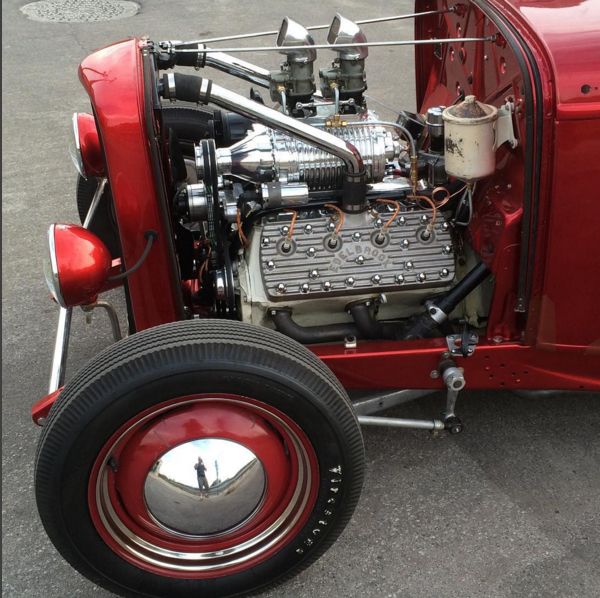
At The Race of Gentlemen, Brian Bass brought his 32 roadster with a mostly stock flathead. A week before the race, he obtained this new H&H Scot blower and decided to bolt it on before the race. It sure woke the engine up.

On about his 3rd race, I was in the other lane and near the end of the run, we could both hear a loud *POP* as if the car transmission popped out of second gear. However, he didn't remember it popping out of gear. He drove it back to the pits, idled the engine, revved it and heard no knocking or any unusual noises.

He went back out on the track and raced 3 more times HARD and winning, and then drove the car back to his trailer about a mile away. When loading the car, he noticed dents in the oil pan.

upon getting back to Dallas and dropping the pan, he found the main cap had sheered both main studs. Very lucky he didn't grenade the engine, but also an interesting occurance.

Anyways, The supercharger can put enough force to blow the main cap!

BassBlownFlathead_zpszblmjq1y.jpg


BassBlownMainCap_zpsdplerfaz.jpg
 
I'd say that he is about as lucky as they come - can't imagine that the crank didn't let go! I'll bet his oil pressure had dropped off quite a bit?

I always replace the stock studs with ARPs. Maybe they help . . . maybe they don't, but in the grand scheme of things - not too expensive of an insurance plan (even for stock caps).
 
Glad to see some info on blower engines, I have a set up from Mike Davidson Flatattack, it uses the billet caps and a re-enforcing plate, After seeing the broken bolts I am going to get the A.R.P studs, the kit has grade 5 bolts, I think the grade 5s will be a little too weak after going to all the expense to use this set up I cant imagine why one would use such soft bolts? They came with the kit. What is the deal about installing studs , I have heard a lot of people set and argue what is the correct way to install studs in an engine block ,some say tighten to torque spec. and some say don't tighten to spec. seems to me they will either be tight enough or not torqued and too loose and will come out. which is it?
fordestes
 
I'd say that he is about as lucky as they come - can't imagine that the crank didn't let go! I'll bet his oil pressure had dropped off quite a bit?

I always replace the stock studs with ARPs. Maybe they help . . . maybe they don't, but in the grand scheme of things - not too expensive of an insurance plan (even for stock caps).

Dale:

You said it. I can't believe the entire package didn't let go. That's pretty amazing.

Tim
 
Glad to see some info on blower engines, I have a set up from Mike Davidson Flatattack, it uses the billet caps and a re-enforcing plate, After seeing the broken bolts I am going to get the A.R.P studs, the kit has grade 5 bolts, I think the grade 5s will be a little too weak after going to all the expense to use this set up I cant imagine why one would use such soft bolts? They came with the kit. What is the deal about installing studs , I have heard a lot of people set and argue what is the correct way to install studs in an engine block ,some say tighten to torque spec. and some say don't tighten to spec. seems to me they will either be tight enough or not torqued and too loose and will come out. which is it?
fordestes

I screw them in by hand with Loctite on the threads and 1/2 turn off the bottom. I let them sit overnight before proceeding.
 
I screw them in by hand with Loctite on the threads and 1/2 turn off the bottom. I let them sit overnight before proceeding.

I was told the threads should be loaded before it sets.
Other wise when you tighten it up the loctite starts to move if you go over the holding point.
 
I tighten studs in by hand. If its a take-a-part engine, then I usually lock tight them in. If you try to torque them in to a hole that is open, then you are forcing the shank of the stud into the threads. All you will do is screw up the threads.


What is the deal about installing studs , I have heard a lot of people set and argue what is the correct way to install studs in an engine block ,some say tighten to torque spec. and some say don't tighten to spec. seems to me they will either be tight enough or not torqued and too loose and will come out. which is it?
fordestes
 
I was told the threads should be loaded before it sets.
Other wise when you tighten it up the loctite starts to move if you go over the holding point.

The stud never moves. It is a coarse thread.
I didn't invent the idea. The guys that teach this stuff figured it out by math and then lab trials.
I know a lot of people that build many different kinds of mechanical gizmos and they all do it this way.
 
I installed large studs and it was very specific installed heights and we had spacers on and preloaded every bolt to specs.
And this was Loctites products and their techs teaching us.
But perhaps it matters more when things are larger in diam.
 
Back
Top